








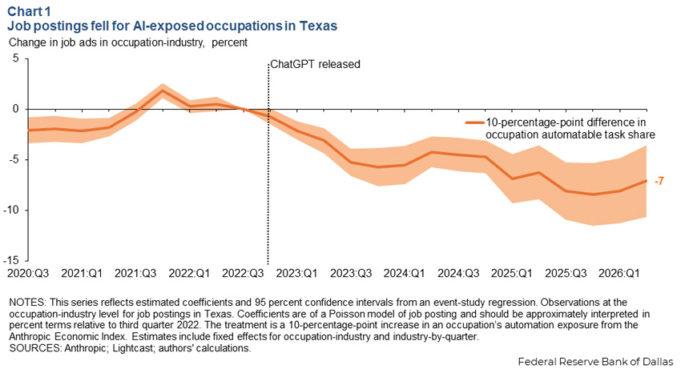
The Dallas Federal Reserve has indicated a significant decline in help-wanted advertisements across Texas for jobs at risk of being affected by artificial intelligence (AI), reporting an 8% drop over the past few years. The primary reason given by employers for layoffs during this period is not competition from China, government regulations, or inflation, but rather the rise of AI, which gained prominence with the launch of ChatGPT on November 30, 2022.
Since the beginning of 2023, approximately 193,226 layoffs nationwide have been attributed to AI, accounting for 20% of total job losses, according to the outplacement firm Challenger Gray & Christmas. However, layoffs are only part of the broader narrative. AI may have a more profound impact on individuals who are unable to secure employment in the first place. In Texas, hiring advertisements for positions most susceptible to AI competition have decreased by 8% from late 2023 to early 2025.
The potential job losses due to AI nationwide could range from 2.7 million to 19.5 million, according to an AI impact tracker created by Tufts University, with a median estimate of 9.5 million jobs at risk. The total annual wages affected could span from $200 billion to $1.5 trillion, with $750 billion representing the median figure.
While the impending job losses due to AI could touch nearly everyone in some manner, the impact has not been evenly distributed. The Dallas Federal Reserve notes that occupations such as software developers, web designers, and other tech-oriented roles are particularly vulnerable. White-collar workers, including managers and clerical staff, also find themselves at risk.
For those seeking job security against digital competition, a report from Anthropic, the developer of the Claude chatbot, has highlighted several roles that may be more resilient to AI encroachment. These include positions such as cooks, motorcycle mechanics, lifeguards, bartenders, dishwashers, and dressing room attendants.
Being established in a career may provide some protection. The Dallas Fed suggests that recent college graduates in Texas are likely to be the first to experience the adverse effects of generative AI technologies, including ChatGPT and Claude. Additionally, a report from the International Labor Organization indicates that younger workers are facing heightened challenges, with youth unemployment in North America rising from 8.3% in 2023 to 9.9% in 2025.
Despite the potential for job loss, AI is also expected to generate new opportunities in fields such as software development and personal financial advising over the next decade, while negatively impacting various insurance-related jobs, according to the U.S. Bureau of Labor Statistics. Anthropic’s analysis presents a more nuanced view, suggesting that older, female, and more educated workers with higher salaries may face the most significant challenges.
Proponents of AI often counter concerns about job losses with optimistic forecasts regarding future job creation. Evidence indicates a rise in job listings related to AI. An AI Economic Impact Tracker from the Maryland state comptroller reported 273,000 AI job postings across the nation during the first nine months of 2026, reflecting a 79% increase compared to the previous year. Nonetheless, this figure remains modest, accounting for less than 2% of all job advertisements.
The potential ramifications of AI could be severe, with some studies suggesting a scenario as dire as the Great Recession of 2007-2009. Anthropic’s research indicates that if all workers in the 10% of jobs most susceptible to AI were laid off, overall unemployment could surge from approximately 4% to around 13%. In comparison, unemployment peaked at approximately 15% during the Great Recession.
However, there is a possibility that the situation may improve. Although recent trends suggest that AI has predominantly been a job eliminator, some forecasts are more hopeful for the long term. Gartner, a technology trend analysis firm, has projected that only 1.8% of global workers will experience job losses due to AI, with a net gain of 1.7 million jobs expected worldwide by 2030.
The U.S. Bureau of Labor Statistics offers an even brighter outlook, predicting a 17.9% increase in software developer roles by the end of the decade from 2023 to 2033. Other positions likely to see significant growth include personal financial advisors, database architects, and electrical engineers. Overall, the BLS forecasts a 4% growth in employment during the first decade of the AI era, increasing from 168 million jobs in 2023 to 175 million by 2033, although certain roles, particularly in credit analysis and various insurance jobs, are expected to decline.
It is important to note that none of these forecasts anticipated the emergence of ChatGPT in 2022, and numerous unforeseen developments could alter the landscape. The recent political shift in Texas presents one such factor.
With the new Democratic state officials in Texas, significant changes are anticipated compared to the AI-friendly policies of outgoing Governor Greg Abbott. Incoming Agriculture Commissioner Clayton Tucker has expressed intentions to investigate the impacts of AI data centers on both employment and the environment, stating, “The more I learn about [AI], the more I’m thinking AI might be the real problem, not just the data centers.”
The Texas Workforce Commission (TWC), responsible for assisting job seekers and employers in the state, maintains a more optimistic, long-term perspective on AI’s effect on employment. In a statement, TWC emphasized, “Ultimately, TWC views AI not as a replacement for human labor but as an opportunity for workforce empowerment. AI will enable workers to allocate less time to repetitive tasks and focus more on activities that require creativity, relationship-building, and critical problem-solving.”
Currently, TWC lacks a specific program to assist Texans who have lost their jobs due to AI. The commission recommends that individuals concerned about AI’s impact on their employment reach out to their local workforce solutions office for programs aimed at acquiring new skills.