








Severe winter weather has left hundreds of thousands without power across the United States, as a massive storm wreaks havoc in various regions, creating hazardous road conditions and leading to widespread flight cancellations. Reports indicate at least 19 fatalities linked to the storm, with casualties occurring in states including Pennsylvania, Kansas, Texas, Louisiana, Tennessee, and New York City.
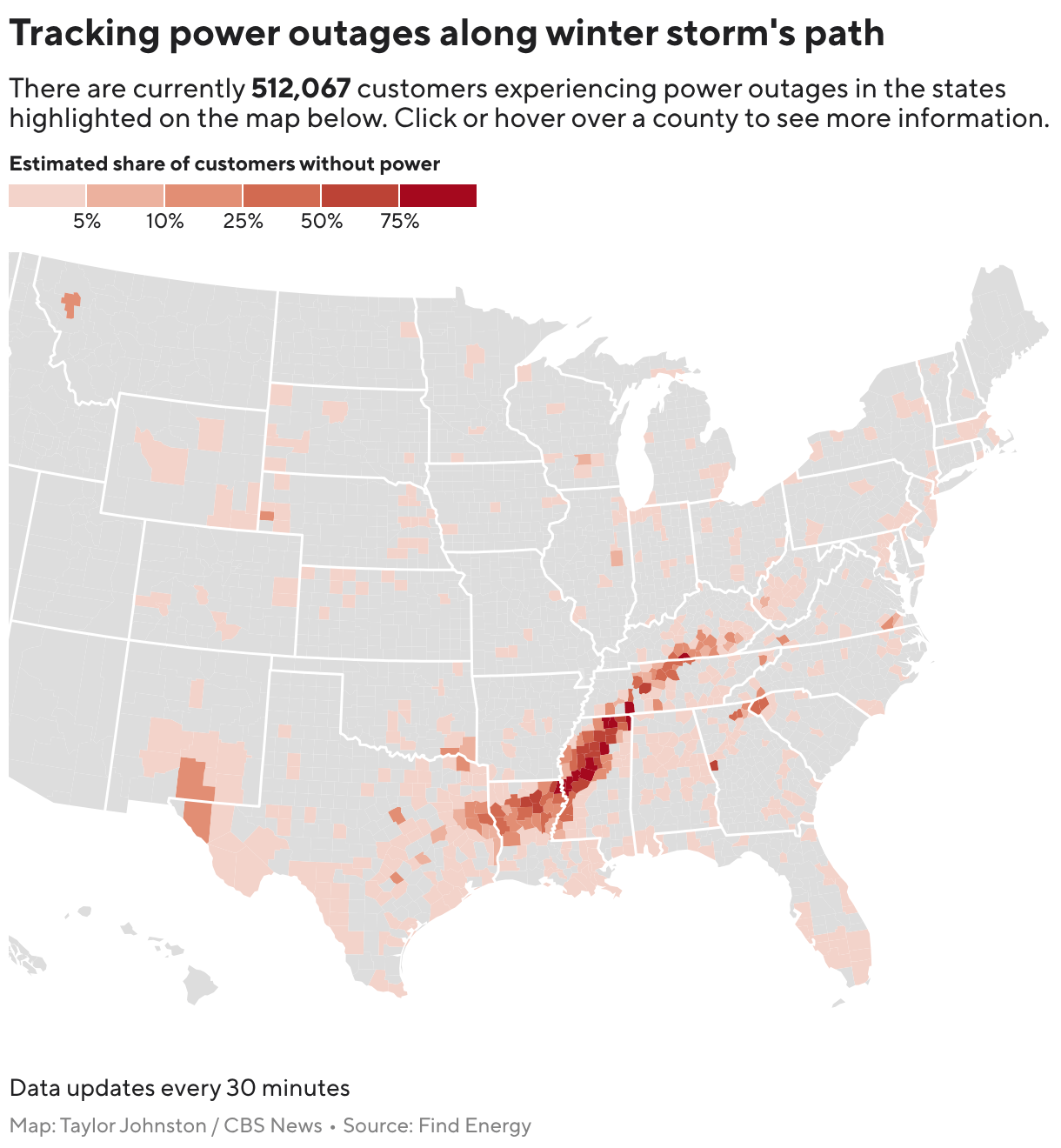
As treacherous conditions continue, significant power outages have been documented in states such as Texas, Louisiana, Mississippi, Tennessee, and Kentucky. The National Weather Service has reported that the storm has impacted nearly 180 million people — over half of the U.S. population — stretching from the southern Rocky Mountains to New England, and has warned residents to prepare for a prolonged period of extreme cold.
“The snow and ice will take a long time to melt, hindering any recovery efforts,” stated Allison Santorelli, a meteorologist with the National Weather Service. Meteorologist Nikki Nolan added that the storm is expected to linger over New England until Monday morning before finally moving out, leaving behind frigid temperatures that are significantly below the seasonal average.
In response to the crisis, President Trump has approved emergency declarations for a dozen states, with the Federal Emergency Management Agency (FEMA) mobilizing resources and personnel across multiple regions. Homeland Security Secretary Kristi Noem emphasized the importance of public safety, urging residents to remain at home if possible.
The Midwest has experienced dangerously low windchills reaching minus 40 degrees Fahrenheit, with Rhinelander, Wisconsin, reporting its coldest temperatures in nearly three decades at minus 36 degrees Fahrenheit.
As the storm progressed, it unleashed heavy snowfall in the Northeast. By Monday morning, parts of Massachusetts reported over 20 inches of snow, with Boston itself receiving 18 inches, prompting school closures statewide. Tragically, a woman in Norwood, Massachusetts, was killed when struck by a snow plow while walking with her husband.
Pittsburgh declared a state of emergency after more than a third of its snow plow fleet broke down, with Mayor Corey O’Connor noting that repairs were needed for 37 of the 95 plows. This declaration enables the city to call in additional resources to assist with snow removal and street clearing.
In New York City, Central Park recorded 11.4 inches of snow, a new record for the date, which led to a shift to remote learning for students. Philadelphia also experienced significant snowfall, with totals exceeding 9 inches, marking the city’s highest accumulation since 2016.
In Lehigh County, Pennsylvania, three people lost their lives while attempting to shovel snow during the storm, with ages ranging from 60 to 84. Forecasters have warned that the storm’s damage, particularly in areas heavily impacted by ice, could be comparable to that of a hurricane, highlighting its unusual intensity.
The storm’s deep freeze also affected the southern U.S., with ice accumulation causing widespread power outages and downed trees in regions like Shelby County, Texas. Local officials reported extensive damage, with one fatality involving a 16-year-old girl who died in a sledding accident in Frisco, Texas.
As of Monday, additional fatalities were reported across Louisiana, Tennessee, Mississippi, and Kansas, where a missing woman was tragically found deceased in the snow. In Louisiana’s DeSoto Parish, reports indicated vehicles colliding with fallen trees, while the majority of electrical customers experienced power disruptions.
Emergency services in Louisville, Kentucky, responded to over 850 incidents related to the storm, including collisions and stranded motorists, with the actual number likely exceeding that due to underreporting. In Georgia’s Rabun County, officials warned against travel as icy conditions persisted even after the storm subsided.
Churches moved their services online, and events such as the Grand Ole Opry’s Saturday performance in Nashville were held without live audiences. In Louisiana, Mardi Gras parades faced cancellations or rescheduling due to the weather.
In Tennessee, over 190,000 residents were still without power as of Monday night, with officials indicating that outages could last for days. Numerous cities announced school closures, including Dallas, Houston, and Memphis, while some universities canceled classes.
Mississippi Governor Tate Reeves noted that the state had not experienced a storm of this magnitude since 1994, as locals recalled extended power outages from that event. Governor Reeves has sought FEMA’s assistance for providing essential supplies to shelters and generators to facilities lacking adequate backup power.
Travel and road clearing efforts faced immense challenges, with road crews overwhelmed by the sheer volume of downed trees and hazardous conditions. Workers reported fatigue and the constant threat of falling trees while attempting to restore normalcy.
As communities grapple with the aftermath of the storm, many residents are left without power and are assessing the damage to their homes and neighborhoods. The recovery process is expected to be lengthy, with continued vigilance required as cold temperatures threaten to complicate restoration efforts.