






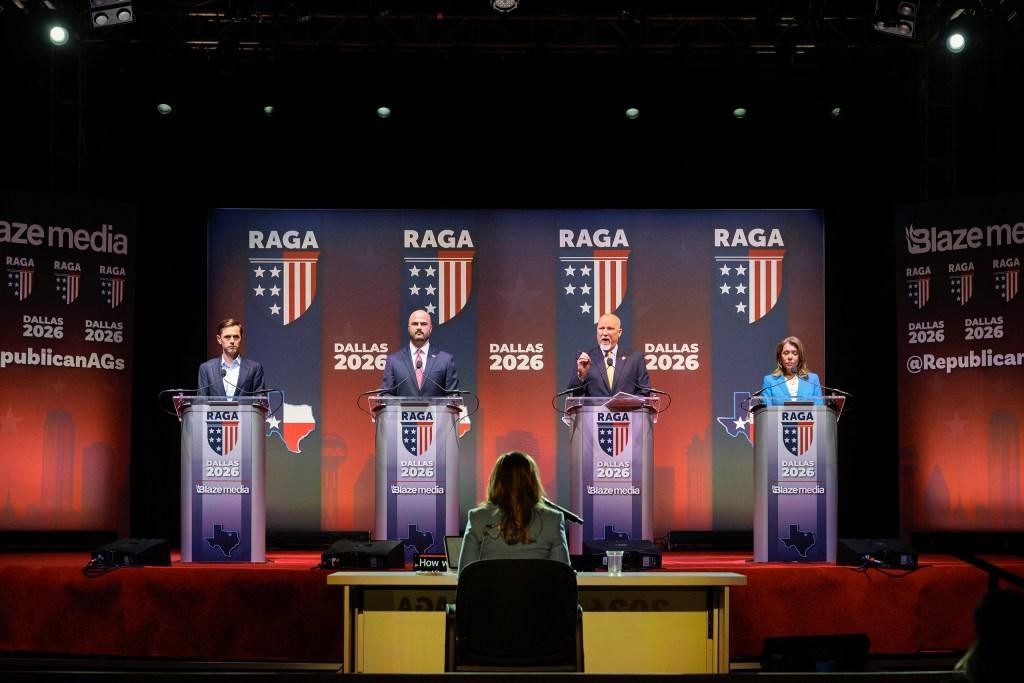
In a debate that highlighted significant Republican themes, four candidates vying for the position of Texas Attorney General aimed to carve out their unique identities and visions for one of the state’s most influential offices.
All candidates share conservative views, with minimal ideological differences separating them from current Attorney General Ken Paxton. During the debate, they reiterated their intentions to combat what they termed the “Islamification” of Texas, reclaim immigration enforcement powers from the federal government, and curb the availability of abortion pills in the state.
As the leading candidate, U.S. Representative Chip Roy faced heightened scrutiny from his opponents, who are keen to prevent him from achieving a majority in order to trigger a runoff election. Roy, a four-term congressman from Austin, has previously served as chief of staff to Texas Senator Ted Cruz and was a top aide to Paxton when he first took office.
Aaron Reitz, who also worked under Paxton and has his endorsement, accused Roy during the debate of being “ineffective” and claimed he was dismissed by Paxton. Roy refuted this assertion, emphasizing his backing from Cruz, with whom Reitz has also worked.
“Having served as solicitor general for ten years for this great state, Ted knows what is necessary in that office, and I’m proud to have his full support and endorsement,” Roy asserted.
Roy also faced criticism for his opposition to a GOP bill aimed at criminalizing hormone therapy for minors, arguing that it would grant the federal government unconstitutional authority over state matters. State Senator Mayes Middleton countered Roy’s concerns about states’ rights by insisting there is “no right” to harm a child, a sentiment echoed by Reitz.
Throughout the debate, Roy maintained a relatively low profile but engaged passionately on the contentious issue of transgender rights, highlighting the contradiction in his opponents’ calls for federal legislation that would override state authority.
“It’s astonishing to hear Republican candidates for attorney general advocating for sweeping federal laws that override Texas,” Roy remarked. “This represents a new frontier.”
Roy, whose independent stance has often placed him at odds with party leadership, prides himself on voting alongside former President Donald Trump’s agenda more than most candidates, while vowing to shield Texas from federal overreach, regardless of the presidential administration.
State Senator Joan Huffman from Houston echoed Roy’s sentiments, asserting, “There can be overreach and bad ideas, no matter who is in power.” Huffman, drawing on her extensive experience as a prosecutor, judge, and long-serving state legislator, aims to present a more measured approach compared to her more bombastic rivals.
While her opponents have pledged to remove left-leaning district attorneys upon taking office, Huffman argued during the debate that such actions are far more complex than they suggest. Reitz labeled her perspective a “loser” mentality.
“If it were as simple as they claim, it raises the question: why hasn’t Paxton already done it?” Huffman retorted.
Middleton, an oil and gas executive and notable GOP donor, has invested nearly $12 million of his own funds into the campaign, branding himself as “MAGA Mayes” and emphasizing his reputation as one of Texas’ most conservative lawmakers. Recent polls indicate that his self-financed advertising is gaining traction, positioning him as a strong contender for the runoff against Roy.
However, his opponents have critiqued his lack of legal experience beyond his family business. When questioned about the attorney general’s office’s role in addressing illegal gambling, Middleton asserted, “Gambling is not only unconstitutional in Texas; it is illegal.”
Reitz responded sharply, “News flash to someone who has never practiced law: if something is unconstitutional, it is indeed illegal.”
This primary marks the first time in over a decade that the race for attorney general does not include Paxton. Throughout his tenure, the office has grown increasingly significant in the national conservative legal strategy to influence policy through the judicial system, making this election closely monitored both within Texas and beyond.
The debate was organized by the Republican Attorneys General Association alongside Blaze Media, with attendance from seven other Republican attorneys general.
“The next Texas Attorney General will build on an office shaped by Ken Paxton, Greg Abbott, and John Cornyn,” stated Adam Piper, Executive Director of RAGA. “The Texas Attorney General plays a vital role both locally and nationally, from safeguarding Texans to upholding the rule of law and preserving freedom for future generations.”
Tuesday marked the commencement of Texas’ 11-day early voting period, which will conclude on February 27. The primary election is scheduled for March 3, and should a runoff be necessary, it will take place in late May. The eventual winner will face the Democratic nominee in November, with three candidates currently in the race; no Democrat has secured a statewide office in Texas since 1994.