









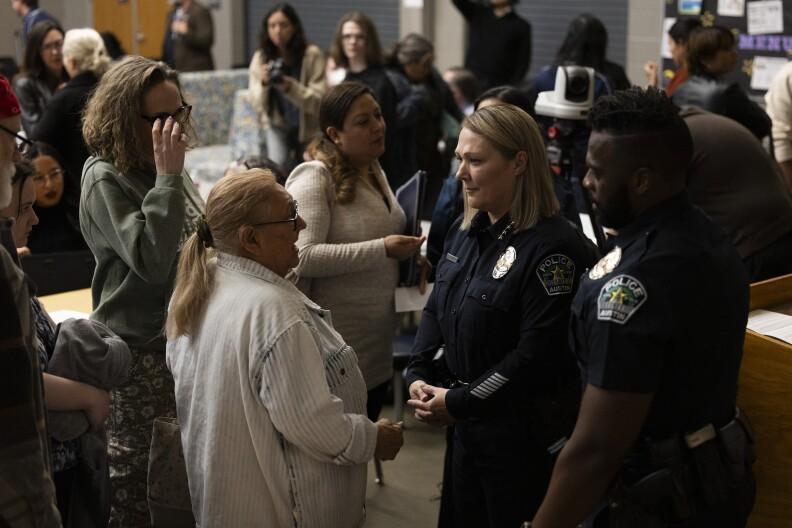
The Austin Police Department has introduced new guidelines aimed at regulating how officers interact with Immigration and Customs Enforcement (ICE) regarding individuals suspected of being in the country unlawfully. These updated protocols were quietly released on the city’s website this week and follow community protests against the increasing collaboration between local law enforcement and federal immigration authorities.
These guidelines align with earlier proposals made by Austin Police Chief Lisa Davis in February, which were intended to minimize the involvement of ICE in local policing matters. While Texas state law prohibits cities from outright instructing officers not to report individuals to ICE, the new rules implement additional oversight when an officer contemplates making such a call.
The regulations specifically detail the procedures officers should follow upon discovering that a person has been flagged by ICE with a civil “administrative warrant,” a designation that emerged during the early stages of the Trump administration’s immigration enforcement efforts. Thousands of these non-criminal warrants were issued during that time.
Under the revised policy, officers are not permitted to detain or arrest an individual solely based on an ICE administrative warrant. If an officer encounters someone with such a warrant who can also be charged with a separate arrestable offense, they should proceed with the arrest and take the individual to jail, where ICE may subsequently take custody.
Conversely, if an officer finds an individual with an administrative warrant but no criminal charges are applicable, they are required to inform their supervisor before reporting the individual to ICE. Should ICE request that the officer hold the person until federal agents arrive, that request must be escalated through the department’s chain of command, culminating in a decision from a duty commander.
During a public hearing last month, Chief Davis expressed confidence that this new policy would lead to a decrease in the number of individuals detained by the Austin Police Department for ICE. “The commander will make the decision on whether we are gonna be waiting for ICE. And I can tell you, the priority is not waiting for ICE to respond,” she stated.
City officials are optimistic that these new regulations will strike a balance between local needs and state mandates. City Councilmember Chito Vela remarked, “APD has limitations, we’re trying to work within those limitations to try to maximize people’s safety,” as the policy was being developed.
These limitations are largely due to Senate Bill 4, a law enacted in 2017 that prohibits Texas cities from establishing policies that would prevent officers from contacting ICE. However, local police departments retain the discretion to deprioritize immigration enforcement if it hampers their primary law enforcement responsibilities.
Chief Davis noted the department is currently understaffed, with 320 officer vacancies, emphasizing that immigration enforcement is not a priority for her department. “I think it’s no secret that we’re 320 officers shy of full staff,” she said.
Ian Adams, a criminal justice professor at the University of South Carolina and former police officer, suggested that the newly implemented policies might deter officers from contacting ICE by imposing additional procedural hurdles. “If there’s some behavior that you can’t outright ban, you can always make the paperwork painful,” Adams explained.
However, immigration advocates, such as Kristin Etter, director of policy and legal services at the Texas Immigration Law Council, remain skeptical about whether these new regulations will foster trust between immigrant communities and law enforcement. “It’s safe to assume that any time law enforcement is involved there is a risk of immigration detention — and then [being] placed in the deportation pipeline,” Etter observed.
In Texas, the decision to report individuals to ICE ultimately rests with individual officers, and state police, who frequently operate within Austin city limits, also possess the authority to enforce federal immigration laws.