









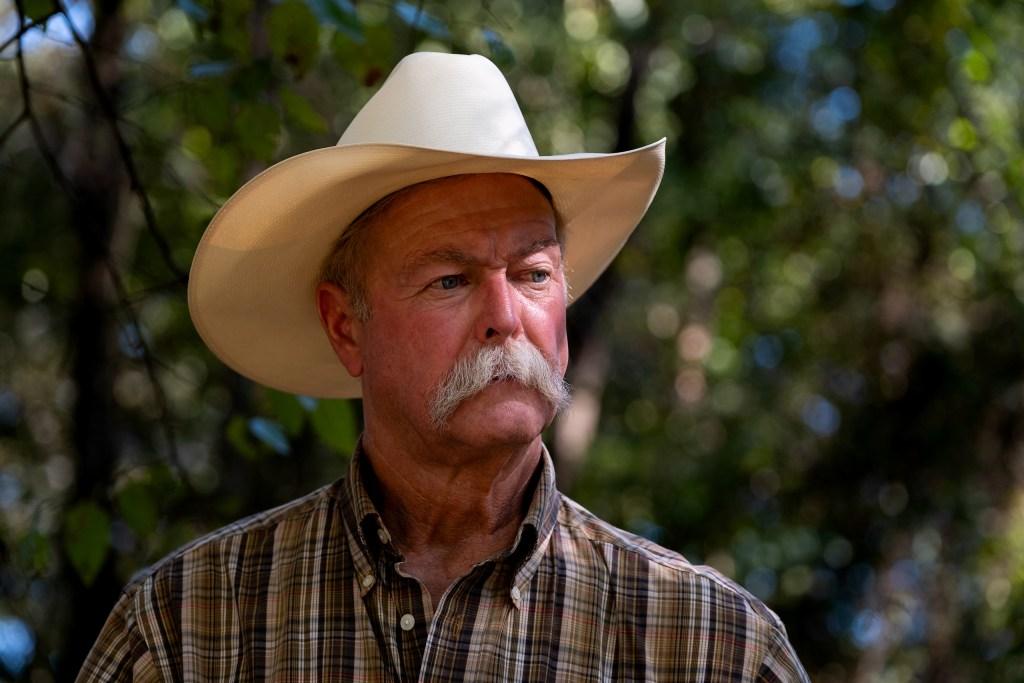
MARION COUNTY — Bob Sanders navigates the rugged dirt roads of his expansive 1,100-acre ranch in a weathered burgundy Chevrolet Suburban. The engine growls as his renowned cattle operation, known for its wagyu beef, unfolds around him. A shotgun rests in the passenger seat, while worn binoculars sit on the dashboard.
The gently rolling pasture, where his rust-colored cattle graze, gives way to trees lining a narrow waterway. Although it appears modest—a slow-moving channel winding through sweetgums and cypress—this 2.6-mile stretch of the Big Cypress Bayou holds immense significance. It serves as the vital link between Lake O’ the Pines, the primary water source for the region, and Caddo Lake, Texas’ only natural lake.
In this lush expanse of northeast Texas, water seems plentiful. Yet, for Sanders and many of his neighbors in Marion County, located about 35 miles northeast of Longview, the bayou symbolizes a growing fragility: a precious water resource that remains tied to its native landscape.
Motivated by this concern, Sanders has taken a significant step that few Texans have embraced in recent decades. He has donated a portion of his water rights to the Texas Water Trust, a little-known state initiative aimed at conserving water for environmental and conservation purposes.
“My goal is to preserve water to maintain the health of this bayou system. If North Texas siphons our water, it would plunge this ranch into an unending drought, ultimately destroying it,” he remarked.
Experts warn that Texas is poised to face a water shortage by 2030 if a severe drought strikes. As the population expands, drought conditions worsen and become more frequent, while increasing temperatures put additional strain on rivers and reservoirs. State water planners caution that without new water sourcing strategies, Texas may confront significant shortages in the years ahead.
In response to the looming crisis, lawmakers made substantial investments last year to enhance water supplies. However, the urgent need for resources has led growing urban areas to seek alternative supplies.
When a Dallas developer announced plans to drill over 40 high-capacity wells across three East Texas counties to extract billions of gallons of water from the Carrizo-Wilcox Aquifer for export to drought-stricken regions, local residents reacted with outrage. They contended that the proposal posed an “existential threat” to their water resources.
The local groundwater conservation district subsequently revoked the developer’s permits following a lawsuit filed by a poultry farm, which was then met with a counter-suit from the developer.
Even in this seemingly water-abundant part of Texas, Sanders and his neighbors feel a personal stake in the matter and are determined to safeguard their water resources.
“I have the right to water my cattle and family crops, but if that water is extracted and trucked away, it creates a different situation that impacts everyone around here,” he asserted.
Understanding the Texas Water Trust
Sanders’ choice to contribute to the Texas Water Trust signifies a growing movement among some rural landowners to retain water within local ecosystems.
The program itself is not new; it was established by the Texas Legislature in 1997 as part of the broader Texas Water Bank initiative. The trust allows water rights holders to voluntarily dedicate their water to maintain river and stream flows, enhance water quality, and protect fish and wildlife habitats.
Water rights can be dedicated to the trust either temporarily or permanently, based on the terms of the agreement.
The conceptual goal is straightforward: instead of diverting water for irrigation or other uses, the water remains within the river system.
However, in nearly three decades, the trust has seen minimal utilization. Only three water rights have been dedicated since its inception—two on the Rio Grande and one linked to the San Marcos River in Central Texas. The first donation occurred in 2003, when Hudspeth County rancher Kit Bramblett contributed over 1,200 acre-feet of Rio Grande water after witnessing sections of the river dry up.
Sanders’ donation marks the first such contribution since 2006, inspired by the devastating drought that gripped Texas in 2011. During that time, the minimal rainfall over five years left the ranch struggling, and the Sanders family feared they might run out of grass to sustain their cattle.
As they explored alternative revenue streams to keep the ranch operational, they observed many mature trees wilting and dying. This experience illuminated for Sanders the vulnerability of the region’s water supply.
“Life revolves around water. While a person can recover from a stroke, a tree deprived of water does not bounce back—it simply perishes,” he explained.
Determined to take proactive measures to protect the bayou, Sanders contacted state agencies and organizations with which he had previously collaborated, including the Texas Parks and Wildlife Department, the Caddo Lake Institute, and the Army Corps of Engineers. These entities directed him to The Nature Conservancy, a nonprofit organization dedicated to conserving Texas land and water. The organization agreed to purchase a portion of Sanders’ water rights and place them into the state water trust.
Challenges of Donation
Experts suggest that the limited engagement with the water trust stems from the complexities and unfamiliarity surrounding the process of donating water rights.
In Texas, surface water rights are treated as property rights, governed by a convoluted array of regulations rooted in a century-old doctrine often encapsulated as “first in time, first in right,” prioritizing the oldest rights during shortages. Navigating this system can involve legal filings, state approvals, and hydrological assessments, which many landowners find daunting or inaccessible.
<p“There’s significant complexity surrounding water rights,” said Myron Hess, a Texas water policy attorney who consults for environmental nonprofits. “Most people are unaware that the water present in the river today may not be available tomorrow, as someone else could extract it and transport it elsewhere.”
Awareness also presents a barrier. “Not many individuals are familiar with the trust,” noted Marty Kelly, water resources program coordinator at Texas Parks and Wildlife.
In recent years, Parks and Wildlife, along with various environmental organizations and state agencies, has conducted workshops, given presentations at water conferences, and met with landowners to clarify the trust’s workings and how Texans can participate.
Furthermore, lawmakers expanded Parks and Wildlife’s responsibilities in 2021, tasking the agency with promoting and facilitating voluntary donations, assisting landowners through the process, and managing rights once they are placed in the trust. Kelly emphasized that this change provides clearer leadership for the program.
“This is a positive step … Now there is someone actively encouraging participation in the trust,” Hess remarked.
Concerns Surrounding Caddo Lake
The 2011 drought compelled many East Texas landowners to recognize the vulnerability of their operations to water shortages, according to Ryan Smith, director of water and science for The Nature Conservancy in Texas. Additionally, Caddo Lake itself serves as a significant motivator, which Smith describes as “a very special place for everyone.”
Located along the Texas-Louisiana border, the lake is renowned for its intricate network of bald cypress trees rising from dark waters. Numerous rivers and bayous feed into the lake, including the Big Cypress Bayou. The interconnected nature of these waterways means that the health of one affects all others.
“We need to utilize every available tool to strike a balance,” Smith stated, “not only in this potential sale from the Cypress to the [DFW] metroplex but in every situation where water demand is increasing.”
Back on his ranch, Sanders reflects that his choice to place some of his water into the trust ultimately relates to his legacy.
As he approaches retirement, his son Dustin, who lives on the ranch with his wife and children, now helps manage the operation. Throughout the years, the family has witnessed significant changes to the land, with storms reshaping creek banks and droughts reducing the bayou to a mere trickle in certain years.
What troubles Sanders most is the potential for the water itself to be diverted away from the watershed or to completely run dry.
He has been discussing the trust with his neighbors, believing that if enough of them choose to participate, it could bolster the protection of the rivers, the hardwood bottoms, and ultimately Caddo Lake itself.
“It’s about protection,” he emphasized. “The larger the coalition, the more robust the protection we can achieve.”
A blue heron perches on a post at Caddo Lake.