







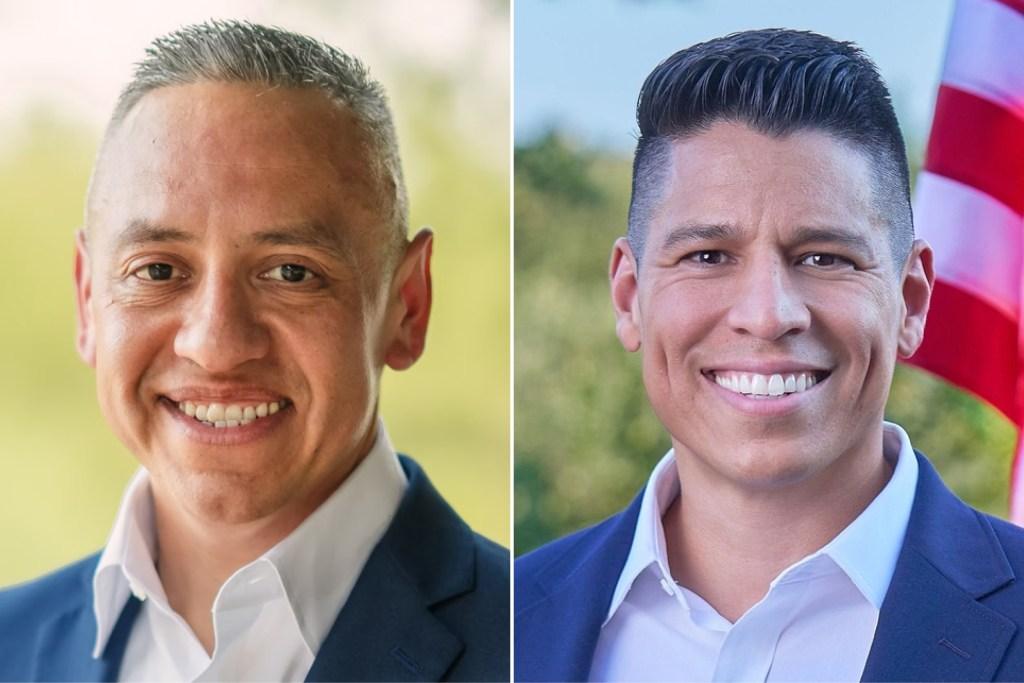
SAN ANTONIO — As canvassers congregated near a golf course on the Southside of San Antonio, equipped with bilingual campaign materials and a determination to face the sweltering September heat, Carlos De La Cruz emphasized the importance of their efforts to his campaign volunteers.
“With God’s help, we will hold onto the House majority this year,” stated the Republican congressional candidate. “But that will only occur through initiatives like this. Let’s get out there and knock on as many doors as possible!”
Following a group prayer led by a local pastor lamenting the separation of church and state, the volunteers fanned out to promote De La Cruz’s candidacy at homes throughout the neighborhood.
De La Cruz, a first-time Republican contender, is vying for a U.S. House district that his party redrew last summer to gain seats in the lower chamber of Congress. An Air Force veteran who has served both overseas and at San Antonio’s Lackland Air Force Base, De La Cruz — who is also the brother of Edinburg Representative Monica De La Cruz — plays a crucial role in House Republicans’ aspirations during a cycle where Democrats are favored to regain control.
Meanwhile, Johnny Garcia, a Bexar County sheriff’s deputy and self-identified “old school Democrat” from San Antonio’s Westside, spent his morning at New Creation Christian Fellowship, a Black church located just outside the city’s northeast boundary. There, he conveyed his economic message to voters, adding a local touch to an issue that Democrats are emphasizing nationwide.
<p“On the campaign trail, I communicate to Latinos that we’re simply trying to make it to Sunday so we can afford our barbacoa and Big Red,” Garcia remarked. “This morning, my message to the church was about making it here with enough gas in our vehicles to attend service and still have enough left over for brunch afterward.”
The contest between these two Latino candidates, one with a military background and the other in law enforcement, challenges conventional partisan narratives. De La Cruz, lacking any prior elected office experience, faces no record of controversial votes. Many of his television advertisements, including promises to “eliminate corruption and reduce costs,” echo familiar Democratic themes. Conversely, Garcia, a Blue Dog Democrat with nearly two decades of law enforcement experience, is difficult to label as an extremist or socialist and is unafraid to critique his party on issues related to the border and social policies.
“This race is fascinating because I would argue it defies the typical narrative for Democrats,” noted Jon Taylor, a political science professor at UT-San Antonio. “Johnny Garcia is much more aligned with moderate Democrats like Vicente Gonzalez and Henry Cuellar… making this a more formidable challenge for Republicans.”
In contrast to the U.S. House battlegrounds in the Rio Grande Valley, where incumbents Cuellar and Gonzalez are seeking reelection, the contest for the 35th Congressional District has remained relatively low-profile. However, similar to the Valley, the outcome in the 35th could hinge on significant questions in Texas politics this election cycle, such as whether Latino voters will shift back to Democrats and the effectiveness of the Republicans’ mid-decade gerrymandering efforts.
Of the five Democratic seats reconfigured by the GOP to favor Republican candidates, analysts have identified the 35th District as the third most likely to flip, making this race pivotal for the entire redraw process. The redistricting led incumbent Democratic Representative Greg Casar to opt for a different district, leaving the 35th as an open seat.
“I predict this will result in a race decided by two or three points on either side,” Taylor stated, forecasting that Garcia would emerge victorious if Bexar County experiences high voter turnout.
As De La Cruz alluded to during the recent canvassing event, the race is also critical for determining which party will control the House.
Republicans in Washington are certainly viewing it as such. House Speaker Mike Johnson addressed GOP supporters at a gathering for De La Cruz earlier this summer, declaring that “this district is the whole enchilada.” President Donald Trump is set to rally with De La Cruz and Senate GOP nominee Ken Paxton in San Antonio this week, with Trump’s political network having invested approximately $4 million in the race.
The district encompasses a heavily Mexican American population in the working-class Southside, the southern portion of Bexar County, suburban areas near Randolph Air Force Base, and three predominantly rural counties east of the city. Approximately 60 percent of the anticipated 2024 vote is expected to come from the Bexar County area.
Historically, no statewide Democratic candidate has secured a victory in the district in recent elections, although Senator Ted Cruz narrowly won it by just 1 percentage point in 2018 and by 4 points in 2024. Trump won the district by a 10-point margin in the last election.
The eligible voter population in the district is 51.8% Hispanic. However, Hispanic voters tend to have lower turnout rates compared to other demographics, thus comprising a smaller segment of the electorate; in 2024, for instance, voters with Spanish surnames accounted for only 37% of those who cast ballots in the newly drawn 35th District.
De La Cruz’s campaign is focusing on the Southside as a critical swing area within the district, engaging with voters they consider to be persuadable. Their strategy begins with an introduction of the candidate’s background as a veteran and small-business owner, having opened a kickboxing gym with his wife several years ago.
The Republican candidate believes that swing voters prioritize a candidate’s vision and values over party affiliation and claims to offer a compelling narrative and economic plan that resonates with them.
“I’m addressing the issues that matter to voters,” De La Cruz stated. “They recognize my 20 years in the United States Air Force, which is a reflection of this community, known as Military City, USA.”
As Election Day approaches, the race has escalated in cost. Republicans have already spent or reserved $4.4 million on advertisements for the general election, with $4 million from No Going Back PAC, which is linked to Trump’s political operation. In comparison, Democrats have invested $5.1 million, primarily from House Majority PAC, the main external organization backing House Democrats.
The Trump-affiliated group has targeted Garcia over a 2019 incident involving a teenage inmate at the Bexar County Jail who attempted suicide. Garcia, who served as the public information officer for the sheriff’s office overseeing the facility, described the situation as “tragic” and criticized state-level Republicans for providing insufficient mental health support in local jails.
Both candidates have sought to connect their opponents to unpopular aspects of their respective parties through attack ads and speeches. De La Cruz has been characterized by Garcia as merely “Donald Trump’s wingman,” highlighting the former president’s low approval ratings among Latino voters and Texans in general. Conversely, De La Cruz has referred to Garcia as a “PR guy” who would “make excuses for his party’s open border policies” in Congress.
Despite the substantial financial backing, the presence of two first-time candidates in a newly established district underscores the importance of each candidate’s grassroots efforts, remarked Henry Bonilla, a Republican who served parts of San Antonio in Congress from 1993 to 2007.
Bonilla, who serves as finance chair for the Associated Republicans of Texas, believes that 2024 presents a critical opportunity for Republicans who have long sought to gain traction with Hispanic voters. However, he expressed concern that the administration’s stringent immigration policies could jeopardize those efforts in districts with substantial Latino populations.
“I was surprised to see pickup trucks with Trump signs even on the Southside, a region that is overwhelmingly Hispanic,” Bonilla recalled. “Yet, many of the current policies are alienating those voters, which is a significant concern for those of us who have worked diligently to build that support.”
Garcia has invested nearly two decades in the Bexar County Sheriff’s Office, beginning his career at age 21 in the county jail. He later became a SWAT crisis negotiator and eventually the agency’s public information officer.
Drawing on his extensive experience on the campaign trail, Garcia often quips — even in his television ads featuring clips of him in uniform — that law enforcement officers don’t inquire about a residence’s political affiliation when responding to calls. He aims to appeal to independent voters and even some Republicans by expressing his readiness to challenge his party.
Garcia criticized the Biden administration for “failures” at the border, referencing incidents such as the discovery of deceased migrants in a truck in San Antonio in 2022, and the emergence of stash houses and the fentanyl trade. He also voiced disagreement with the notion that transgender women should participate in women’s sports.
“We acknowledge that we’ve made mistakes regarding the border here in Texas,” Garcia explained to voters. “However, I also emphasize the economy and how much has changed under this administration, with tariffs adversely affecting working-class families and healthcare cuts. Voters recognize that I