







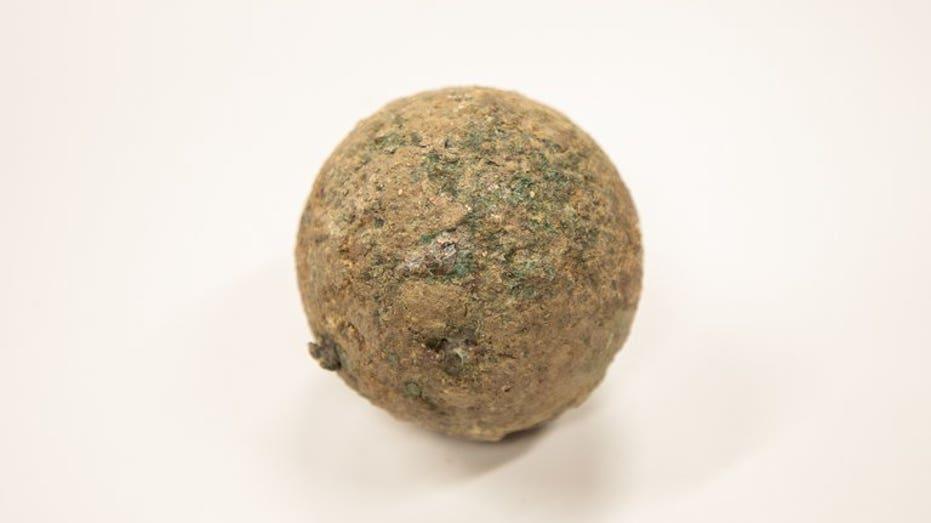
Archaeologists at the Alamo have made a remarkable discovery: a cannonball believed to have been fired during the pivotal 1836 battle between Mexican troops and Texian defenders. This significant artifact was unearthed just prior to the 190th anniversary of the historic clash.
The find was reported by the Alamo Trust, the nonprofit organization responsible for managing the Alamo Mission, on March 19. The cannonball was uncovered on March 5, just a day before the anniversary of the battle, which commenced on February 23, 1836.
During the 13-day siege, Texian forces, led by notable figures such as Davy Crockett and William B. Travis, faced off against a much larger Mexican army. The siege ended with a fierce assault that resulted in the deaths of nearly all the approximately 200 Texian defenders. The rallying cry “Remember the Alamo!” later inspired Texian forces to a decisive victory at the Battle of San Jacinto.
The cannonball, weighing four pounds, was found approximately three feet below the surface outside the Alamo Church. In addition to the cannonball, researchers also discovered four fragments of exploding shot—three made of bronze and one of iron—identified as Howitzer rounds designed to detonate upon impact, scattering shrapnel.
Tiffany Lindley, director of archaeology at the Alamo, stated that the cannonball was “very likely” associated with the historic battle. Its location and condition are particularly noteworthy, as it is the only solid shot of its size found at the site. Lindley explained that the cannonball was found within a layer dating back to the siege, where the Mexican Army bombarded Texian forces from an artillery battery located on the northeast side of the Alamo compound.
“Due to extensive use of the site after the battle, looting shortly thereafter, and previous utility installations, many artifacts—especially of this size—were removed from the site,” Lindley noted. “Once an artifact is taken from its original context, it loses much of its significance for researchers.” She emphasized that the context of this solid shot is what renders the find so important.
Once the fieldwork concludes, researchers will analyze the cannonball, with hopes of displaying it in the future. Lindley expressed aspirations to showcase the cannonball at the upcoming world-class Alamo Visitor Center and Museum, set to open in 2028.
This cannonball adds to the extensive collection of over 250,000 artifacts discovered at the Alamo site, which primarily includes ceramic shards, musket balls, adobe floor pieces, and glass bottles. Lindley acknowledged that while not every artifact will be publicly displayed, each contributes to the rich narrative of the Alamo.