





HOUSTON — Mohamed Hussein knew he was stepping into a challenging environment when he decided to attend the Republican Party of Texas Convention. His aim was to ascertain his place within the GOP, despite the party’s ongoing rhetoric against Sharia Law and the perceived “Islamification” of Texas.
However, what he encountered was a stark reality: a party that appeared unwelcoming. He arrived with optimism but left devastated after being told he should leave the country.
Hussein was one of four Muslims who attended the convention not as protesters but as delegates and participants, eager to engage in the annual assembly of the state’s most hardline Republicans. The convention prominently featured discussions on party unity and a campaign against Sharia Law, which some attendees transformed into overt Islamophobic sentiments.
“When they speak of a Sharia-free Texas, it essentially translates to a Muslim-free Texas, eliminating Islamic practices altogether,” Hussein remarked in an interview. “No one is advocating for the state to adopt Sharia laws.”
Hussein expressed disbelief at being told for the first time in his life to convert or leave during a convention themed around “Unity drives victory.”
The slogan, which was prominently displayed throughout the convention and highlighted by the governor, served as a rallying point for party leaders and candidates as they geared up for the upcoming elections. Despite warnings of potential losses to Democrats, party members seemed willing to forfeit the support of Muslim conservatives.
On the final day of the convention, outgoing GOP chair Abraham George addressed two Muslim delegates from the stage, who were targeted for removal due to their affiliations with the Council on American-Islamic Relations (CAIR), an organization the GOP and Governor Greg Abbott have labeled a terrorist threat.
“I would strongly advise you to leave our caucus,” George stated. “There’s a Democrat convention happening in a couple of weeks. You should join them.”
During a session hosted by the Judeo-Christian Caucus, moderated by Dr. Rick Scarborough, a former Southern Baptist pastor, speakers asserted that immigrants who do not adhere to Judeo-Christian values pose a threat to American society. Scarborough went so far as to accuse Muslims of deception in their quest for political power.
“You may find Muslims who are not openly antagonistic, but I guarantee that if they gain power, they will turn hostile towards Christians,” he warned.
State Senator Bob Hall echoed Scarborough’s sentiments, alleging that Muslims are “required by Sharia to lie” to remain undetected.
Hussein, appalled by the rhetoric, objected from the back of the room, asserting that the lies about Sharia were harmful and unjust. “When you claim we are compelled to deceive, you place our Texan neighbors in an impossible situation, where nothing we say can absolve us of these accusations. That is neither just nor American,” he argued.
Sharia, as he explained, consists of the teachings of the Prophet Muhammad and serves as a framework for how Muslims should conduct their lives, encompassing practices such as prayer, fasting, modesty, and charity.
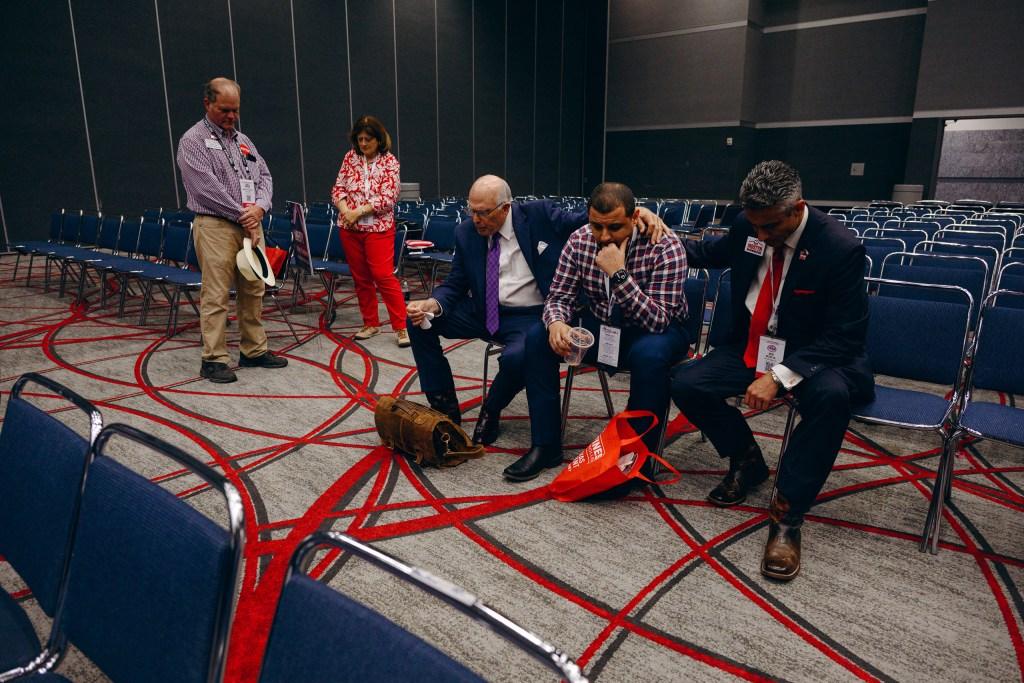
After the panel, Scarborough approached Hussein, and when asked if he wanted him to leave, Scarborough replied affirmatively. Overcome with emotion, Hussein retreated to a quiet area to collect himself, with Scarborough sitting beside him, attempting to offer comfort.
In a subsequent interview, Scarborough clarified his stance, stating that if Hussein embraced the values he professed, America was not a suitable place for him. “That’s not assimilation; that’s an attempt to take over,” he asserted.
Hussein’s family emigrated from Egypt to Houston in 1992. A history enthusiast, he cherishes the Bill of Rights for its promise of religious freedom. Now a father and healthcare manager, he identifies as a conservative on economic and social issues, believing that religion should play a part in public life.
At the convention, he was accompanied by his father, Tarek Hussein, the founder of CAIR Texas-Houston, who was a registered delegate. In recent months, both the Texas and Florida governors have designated CAIR and the Muslim Brotherhood as foreign terrorist organizations, accusing them of promoting Sharia Law and terrorism.
CAIR has consistently denied any wrongdoing and asserts that its mission is to enhance understanding of Islam, protect civil rights, promote justice, and empower American Muslims. The organization claims it has been unfairly targeted for its opposition to Israel amid the ongoing conflict in Gaza.
In a statement, Texas GOP Chair D’rinda Randall labeled CAIR a radical organization connected to terrorism, emphasizing party unity as they head into the November elections.
Tarek Hussein aligns with the GOP on fiscal conservatism and issues like abortion and healthcare reform. He became politically active in the wake of the 9/11 attacks, aiming to combat the rising tide of Islamophobia by educating fellow Muslims about the political landscape and encouraging engagement to counter extremism.
Recently, Frank Gaffney, a former defense policy analyst, referred to some of Hussein’s earlier writings as evidence of attempts to “infiltrate” political parties.
“Now, when I educate my community on political engagement, I’m being accused of infiltration,” Hussein lamented.
Samar Halabi, the only woman at the convention wearing a hijab, faced hostility during the event as attendees warned her against associating with CAIR. Despite the backlash, she remained composed, asserting her commitment to inclusivity.
Halabi’s husband, Amjad Muhtaseb, a delegate and business owner, emphasized the conservative values inherent in the Muslim community, highlighting their opposition to issues like gambling and pornography.
They aspire to attract more Muslims to the Republican Party, but in the days leading up to the convention, their connections to CAIR drew scrutiny, leading to attempts to expel them as delegates. Ultimately, the party concluded that the full convention lacked authority to remove them, though new rules were established to allow future delegations to exclude those linked to designated terrorist groups.
Some delegates expressed concerns about the focus on Sharia, suggesting that it detracted from more pressing issues facing the party.
As the midterms approach, Tarek Hussein intends to support candidates he believes embody Republican values, while Mohamed Hussein is left questioning his place in a party that seems to reject him.
“How can I support a party that tells me to leave or convert?” he pondered, expressing concern that anti-Islamic rhetoric might incite further violence against Muslims.
In a dialogue with Scarborough after the incident, the pastor reflected on his approach and expressed a desire to pray for Hussein’s conversion to Christianity. Hussein, while moved by the interaction, struggled to reconcile the pastor’s conflicting messages.
Reflecting on his experience at the convention, Hussein remains uncertain about his future political affiliations, questioning the implications of a party that employs such divisive rhetoric.