








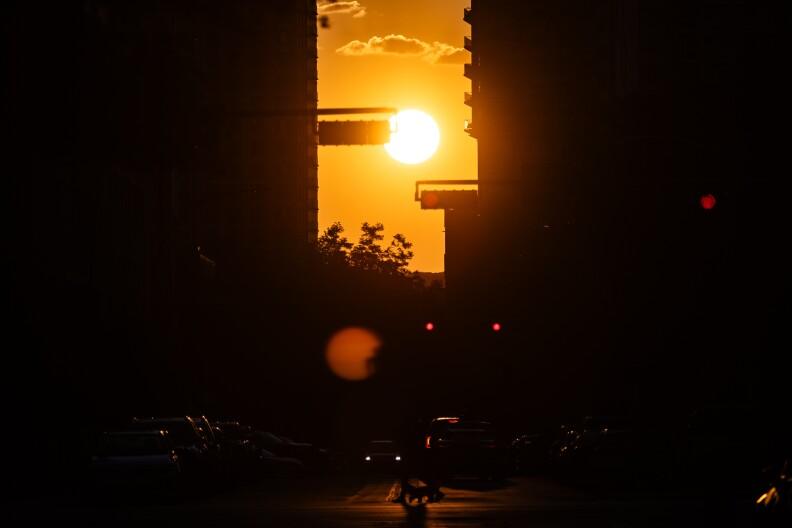
Austin’s unique astronomical phenomenon, affectionately dubbed “Austinhenge,” has returned, captivating residents and visitors alike. This twice-yearly event takes place in early August and May, when the sun sets in perfect alignment with the city’s downtown east-west streets, creating a striking visual effect.
During these special evenings, drivers may find their journeys through Austin transformed, as the sun casts a radiant tunnel of light directly down certain streets. This dazzling spectacle can feel almost otherworldly, as if one is heading straight into the heart of the galaxy.
The term “Austinhenge” reflects the city’s embrace of this celestial occurrence, which is not exclusive to Austin. Cities with east-west street layouts, such as New York with its “Manhattanhenge,” San Francisco’s “California Henge,” and Chicago’s “Chicagohenge,” also celebrate their own versions of this phenomenon. All these events take inspiration from Stonehenge in England, an ancient structure aligned with the sun’s path during the solstices.
This year, the most precise alignment will occur on Sunday, though the effect will be similar from Saturday through Monday, notes Will Best, an astronomy researcher and lecturer at the University of Texas at Austin. He explains that Austin’s downtown streets are oriented slightly northwest to southeast, which means that the phenomenon does not coincide with the spring and fall equinoxes.
“It’s six months apart if the grid is exactly east-west,” Best explains. “The tilt-off changes that, but the timing remains consistent with the days surrounding the summer solstice.”
The diverse street grids across Austin lead to multiple “henge days” depending on specific locations. For instance, the numbered streets just east of downtown align best with sunset a couple of days earlier, around August 7, while streets south of the University of Texas campus find their ideal alignment a day later, on August 8, according to Hengefinder, a dedicated website tracking these events.
While not all streets in Austin experience this phenomenon, residents can discover when their particular street aligns with sunset through resources like Hengefinder or various solar planning applications. Best emphasizes the significance of these celestial moments, remarking, “People today may be less attuned to astronomical events, but moments like these can remind us of our connection to the larger universe.”