








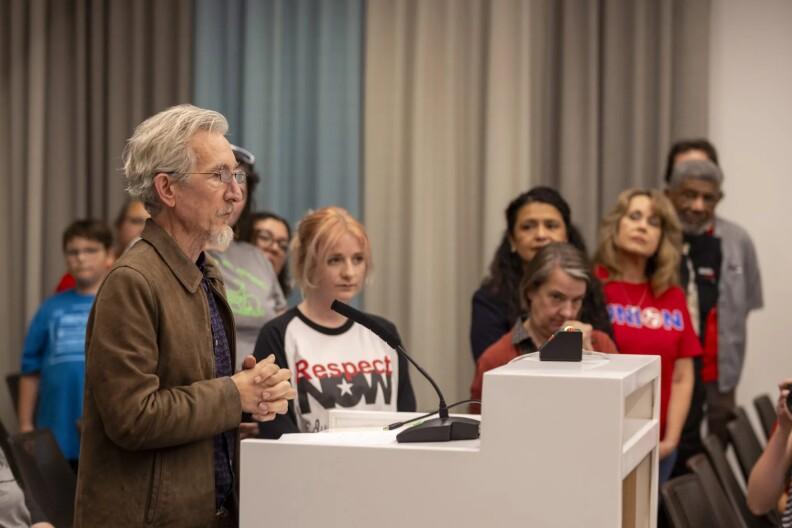
In a passionate display of solidarity, educators and community members gathered at the Austin Independent School District (AISD) headquarters to voice their opposition to potential budget cuts that threaten classroom positions and essential stipends. The meeting, held on a Thursday evening, saw more than a dozen individuals testify both in person and via virtual platforms, warning that such cuts could have dire consequences for students and educators alike.
The AISD board was reviewing preliminary budget updates aimed at addressing a rapidly escalating deficit. As of February, district leaders projected a $49 million shortfall for the current school year, a staggering $30 million more than initially anticipated. Just weeks later, the district announced that the deficit could swell to $181 million by the end of the next school year if corrective measures are not implemented. While AISD had previously indicated intentions to protect classrooms from budget cuts, an unexpected drop in student enrollment has led officials to reconsider their stance on necessary reductions.
Denise Hankins, a special education teaching assistant at AISD, shared her concerns during the meeting, stating, “Our staff rely on the stipends for special education, and of course we are living paycheck to paycheck. A lot of people are already working two or three jobs and struggling now.” Many speakers echoed Hankins’ sentiments, highlighting a looming discussion among district leaders about compliance in special education even as they consider cutting stipends for these critical roles. Following years of state oversight due to special education violations, the financial strain on educators could detract from their focus on student needs.
As board members prepare to finalize the budget for the upcoming school year by June, Superintendent Matias Segura noted that potential cuts could impact teacher positions, planning time, and funding for technology and academic programs, as well as stipends related to travel, cell phones, and special education. In a continuation of cost-saving measures, librarians may also face reassignment to different roles. These considerations follow a previous decision by the board to close ten campuses and a hiring freeze imposed on central office positions since December.
To further address the deficit, AISD is exploring the monetization of district properties, which could yield an additional $50 million in revenue next school year. Superintendent Segura indicated that this might involve land sales or leases.
During the board meeting, Chief Financial Officer Katrina Montgomery and Segura provided insights into the budget, discussing assumptions regarding falling property values and projected daily attendance. Segura warned, “There are probably going to be staffing changes. It is almost certain.”
Concerns regarding potential cuts also encompassed elementary-level staffing for arts, music, and physical education, as well as secondary teaching positions, class sizes, and scheduling. The trustees debated whether the proposed cuts would align with academic goals and whether conservative estimates for property values and enrollment could necessitate even deeper reductions.
Trustee Arati Singh expressed a sense of urgency, stating, “We are in a situation where the budget is driving the academic plan.” Additionally, leaders informed the board that a 2022 bond program for improvements and technology is projected to face a $217 million deficit due to rising construction costs. Despite this, accrued interest and previously allocated funds mean the program may still have a reserve of $2 million.
Community Response to Proposed Cuts
Just days after the budget cuts were announced, librarians and their supporters rallied to advocate for the preservation of librarian positions. Nearly 100 participants, including teachers, parents, and community members, attended a virtual meeting organized by the employee union Education Austin to discuss the potential ramifications of the proposed changes.
Ken Zarifis, president of Education Austin, outlined the primary concerns raised during the meeting: secondary teacher planning time and student-teacher ratios; the need to maintain stipends for special education and bilingual educators; and the protection of support staff roles, including librarians and interventionists. Zarifis emphasized that removing stipends from educators who helped the district exit state oversight would undermine recent progress in special education compliance.
He further criticized the proposed changes that would require secondary teachers to increase their workloads without additional pay, stating, “We have a state that has attacked our district in an outrageous way budget-wise and refuses to pay for schools the way they should.” A petition opposing the cuts is circulating within the AISD community, with union members actively encouraging feedback from teachers, parents, and students while pushing for community members to voice their concerns at upcoming budget meetings.
Zarifis concluded, “It is not just about the money, it is about the education that you can produce. This is about people who are important in this district, and we are going to fight for them.”
Factors Contributing to the Deficit
This year, AISD trustees had previously approved a budget anticipating a $19 million deficit, based on expected land sales and a smaller dip in student enrollment. However, the district experienced a loss of over 3,000 students this year, attributed to factors such as increased immigration enforcement, declining birth rates, and rising living costs leading families to explore alternative schooling options.
Superintendent Segura noted that diminished property values and a delayed property sale worth an estimated $26 million have compounded this year’s financial challenges. Additionally, significant payments to the state under the recapture policy, which requires financially robust districts to contribute portions of their property tax revenue to support lower-wealth districts, have strained AISD’s finances. This year alone, the district anticipates sending approximately $715 million to the state, accounting for nearly half of its total revenue of $1.58 billion.