







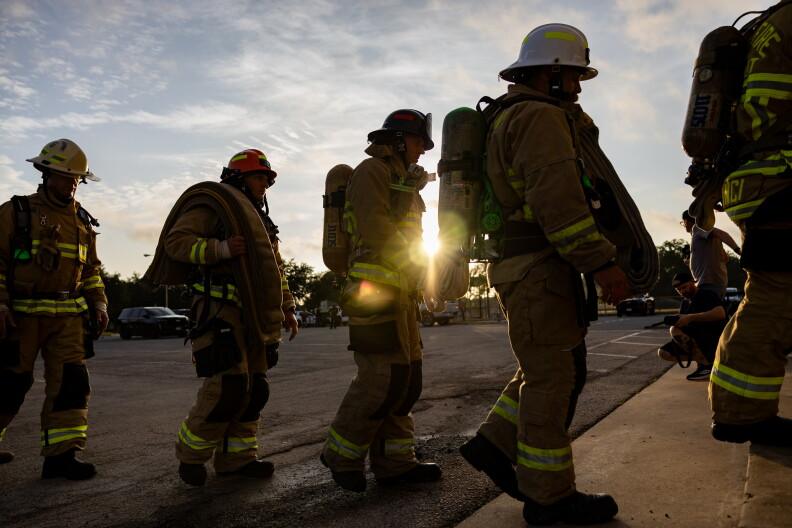
In recent years, the Austin Fire Department has faced a troubling trend, with several firefighters taking their own lives. This has prompted a renewed focus on mental health support and prevention strategies within the department.
Firefighter Jason Venzant recalls the profound impact of his experiences on the job. “I still remember the first time I saw a dead body back in March of 1997. That image never goes away,” he shared. Firefighters are often exposed to traumatic situations, yet many do not seek the mental health support they need to cope with these experiences.
Reflecting on his own struggles with suicidal thoughts, Venzant, who has served with the Austin Fire Department (AFD) for 15 years, expressed gratitude for not having gone down that path. His sentiments echo the concerns voiced by Fire Chief Joel Baker, who identified suicides among department members as one of his greatest regrets. “One day you’re sharing a meal with someone, and the next you receive a call saying they’ve taken their life. It’s shocking and heartbreaking,” he lamented.
Firefighters regularly confront life-threatening situations, from battling blazes to rescuing victims from wrecked vehicles. Venzant recalled a particularly harrowing incident in 2017 involving a motorcycle accident caused by a drunk driver, which resulted in devastating injuries and loss. Such experiences can lead to lasting psychological effects, yet there remains a stigma surrounding mental health discussions within the firefighting community.
Dr. Celesta Taylor, a clinical forensic psychologist at the Austin Public Safety Wellness Center, noted that many firefighters are reluctant to seek help because they are conditioned to be the ones providing assistance. “They often don’t view themselves as needing help, which can be a significant barrier,” she explained.
Research indicates that first responders, including firefighters, have higher suicide rates than the general population. Despite this alarming statistic, the AFD does not maintain specific records on suicides within the department. Dr. Taylor estimates that there has been at least one suicide annually among firefighters over the past five years, although an AFD spokesperson suggested the number might be lower.
With around 1,330 personnel in the AFD, the wellness center is actively working to educate firefighters about mental health care. “Part of our approach is to provide psychoeducation, helping them understand that their reactions to traumatic events are normal,” Taylor stated.
Venzant sought counseling after the motorcycle accident, encouraged by a former chief. He attended therapy sessions regularly for four years, during which he processed his feelings and experiences. However, the AFD’s mental health resources are limited, with only two in-house psychologists available, leading to long wait times for new firefighters seeking help.
In a 2026 audit report, nearly 40% of firefighters indicated that increased access to mental health services would benefit their well-being. Venzant emphasized that had he encountered a lengthy wait for help when he first reached out, he likely would have hesitated to seek assistance.
Firefighters often endure long shifts, sometimes lasting 24 to 48 hours, which can exacerbate stress. The same audit revealed that 86% of respondents believed improved work schedules would enhance their mental health, highlighting the challenges of working during holidays and mandatory overtime.
Venzant shared the emotional toll of missing significant family events, such as his child’s first steps and holiday celebrations. “I had to explain to my son that I couldn’t be there, but I would make it up to him. Sometimes, you just can’t get those moments back,” he lamented.
His demanding job also strained his marriage, ultimately leading to divorce in 2016. Venzant described the difficulty of processing traumatic experiences at home, often met with indifference from family members who struggled to understand the weight of his profession.
The 2026 survey revealed that while 95% of firefighters felt supported by their peers, only 21% believed that department leadership genuinely cared about their well-being. Venzant noted that trust between firefighters and leadership has been improving, but lingering concerns about responses to critical issues like cancer and mental health persist.
Since 2019, 64 AFD personnel have been diagnosed with cancer, and a veteran firefighter recently won a lawsuit against the city after being denied workers’ compensation for Stage 4 cancer.
Lieutenant Xochitl Chafino, the peer support coordinator at AFD, emphasized the importance of peer connections for firefighters. “While we have a formal support team, many firefighters turn to one another during meals or through phone calls,” she noted.
Lieutenant Brian Davis, a member of the peer support group, shared insights on their supportive approach. Through role-play exercises, he illustrated how they assist colleagues dealing with various challenges, including relationship issues and burnout. Davis emphasized active listening and validation of feelings while guiding individuals toward actionable solutions.
Venzant eventually stopped attending therapy in 2021, describing a transformative moment when he felt a renewed sense of clarity and hope. He recognizes that the stigma surrounding mental health is gradually diminishing, and he now feels comfortable reaching out to his peers for support.
If you or someone you know is struggling with mental health issues or suicidal thoughts, please reach out for help by calling 988 or texting “HOME” or “HOLA” to 741741.