









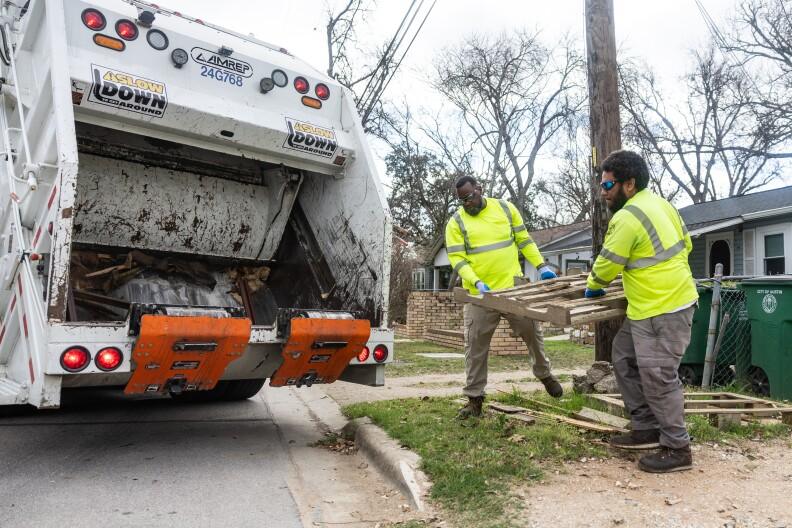
Austin’s recent transition to on-demand bulk trash collection has yielded significant financial savings, amounting to over $180,000, according to city officials. This change, implemented a year ago, has also enhanced customer service while allowing the city to explore further efficiencies amid ongoing budgetary constraints.
Previously, residents faced a cumbersome process for disposing of large items such as furniture and yard waste, having to wait for scheduled pick-up days. This led to curbs cluttered with discarded sofas, mattresses, and brush piles. Under the old system, each household was limited to two bulk and two brush pickups annually. Now, residents can conveniently schedule pickups at their own convenience.
Amy Slagle, assistant director for Austin Resource Recovery, explained that the earlier system was not only inefficient but also led to unnecessary fuel consumption. Crews would drive down every street, often encountering empty ones while others were overloaded with discarded materials. “This created additional work hours and increased fuel costs,” she noted.
Cost savings were a primary motivation behind the shift to an on-demand service. Additionally, the city aimed to improve the overall experience for residents. Slagle highlighted that the previous schedule often conflicted with residents’ availability, particularly when they were away from home.
Since the on-demand program’s launch in January 2025, data reveals that over 73,000 appointments have been made, predominantly for bulk pickups. This has resulted in substantial financial benefits for the city, with Slagle reporting a reduction of approximately $91,000 in overtime costs, alongside savings of around $11,000 in fuel expenses and $86,000 in landfill fees.
While the landfill savings might suggest residents are becoming more mindful of their disposal habits, Slagle indicated there could also be a lack of awareness regarding the new service. The city plans to bolster its outreach to ensure more residents are informed about the on-demand option.
Moreover, the on-demand pickups have enabled the city to divert more items from landfills, repurposing them instead. Donald Hardee, who oversees the city’s diversion facilities, mentioned a pilot program focused on rehoming furniture for individuals transitioning out of homelessness. This initiative allows the city to better understand the types of furniture commonly discarded and find ways to extend their lifespan.
“Furniture is a significant contributor to landfill waste,” Hardee stated. “The more we can keep out of the landfill, the closer we get to our zero waste goals.” Austin aims to divert 90% of its waste from landfills by 2040, a target the city is currently striving to meet.