








Democratic members of the State Board of Education in Texas are advocating for a pause in the state’s review of its social studies curriculum due to concerns over a financial contribution from a conservative think tank to a university department associated with one of their advisers.
A letter sent to the State Board revealed apprehensions regarding a 2024 tax filing that disclosed a $70,000 grant from the Texas Public Policy Foundation to the Texas Center at Schreiner University in Kerrville. This funding was intended for the development of state learning standards that dictate the knowledge required of students prior to graduation.
Donald Frazier, a Texas historian and director of the Texas Center, was appointed last year as one of nine expert advisers tasked with shaping the future of social studies education in Texas. In response to the letter, the Democratic board members called for a “comprehensive and independent investigation” concerning the grant and its implications on Frazier’s contributions during the curriculum revision process.
“Given the scope and significance of this work, which impacts more than 5.5 million public school students across Texas, it is essential that the process remain transparent, objective, and free from undue influence,” the letter emphasized.
The board members expressed that significant public testimony and feedback from Texans have already raised concerns about the process’s speed and transparency. They warned that proceeding without addressing these issues could jeopardize public trust and cast doubt on the legitimacy of the decisions made.
In emails, Frazier defended the grant, stating that his university collaborates with various organizations. He emphasized that while he provides recommendations as an adviser, the State Board ultimately decides on the educational requirements for students.
“Texas Public Policy hired us to discuss Texas ideas, which is what we do,” Frazier stated, adding that he believes his influence has been overstated. “The idea that I am some Great Oz figure with huge influence on this state board process, while flattering, is wishful thinking.”
When asked about his contributions to the conservative organization, Frazier directed inquiries to his department’s website, where he expressed his commitment to illustrating connections between global, national, and local narratives.
The Texas Public Policy Foundation responded to the claims, asserting that the concerns raised by the Democrats are merely a tactic to delay the curriculum review process. Brian Phillips, a spokesperson for the foundation, urged board members to concentrate on the merits of the curriculum to ensure Texas students receive the best education possible.
Currently, the State Board of Education is in the process of redesigning Texas’ social studies standards, with a vote on the new framework scheduled for this summer and classroom implementation expected by 2030.
So far, the Republican majority on the board has favored a curriculum that emphasizes Texas and U.S. history while downplaying world cultures, history, and geography. The advisory panel, composed mainly of individuals without K-12 classroom experience in Texas and several with links to conservative activism, has faced criticism for monopolizing the social studies revision process and diminishing teacher input, which has typically played a crucial role in such revisions.
Critics argue that the proposed changes prioritize rote memorization over critical thinking, simplify complex historical narratives, and disproportionately highlight Western civilization, often at the expense of a diverse representation of cultures and perspectives, particularly those of people of color. Furthermore, they contend that the current framework tends to favor Christianity over other world religions.
Frazier has previously chaired the advisory committee for Texas’ 1836 Project, which counters The 1619 Project by examining slavery’s role in American history. Since his appointment as a social studies adviser, he has been a prominent figure in discussions, frequently sharing his viewpoints during public meetings.
In recent comments, Frazier expressed approval of a narrative approach to history that centers on Western civilization and acknowledges Christianity’s influence on American culture. He argued that discussing Christianity is not an attempt to promote it but rather an acknowledgment of its historical significance in the U.S.
Meanwhile, the Texas Public Policy Foundation has been influential in state politics, frequently hosting events with key Republican leaders and spearheading conservative policy discussions at the Legislature. Over the past year, the organization has strongly supported a Texas-centric model of social studies instruction.
During a September board meeting, when asked about their involvement in developing the current social studies framework, Matthew McCormick, the foundation’s education director, stated that the Texas Public Policy Foundation had not contributed to that process.
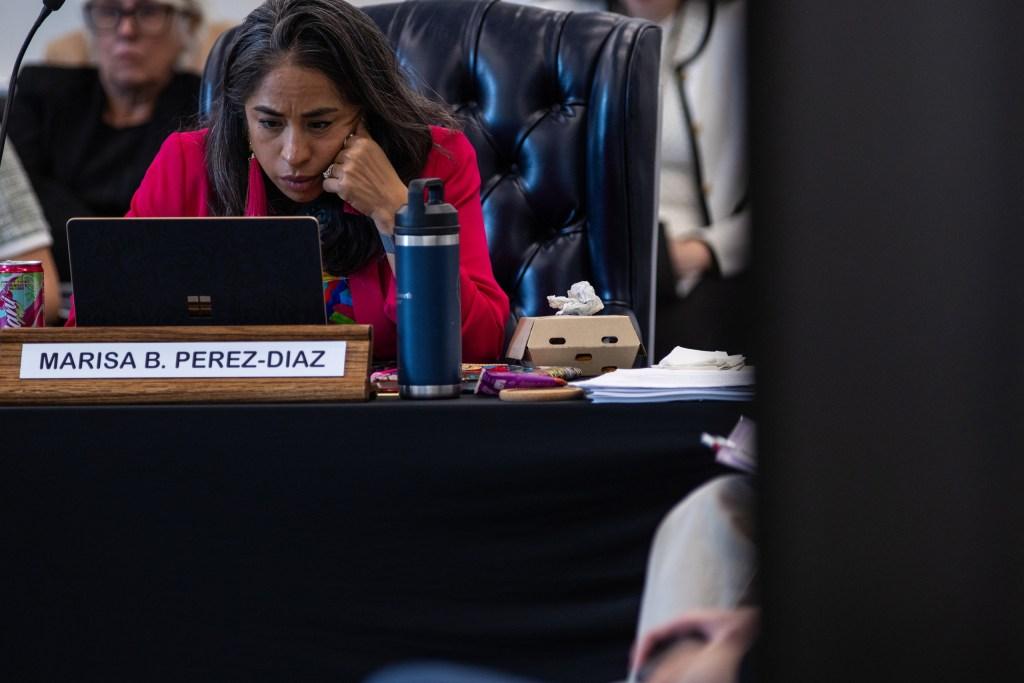
Recently, Democratic board member Marisa B. Pérez-Díaz inquired about the nature of the relationship between Frazier and the Texas Public Policy Foundation. Several Republican members objected to her questions, suggesting the board should maintain focus on the content of the social studies curriculum.
Tom Maynard, one of the Republicans who appointed Frazier as an adviser, described the insinuations of wrongdoing as troubling. He dismissed the notion of a quid pro quo as unfounded and urged the board to concentrate on completing the Texas Essential Knowledge and Skills (TEKS) standards without engaging in political distractions.
However, Democrats maintain that the curriculum review process is too crucial to continue amid uncertainties, insisting that any adopted standards must reflect the highest levels of integrity and serve the best interests of all Texas students.