






In the exhibit “Holding Spaces” at the Austin Central Library, photographer Steven Hatchett emphasizes the importance of supporting Black-owned businesses and the communities they foster. The exhibit aims to preserve cultural heritage and address the challenges posed by gentrification.
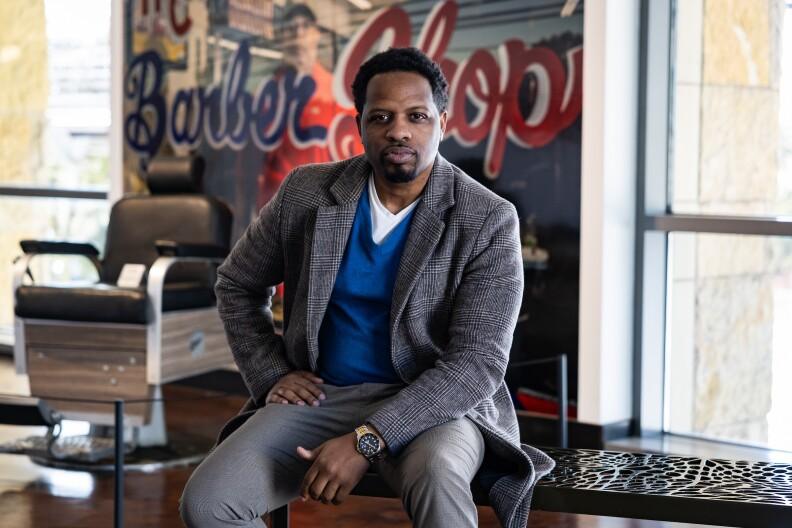
One striking feature of the exhibit is a well-worn barber’s chair, complete with creased leather and visible stuffing, accompanied by a poignant 5-foot-tall photograph of Kevin Asberry gazing through the window of Marshall’s Barber Shop. “He’s looking out over the chair,” Hatchett explains. “He sees this as a prized possession.”
Hatchett, co-founder of OFCOLOR, a nonprofit arts organization dedicated to uplifting underrepresented communities in Austin, hopes to convey a narrative of resilience and belonging through this collection. “Even though the idea of displacement and folks leaving Austin is a very real thing,” he notes, “the folks that choose to stay, the folks that do the work, and the folks who choose to hold space are the lifeblood of the culture here.”
The exhibit features portraits and narratives from notable local establishments such as RichesArt Gallery, Black Pearl Books, and Kicking It ATX. Visitors can view the exhibit until March 29, which kicked off with an opening reception and includes a panel discussion and community dialogue later this month.
Independent curator Taylor Danielle Davis, who played a key role in organizing the show, highlights the ongoing struggle to protect cultural spaces, particularly in East Austin and the historic Six Square. “To hold onto those spaces and to really highlight that they’re here and important, I think that that’s what this project means to me,” she reflects.
Hatchett’s work includes a photograph of Virginia Baldwin on her farm in Luling, capturing her journey of land ownership as a tribute to her family’s sharecropping roots. Davis collaborated with Hatchett to create an immersive experience within the gallery, incorporating objects from the featured businesses, such as the barber’s chair, recommended books from Black Pearl, and a sneaker from Kicking It ATX. “All of those little things sort of make this more than just a photo exhibit,” Davis asserts.
Across the room from the barber’s chair hangs a large vinyl image of Minnie Little, who is seen gazing into a mirror at her salon, Shag Noir. A display case nearby contains a lock of her grandmother’s gray hair, a personal item that Davis describes as “very heavy” with significance. “I was like — who’s is this? She said, ‘That’s my grandmother’s hair.’ Very casual about it,” Davis shares.
Another display showcases handmade wooden spoons from Chi Ndika, owner of Luv Fats Ice Cream. Ndika reminisces about using similar spoons during childhood trips to Kenya, calling them an essential part of her cultural identity. “It’s just something that reminds me of my family and the food that I used to eat when I would go to Kenya,” she explains.
Ndika notes that the Black population in Austin was much larger during her childhood. However, through her business, she has cultivated a new community that fosters joy and connection. A photograph in the exhibit captures Ndika smiling at the service window of her former ice cream shop, which she had to vacate after a rent increase of nearly $1,000. She is currently awaiting city permits to establish a new storefront in East Austin.
Hatchett conceived the exhibit after hearing stories about the challenges faced by Black-owned businesses. “What came out of hearing those stories became sort of a spiritual awakening around the idea of us wanting to hold a space for our humanity in safety and in camaraderie with what it means to be Black in Austin,” he reflects.
Having relocated to Austin from Chicago nine years ago, Hatchett acknowledges that Black newcomers often feel disconnected until they find their community. The business owners featured in “Holding Spaces” aim to provide that sense of belonging. “I think that’s the most important piece to me,” he concludes. “If folks can get an eye over the shoulder of one of these entrepreneurs and learn that through the blood, sweat, and tears they’ve developed the ability to say, ‘I deserve to be here and here’s why.’”