








In the midst of Texas’ midday hours, electricity prices experience a significant drop, primarily due to an abundance of energy generated by the state’s solar and wind resources. This surplus creates an opportune moment for energy buyers, leading to the charging of 500 batteries that were once integral to General Motors’ electric vehicles.
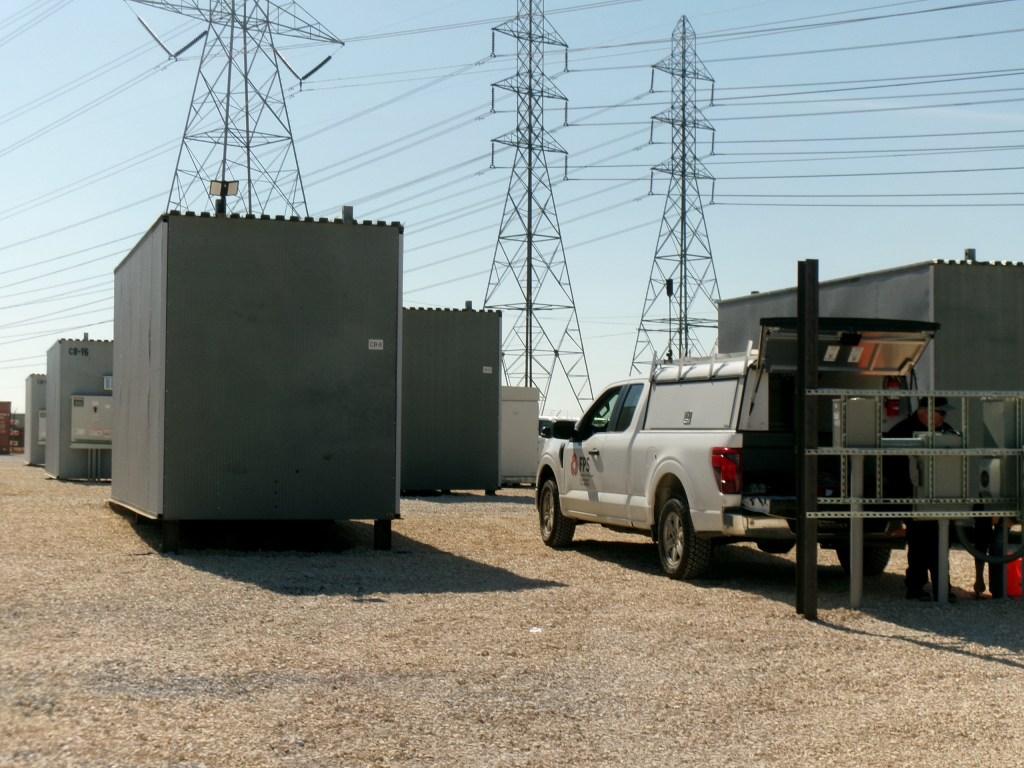
These batteries, now repurposed for a new function, are housed in staggered steel mesh containers at a site located just east of San Antonio. The electricity is transmitted across extensive distances until it reaches the storage facility.
As renewable energy production wanes during the night and Texas shifts towards fossil fuel sources, these retired EV batteries can sell power back to the state’s electric grid when market prices are favorable.
B2U Storage Solutions’ Innovative Approach
The 24 megawatt-hour battery project represents the first operational site in Texas for B2U Storage Solutions, a company based in California. Plans are underway to establish three additional battery sites connected to the Texas grid, aiming for a total storage capacity of 100 megawatt-hours, enough to power approximately 3,300 homes for a day.
This facility will connect with CPS Energy, one of the largest city-owned utility companies in the United States. B2U’s unique design enables the batteries to be deployed in a ‘plug-and-play’ manner, allowing for a diverse range of electric vehicle batteries from manufacturers like Nissan, Honda, Tesla, and Ford.
Freeman Hall, co-founder and CEO of B2U, noted that the company can achieve this at a cost of under $200 per kilowatt hour, significantly lower than the global average of approximately $117 per kilowatt hour and the U.S. average nearing $219 per kilowatt hour, as reported in December 2025 by BloombergNEF.
“This is super scalable,” Hall stated, emphasizing the safety, effectiveness, and cost-efficiency of their design.
Challenges in the Second-Life Battery Market
Despite the optimism surrounding B2U’s project, some experts express skepticism regarding the economic viability of second-life battery applications. George Hilton, a senior renewables analyst at S&P Global Energy, pointed out that for the reuse market to flourish, it must compete with simpler and more affordable alternatives, such as recycling or exporting used vehicles to developing electric vehicle markets.
Hilton explained that reusing batteries presents more complexities than recycling or exporting, which hinders rapid growth in this sector. “This has been a very strong barrier to growth for second-life battery companies,” he noted.
Additionally, the decline in battery cell prices due to advancements in manufacturing has reduced the incentive to repurpose end-of-life EV batteries for storage. Henrique Ribeiro, an analyst at S&P Global Energy, highlighted that newer batteries designed for grid storage possess longer lifespans compared to those originally developed for electric vehicles, rendering them less competitive despite lower costs.
Notable Players in the Market
Nevertheless, significant players are emerging in this space. B2U is joined by Element Energy, another California-based firm that began utilizing 900 second-life EV batteries for electricity storage within ERCOT last year. Redwood Materials, founded by a former Tesla executive, has also entered the second-life grid storage market with Redwood Energy, establishing a microgrid near Reno, Nevada, powered by repurposed batteries.
This microgrid offers the artificial intelligence company Crusoe cheaper power than purchasing from the grid, according to Redwood.
Contributions to Texas’ Electric Grid
The B2U project emerges at a time when Hall and other energy providers are capitalizing on the increasing demand for additional capacity on Texas’ electric grid, managed by the Electric Reliability Council of Texas (ERCOT). Most battery storage facilities participate in ERCOT’s day-ahead market, selling energy for the following day and providing ancillary services that help maintain grid stability.
In recent years, batteries have significantly contributed to ERCOT’s capacity and have played a crucial role in preventing blackouts during extreme weather conditions. Their effectiveness was particularly evident during Winter Storm Fern, which tested the resilience of the grid following the challenges posed by Winter Storm Uri, when battery storage was nearly nonexistent.
Currently, ERCOT boasts over 16,000 megawatts of storage capacity, with another 600 megawatts expected to come online soon.
Innovative Safety Measures
B2U’s design incorporates equipment that allows batteries to function at a standard voltage, ensuring compatibility despite varying capacities among the repurposed electric vehicle batteries. This innovation addresses the challenges of integrating batteries with different discharge rates, maximizing overall efficiency.
While much of the monitoring at B2U is automated, a dedicated system operator oversees the battery arrays via an internal dashboard. Color-coded indicators—green for operational status and red for issues—help track performance. A popped fuse caused a red alert in January, showcasing the system’s proactive monitoring capabilities.
Hall indicated that frequent battery replacements are unnecessary; B2U has operated battery systems for five years with minimal replacements needed. The company currently manages over 3,000 batteries across its California and Texas locations, with ambitions to scale up to 30,000, then 300,000, and ultimately 3 million.
Potential Environmental Benefits
While some analysts doubt the growth potential of the second-life industry due to economic constraints, others remain optimistic. They argue that the technology is already refined enough to mitigate mining demands for new battery materials. Allison Feeney, an energy storage research analyst at Wood Mackenzie, believes that leading companies have addressed many challenges associated with grid battery usage, paving the way for significant opportunities.
Despite the early stages of development, these second-use applications enable the full utilization of mined materials in batteries before they are recycled. BloombergNEF Senior Associate Andy Leach emphasized the importance of using resources to their fullest extent before recycling, as both reuse and recycling can minimize the environmental impact of mining.
Leach anticipates that while the U.S. energy storage market will likely outgrow the battery reuse sector, the latter could provide valuable options for the future. He suggested that although the second-life industry may not be substantial by 2030 or 2035, advancements over the next 15 years could lead to a more established framework.
Addressing Safety Concerns
One of the significant concerns surrounding battery storage projects is preventing thermal runaway, a phenomenon where a battery overheats, potentially leading to fires or explosions. This issue gained attention following the Moss Landing fire last year, which resulted in extensive environmental damage and ongoing cleanup efforts.
B2U’s steel mesh containers are engineered to prevent the buildup of hydrogen gas, mitigating explosion risks. The company has implemented a liquid cooling system, similar to those used in electric vehicles, to regulate battery temperatures and enhance safety.
Under safety regulations, B2U conducts fire tests at its facilities, evaluating how far heat spreads in the event of a fire. At their Bexar County site, the testing revealed a heat radius of approximately 13-14 feet, prompting the arrangement of cabinets 20 feet apart for safety. They have also integrated infrared sensors to monitor thermal conditions and installed insulation to facilitate firefighting access and limit vegetation around the batteries.
Security is another crucial aspect, particularly as the value of copper has surged, leading to thefts at power plants and data centers. Project manager Joao Domingos has implemented motion cameras at the site to deter theft, especially during construction phases. As the infrastructure evolves, buried or elevated copper wiring will complicate potential theft.
Originally, Hall estimated a lifespan of seven to eight years for the repurposed batteries, but he now believes this estimate may be conservative, with some batteries potentially lasting up to 15 years in their new applications.
With the facility located along U.S. Route 87, Hall envisions seamless operations once the site is connected to the grid. “Our whole view is that once you plug into the grid system, this site will operate for a long time,” he asserted.