






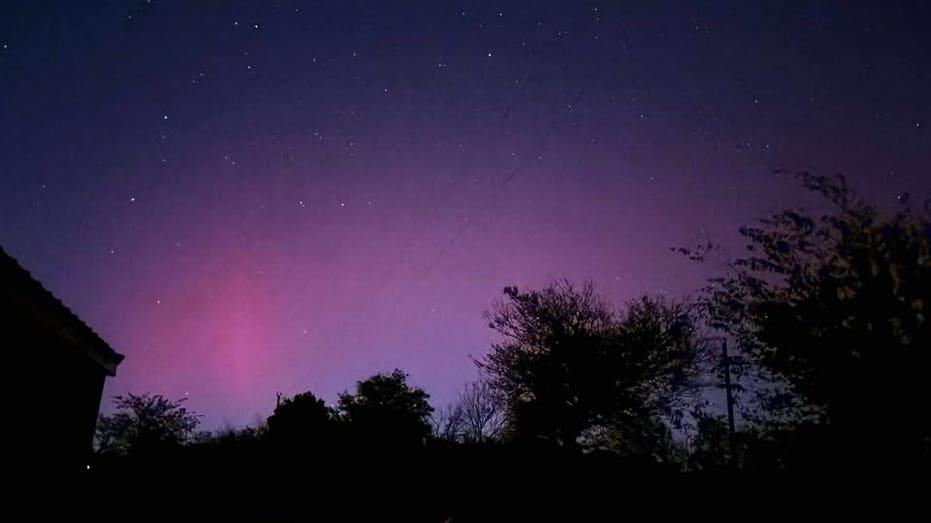
The Northern Lights have made a stunning appearance across Texas, delighting residents and stargazers alike. Observers in Dallas and beyond were treated to this breathtaking display, with some feeling puzzled as they gazed at the sky. If you missed it, there’s good news: the aurora may return tonight.
On Tuesday night, a powerful geomagnetic storm brought the Northern Lights to Texas, with sightings reported as far south as Fredericksburg. This unexpected phenomenon was spurred by a significant solar eruption, known as a coronal mass ejection (CME). Another geomagnetic storm is predicted for Wednesday evening, offering a second opportunity for Texans to witness this celestial spectacle from 6 p.m. to 11 p.m.
Texas Experiences the Northern Lights
Texans took to social media to share their photos of the lights, with sightings reported from various locations, including Fredericksburg. The early timing of these displays caught many by surprise, as it was initially thought that the auroras would not be visible this far south until later.
Will the Auroras Appear Tonight?
For those hoping to catch another glimpse of the Northern Lights, conditions look promising for Wednesday night. To enhance your viewing experience, it’s advisable to find a location away from the bright lights of urban areas, as the auroras should be visible in the northern sky.
The Science Behind the Northern Lights
The potential for a severe geomagnetic storm increases the likelihood of seeing the Northern Lights across a wider area, reaching as far south as Alabama in the coming days. This phenomenon is triggered by a significant coronal mass ejection expected to reach Earth by midday Wednesday, continuing into the evening.
Many North Texans experienced a memorable night as they witnessed the Northern Lights between Friday and Saturday morning. This event could lead to a geomagnetic storm watch, categorized as G4, indicating a severe storm that may impact electrical systems and communications.
Understanding Geomagnetic Storms
A geomagnetic storm is defined as a major disruption of Earth’s magnetosphere caused by energy from the solar wind interacting with Earth’s space environment. Such storms are rated on a scale from G1 to G5, with G4 indicating a severe storm that can lead to widespread voltage control issues.
Capturing the Northern Lights
When viewing the auroras, they may sometimes appear as a faint green or milky haze, especially if the display is less intense. However, during a more vigorous storm, viewers might be treated to vivid greens and purples. For photography enthusiasts, using a camera with long exposure settings can reveal the full spectrum of colors, which may not be visible to the naked eye.
In conclusion, while the lights may appear differently to the human eye versus a camera, witnessing the Northern Lights is an extraordinary experience that many Texans will not soon forget.
For ongoing updates and more information, stay tuned to local news sources.