






Attorney General Ken Paxton’s announcement to run for the U.S. Senate has sparked a highly competitive and costly race for the position of Texas attorney general, one of the state’s most influential roles.
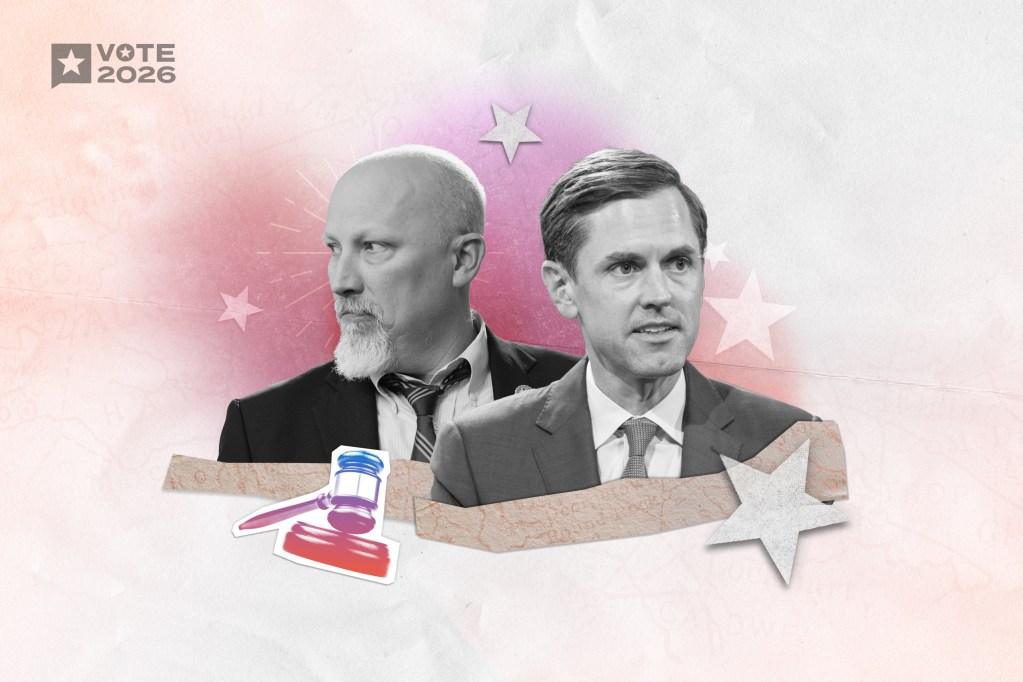
As no Republican candidate garnered more than 50% of the votes in the March primaries, state Senator Mayes Middleton from Galveston and U.S. Representative Chip Roy from Austin are set to compete once more in the primary runoffs on May 26. The victor will face the Democratic nominee in November, aiming to uphold the Republican Party’s three-decade winning streak in statewide elections.
The individual elected to this role will be tasked with defending state agencies and laws in court, issuing legal opinions, conducting investigations, and filing lawsuits to safeguard Texas residents. Their responsibilities will encompass legal matters that directly affect the lives of everyday Texans, including enforcing child support judgments, curbing waste and fraud in government programs, and investigating deceptive charities, unscrupulous businesses, and fraudulent billing practices.
Middleton and Roy outperformed state Senator Joan Huffman of Houston and Aaron Reitz, a former aide to Paxton and high-ranking official at the U.S. Department of Justice, during the crowded March primary. Both candidates have vowed to leverage the attorney general’s office to challenge longstanding Supreme Court precedents, particularly regarding public school access for undocumented students.
Roy, recognized for his willingness to criticize leaders within his own party, presents himself as a conservative candidate dedicated primarily to Texas, accompanied by experience from the attorney general’s office. In contrast, Middleton positions himself as a fervent supporter of former President Donald Trump, a stance that sets him apart from Roy, who controversially voted to certify the 2020 election results that confirmed Joe Biden’s victory—an action that has alienated some Trump loyalists.
The next attorney general will have the authority to set the agency’s priorities. To aid primary voters in distinguishing between the Republican contenders, both candidates were invited to express their views on critical issues facing the office ahead of the March primary. Their responses reveal notable differences.
It is significant to note that Middleton opted not to participate in this inquiry. In light of his absence, reporters analyzed his prior public statements and legislative record to offer voters insight into his perspectives.
Candidate Profiles
Mayes Middleton
State Senator, Galveston
Campaign finance (July 1, 2025 – Feb. 21, 2026):
Total raised: $14,780,863
Total spent: $15,195,247
Cash on hand: $28,328
Major donors this cycle:
Self-funded with over $13 million
William Oberndorf, California billionaire supportive of school vouchers
Will Hardeman, Austin car dealership owner
Monty Bennett, Dallas area businessman
Experience:
State senator since 2023, representing Galveston and nearby areas
State representative from 2019 to 2023
President, Middleton Oil Company, a family business
Graduate of the University of Texas School of Law
Authored the anti-trans “bathroom bill” passed by the Texas Legislature in 2025
Endorsements:
Aaron Reitz, former Trump DOJ official and primary candidate
Texas Eagle Forum
The True Texas Project
Conservative Republicans of Texas
Numerous Republican state legislators
Chip Roy
U.S. Representative, Central Texas
Campaign finance (Aug. 21, 2025 – Feb. 21, 2026):
Total raised: $5,127,045
Total spent: $4,900,986
Cash on hand: $1,207,789
Major donors this cycle:
Chip Roy for Congress (transferred $2.1 million from his federal account)
Douglas Scharbauer, Midland oil investor
Alex Fairly, Amarillo businessman
Mickey Dunn, Fredericksburg businessman
Experience:
Four-term congressman representing Central Texas
Former chief of staff to Senator Ted Cruz
First assistant attorney general under Paxton
Senior advisor to Governor Rick Perry (2011-2012) and ghostwriter of his book, “Fed Up!”
Authored the SAVE Act requiring proof of citizenship, passed by the U.S. House in 2025
Endorsements:
Senator Ted Cruz and several U.S. representatives
Former U.S. representatives Matt Gaetz and Mark Meadows
Key Issues
In response to a question regarding the responsibility of the attorney general’s office to defend state agencies in lawsuits, Chip Roy stated that while the office must employ top in-house legal talent, it sometimes necessitates the use of outside counsel to achieve effective litigation outcomes. Mayes Middleton did not provide a response.
On the subject of utilizing outside counsel for litigation against major corporations and tech companies, Roy expressed that such a practice is appropriate and would continue under his leadership. Middleton did not answer this question either.
Regarding the open records law, Roy asserted that Texans have a right to government transparency and pledged to enhance the Open Records Division’s efficiency. Middleton has previously filed legislation to broaden access to public records, emphasizing its importance in combating waste and fraud, though he did not directly address Paxton’s management of this law.
When asked about the legitimacy of the 2020 election and the potential for similar lawsuits as those filed by Paxton, Roy claimed that the election faced significant fraud issues and that he disagreed with the previous litigation strategy. Middleton has previously claimed the election was “stolen” from Trump but did not respond to this question.
Both candidates were also questioned about whether Texas laws should be enforceable in other states, with Roy firmly advocating for enforcement, while Middleton did not provide a comment.
The candidates also discussed the attorney general’s role in prosecuting election crimes. Roy emphasized this as a core function of the office, while Middleton has expressed a commitment to establishing an election integrity division aimed at investigating voter fraud.
Finally, on the question of expanding independent prosecutorial authority for the attorney general’s office, Roy supported the idea, while Middleton called for the removal of district attorneys who fail to prosecute certain crimes.