







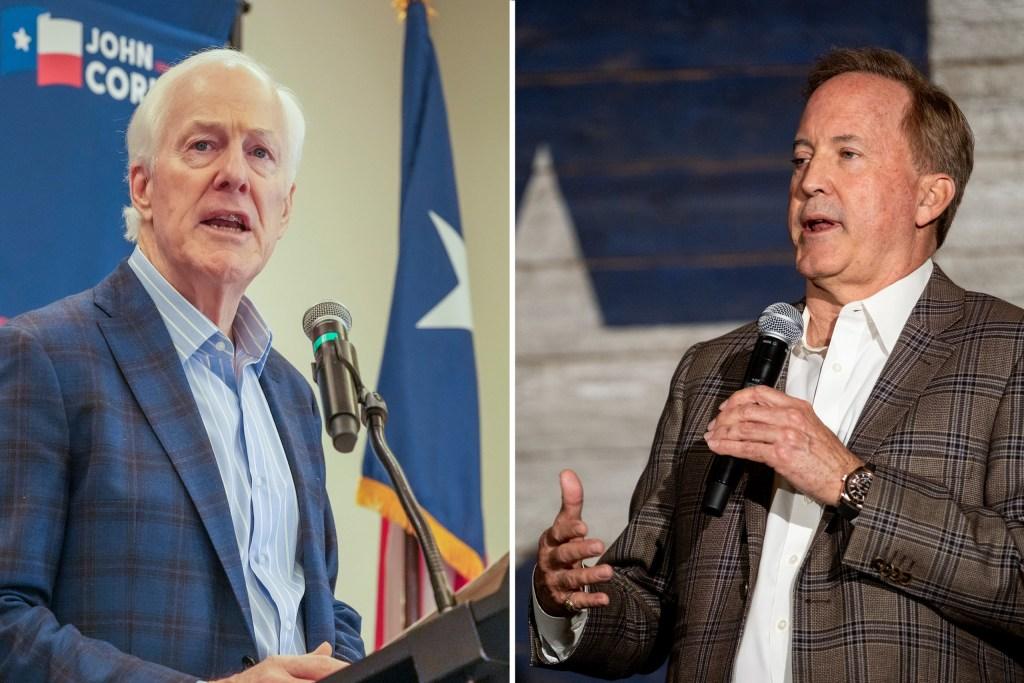
In 1996, Ross Perot Jr. made headlines by acquiring a controlling interest in the Dallas Mavericks for $125 million. Fast forward to today, and the competitive Republican Senate primaries in Texas are shaping up to be almost as costly.
The high-stakes battle between Senator John Cornyn and Attorney General Ken Paxton has attracted a historic level of financial backers, with over $120 million allocated for advertising throughout the two rounds of the primary, including $21 million during the runoff, as reported by media tracking firm AdImpact. A coalition of campaigns, political action committees (PACs), and dark money organizations has been actively campaigning for nearly a year to secure a victory for their chosen candidate.
Set to culminate in a runoff election on May 26, the Cornyn-Paxton race has been characterized not only by fierce personal attacks between the candidates but also by astonishing financial expenditures that have made the animosity visible to the electorate through a barrage of negative advertisements. Prior to the runoff, the contest had already established itself as the most expensive primary in U.S. history.
The financial support for both candidates has come from a diverse array of donors, including Wall Street billionaires, Texas business leaders, political insiders, and grassroots contributors. This collective funding has allowed both candidates, particularly Cornyn, to flood Texas media channels—television, social media, radio, and mailboxes—with ads that both promote their campaign and disparage their opponent.
With a well-established network of donors and connections in both Texas and Washington, Cornyn has been able to maintain a significant financial advantage over Paxton. Last summer, groups supporting Cornyn invested heavily to reintroduce him to voters, highlighting his 99% voting alignment with former President Donald Trump and endorsements from law enforcement agencies.
The primary has also seen an influx of dark money—funds from tax-exempt organizations that are not obligated to disclose their donors. Even some PACs, while required to report their funding sources, have been heavily financed by these dark money groups, leaving the origins of millions of dollars in campaign spending untraceable.
As the runoff approaches, spending has intensified, with Cornyn’s faction continuing to outpace Paxton’s campaign in terms of financial outlay. Both sides have ramped up their negative advertising efforts against each other.
The Texas Tribune has meticulously detailed the connections between external groups and key donors fueling both campaigns in their quest for electoral success. The primary fundraising and expenditure figures are derived from Federal Election Commission records, which primarily reflect activities through May 6. To provide a real-time perspective on spending, including upcoming ad reservations, data from AdImpact, a political spending tracker, has been incorporated.
Campaign Finance Overview
Pro-Cornyn Groups
Campaign Finance:
- Amount raised this cycle (FEC records): $26.5M
- Amount spent this cycle (FEC records): $23.4M
- Total ad spending (AdImpact): $24.1M
- Runoff-only ad spending (AdImpact): $6.4M
The majority of Cornyn’s financial expenditures are sourced from his joint fundraising committees, leveraging new regulations that permit these committees to purchase advertising at discounted rates typically reserved for candidates. Through three different vehicles—his main campaign account and two joint committees that collaborate with groups like the National Republican Senatorial Committee—he has significantly outpaced Paxton in fundraising.
Contributors are limited to a maximum of $3,500 per election, per candidate, leading to many donors reaching this cap. Among the notable contributors are:
- Former President George W. Bush
- Media mogul Rupert Murdoch
- Ross Jr. and Sarah Perot
Texans for a Conservative Majority Super PAC
Campaign Finance:
- Raised (FEC): $35.6M
- Spent (FEC): $32.8M
- Ad spending (AdImpact): $32.9M
- Runoff-only ad spending (AdImpact): $9.5M
This pro-Cornyn super PAC has emerged as the largest spender in the Republican primary this election cycle, closely associated with Trump’s inner circle. It has made substantial ad buys targeting Paxton over ethical concerns and his performance as attorney general.
Among the top contributors to this PAC are:
- Ohio Works, Inc. + America Works Fund, Inc.: $8.6M
- John Nau III: $7.9M
- Stephen Schwarzman: $1.5M
The Pro-Paxton Groups
Campaign Finance:
- Raised (FEC): $8.1M
- Spent (FEC): $5.3M
- Ad spending (AdImpact): $4.8M
- Runoff-only ad spending (AdImpact): $2.5M
Paxton’s campaign has struggled to reach its fundraising goals, indicating the challenges he faces in transitioning from state elections, where there are no contribution limits, to federal contests with strict regulations.
Notable donors supporting Paxton include:
- Michael Rydin
- Darwin and Doug Deason
- Phillip Huffines
As the runoff draws nearer, the financial landscape continues to evolve, with both candidates seeking to solidify their positions through strategic spending and targeted advertising.