









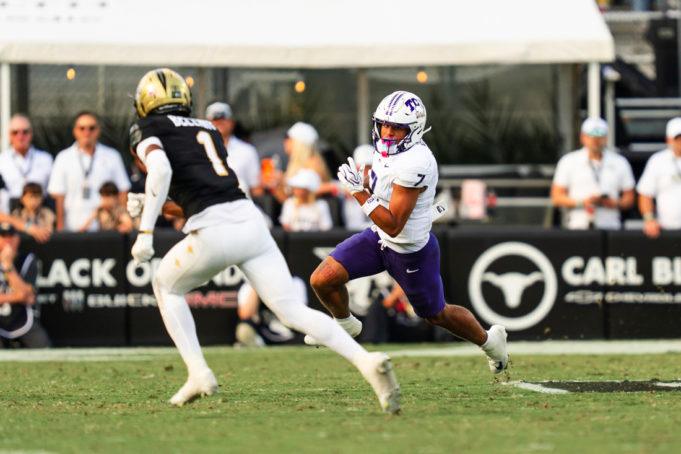
TCU’s inaugural matchup in the Big 12 at Disney World has raised several concerns for fans and analysts alike.
Although I was not present for Saturday’s game against Central Florida, the Frogs’ defeat has prompted serious doubts about their performance this season. Fans in Fort Worth are grappling with limited data from just two games. While the early matchups against Grambling and Arkansas State may seem inconsequential, even TCU’s win over Arkansas State raised eyebrows due to their difficulty in dominating a Sun Belt opponent. Thus far, the Frogs have managed only two touchdowns in two games against unranked power-conference teams, a statistic that leaves little room for optimism.
Graduate transfer quarterback Jaden Craig, heralded as a potential star akin to Ryan Fitzpatrick, may have been overhyped by coaching staff and scouts. He does possess a commendable throwing motion and the ability to deliver deep passes, but there are significant gaps in his game.
Craig’s pocket presence has been underwhelming, as he struggles to maneuver under pressure, often appearing slow and uneasy. His short and mid-range throws lack touch, resulting in an alarming number of dropped passes—currently the highest in the conference. While this is not solely his fault, the synergy between quarterback and receivers is evidently lacking.
Moreover, Craig has not demonstrated the ability to run effectively, neither as a designated runner nor as a scrambler. This limitation places added strain on the rushing game, allowing defenses to capitalize on his predictability. Since Max Duggan’s departure, the Frogs have missed a quarterback capable of executing effective read-options, a gap that is becoming increasingly apparent.
Craig’s progression has also been a concern; he often focuses on check-down options without quickly identifying multiple targets. Most alarmingly, his ball security has been questionable. Despite the narrative that he protects the ball well, Craig has yet to throw a touchdown against competitive teams and has recorded three turnovers along with seven sacks. His performance against North Carolina and UCF has been starkly disappointing, resembling a tragic tale from Shakespeare.
While it may be premature to write off head coach Gordon Sammis, his second-half adjustments have been lacking. UCF exploited weaknesses in the Frogs’ offensive strategy by neutralizing the outside zone run and forcing them into less favorable plays. The significant drop in rushing yardage, from over 150 against UNC to around 50 against UCF, highlights the team’s struggles. Effective counter-strategies are missing, and the team appears ill-prepared to adapt.
The recent return of wide receiver Jordan Dwyer, who played his first game of the season, injected some life into TCU’s offense. Dwyer made five receptions for 100 yards, including a stunning 43-yard catch. However, his injury concerns continue to loom over his contributions.
Critics have pointed fingers at TCU’s offensive line for their struggles in both run blocking and pass protection. While the line has its shortcomings, they have shown proficiency within the scheme. The team’s inability to establish a mid-range passing game has compounded the issue, as defenses become increasingly aggressive. Craig’s struggles to evade pressure have left the offense stagnant when plays break down.
Defensively, Andy Avalos’ unit has shown flashes of opportunism and pressure generation but has faltered in mid-range and zone pass coverage. Notably, UCF’s quarterback, Keyone Jenkins, who had struggled in the previous week, completed an impressive 19 out of 20 passes against the Frogs. This trend underscores the need for TCU to bolster their defensive strategy.
Despite not conceding a plethora of points, TCU has been unable to execute a successful offensive plan. The Frogs failed to score in the fourth quarter against both of their previous power-conference opponents, managing to find the end zone only in the first quarter of each game, which is simply unacceptable.
To gauge the level of concern surrounding the team, one might liken the situation to the U.S. military’s DEFCON readiness system. For TCU, the ideal threat level might be DEFCON 3—serious but not catastrophic. Coach Dykes must present a significantly improved team on the field, as the Frogs have shown themselves unprepared, undisciplined, and lacking in adjustments.
TCU will face BYU next, the current top-ranked team in the Big 12, who have proven themselves formidable in the rushing game. The Frogs will need to improve their offensive output, aiming for at least three touchdowns to secure a home victory. Given their current form, the challenge ahead is daunting.