






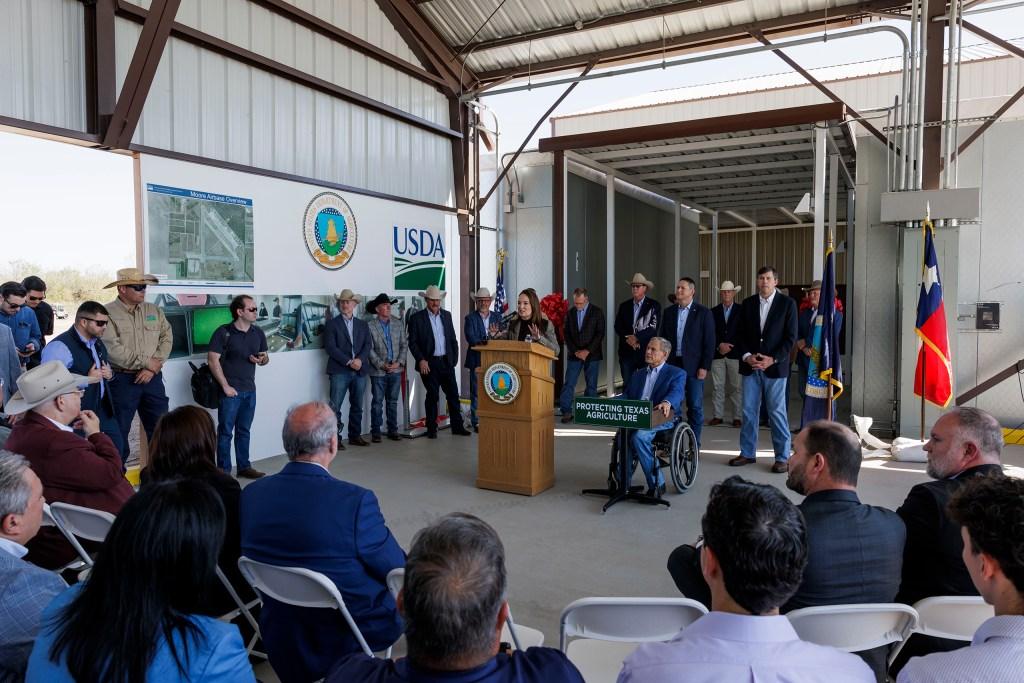
EDINBURG — U.S. Agriculture Secretary Brooke Rollins announced on Monday that both the United States and Texas are well-equipped to tackle a parasitic fly that threatens to inflict significant economic damage on the state’s agricultural sector. During a visit to the Rio Grande Valley alongside Governor Greg Abbott, Rollins emphasized the proactive measures implemented by the USDA and local response teams, which are aimed at eradicating the New World Screwworm, a fly known for laying eggs in open wounds, thereby endangering livestock.
Texas, the nation’s leading cattle producer, faces an extraordinary risk from the screwworm, prompting ranchers and agricultural advocates to raise concerns for over a year. The presence of screwworm has already been identified in Mexico, with cases reported as close as 70 miles from the Texas border in Nuevo Leon.
“I don’t want to underplay it because it is a big threat to our country, but I believe we’re as prepared as we could possibly be to deal with it and move toward eradication,” Rollins stated.
During the visit, Rollins and Abbott inaugurated a sterile fly dispersal facility at Moore Air Base in Edinburg, which is central to the strategy for combating the screwworm. The facility will produce sterile male flies that will mate with female screwworms, resulting in the laying of unfertilized eggs.
This week, sterile flies will be released in Northern Mexico and within 50 miles of the Texas-Mexico border as a precautionary measure. Rollins highlighted last year’s decision to close all southern ports of entry to livestock, a move that countered predictions of screwworm crossing into the U.S. last fall. The federal government has allocated $100 million for research, traps, treatment measures, and the establishment of the sterile fly dispersal facility, alongside increased border surveillance involving mounted patrols, referred to as tick riders.
In addition to these measures, officials are utilizing cameras equipped with artificial intelligence technology to identify screwworms. At the state level, Governor Abbott has directed the Texas Parks and Wildlife Department and the Texas Animal Health Commission to create a specialized response team for screwworm management. Recently, Abbott issued a disaster declaration, enabling the team to access all necessary state resources for prevention and response efforts.
Through a collaborative effort between state and federal authorities, plans are underway to develop a sterile fly production facility, complementing the existing facility in Panama. Larvae produced in Panama will be transported to the Edinburg facility, where they will mature and be released upon hatching. However, the USDA intends to establish its own production facility by the end of 2027, with an investment of $750 million expected to coincide with the existing dispersal facility at Moore Air Base.
“If it does cross our border, we are ready,” Rollins asserted. “We know the enemy, we know how to manage it, we know how to solve for it, and we will do everything we can to protect our country.”