








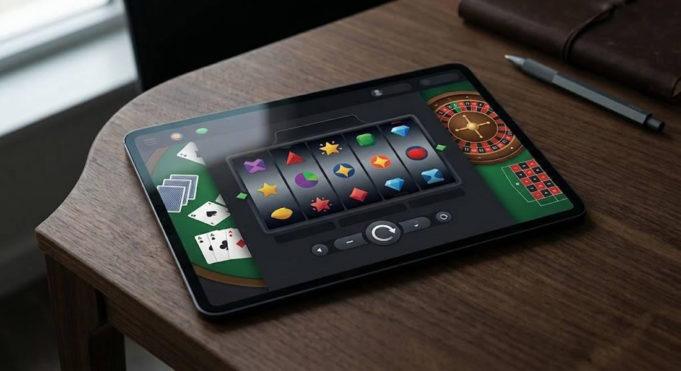
Online casinos are adept at creating distinct experiences for their various games, despite the limitations of a shared screen. Each game, whether it involves slots, cards, or wheels, possesses unique rules, parameters, and visual identities, akin to how a film or TV series is divided into episodes. The challenge lies in effectively separating these games within the confines of a digital display, requiring innovative design solutions that consider elements such as hierarchy, spatial relationships, and movement.
Designers of online gambling games must skillfully compress multiple experiences into a narrow video frame. This involves creatively fitting a rectangular poker table alongside a roulette wheel and a multitude of flashing icons. The ingenuity of digital designers shines through as they navigate the specific constraints of online gaming, showcasing their creative capabilities.
The design of a game extends beyond its individual elements; it encompasses the overall lobby experience as well. For instance, Betinia New Jersey incorporates various design signals into its lobby, enhancing user engagement. The animated design of their slot games contrasts with the calm, structured layout found in blackjack. Roulette, with its cool blue-green color scheme, offers a serene visual tone, allowing players to discern their preferred game based on the lobby’s design.
Many design choices are intentional, aiming to communicate the nature of the game to the player. Kinetic designs for slots contrast with the more methodical presentation of wheel games, while lobby designs categorize and group games based on their core mechanics, ensuring an intuitive user experience.
Designing Slots
While it may seem simplistic to consider a digital slot machine as merely a rectangle within another rectangle, this perspective provides a useful framework for discussing design. The digital display serves as the outer boundary, while the symbol grid forms the inner edge. The arrangement within this frame is determined by careful design choices. Typically, slot games adhere to an industry standard of five vertical columns and three horizontal rows of symbols, though variations exist, ranging from single columns to more complex configurations.
Most slot games feature between nine and twelve unique symbols. Low-paying symbols often include card ranks like Aces, Kings, and Queens, while themed illustrations represent mid- and high-paying symbols. The Wild symbol stands apart from the standard pay symbols, substituting for others, while the Scatter symbolizes the game’s bonus feature, designed to be easily recognizable.
Motion plays a critical role in storytelling within slot games. Techniques like Cascading Reels, also referred to as Tumbling or Avalanche Reels, enhance the gaming experience. A brief pause after a win allows players to absorb the outcome, while accompanying sound effects align with the win animation, creating a cohesive sense of pace.
The Table That Fits in Your Hand
Card games, such as poker and blackjack, share a common reference point in their table structure, featuring a felt surface that facilitates player interaction. This shared spatial concept fosters a sense of familiarity, despite differing rules. In blackjack, the screen mirrors the physical table layout, with the dealer’s area at the top and the player’s area at the bottom, clearly indicating turn structure and options like hitting or standing.
In poker, the design expands to encompass information relevant to all players in the center of the screen, while individual player details and controls occupy the bottom section. This organization facilitates interaction while maintaining a familiar spatial relationship.
Baccarat diverges from blackjack by having players bet on the outcome of two hands rather than playing individual hands. The interface reflects this difference, requiring players to choose which of the two dealt hands to wager on, with consistent representation of cards across all formats.
Roulette’s Unique Challenges
Roulette presents design challenges akin to blackjack but adds complexity due to its circular wheel. The user interface must accurately represent the wheel’s relationship to the betting surface, which is laid out in a rectangular grid. Ensuring the wheel is sufficiently large for visibility while providing an adequately spacious betting area is essential for user interaction.
The standard approach involves a split-screen design, where the wheel occupies one section and the betting area another. On mobile devices, the wheel’s size is crucial for conveying momentum, while the betting area must be sufficiently large for precise chip placement. Some interfaces allow users to toggle between enlarged views of the wheel and betting area for improved usability.
The racetrack feature offers an alternative navigation option for placing bets, displaying bets in a curved format that resembles the wheel. Selecting a section of the racetrack corresponds to placing chips in the relevant wheel pockets, creating a dynamic interaction model between different betting logic systems.
Design Tools Used Throughout The Gambling Industry
Despite their differences, slots, card games, and roulette share fundamental game design tools, including spacing, movement, hierarchy, and control architecture. While the application of these tools varies across formats, their presence is consistent throughout.
Hierarchy is a defining element of game design, dictating the focal points of player attention. In slots, the primary focus is on the spinning reels, while blackjack emphasizes the two hands and action buttons. In roulette, the design hierarchy centers around the wheel and the betting layout.
Spacing also plays a vital role in design. In blackjack, the distance between the dealer and player indicates turn order, whereas in slots, the space separating the reels from the control panel delineates the game’s visual spectacle from user input. In roulette, the spacing of numbers on the betting layout is critical for accurate bet placement.
Movement serves as a key differentiator among games. Slot games are characterized by constant motion, while blackjack and roulette exhibit less frequent movement tied to player actions. The pace of movement can evoke varying emotions, impacting the overall gaming experience.
How Different the Controls Can Be and How Important They Are
Control schemes vary significantly across different game formats. In slots, players primarily adjust bet size and spin, while blackjack features a more complex branching decision tree. Roulette, too, demands careful spatial reasoning as players place bets within a grid, necessitating unique control layouts and button designs tailored to each game.
Despite the constraints of a rectangular play area, each game cultivates its distinct style and symbolism within this framework. If games were to step outside this rectangular boundary, designers could leverage the shape for additional meaning. However, the current design must rely on other differentiation methods such as symbolism, animation, controls, layout, and overall style.
This focus results in a streamlined game design aimed at immediate visual identification. If a game fails to establish its identity quickly, players may lose interest. Slot games capitalize on dynamic motion, while card games emphasize the authority of the table, and roulette relies on the wheel and betting layout for distinction. The game board effectively compartmentalizes components, ensuring a straightforward and intuitive interface.
While casino games represent a niche segment of digital entertainment, they offer valuable insights into user interface design and the constraints faced by designers. With limited space to convey information, every design decision must be clear and self-explanatory, making efficient use of every available pixel.