







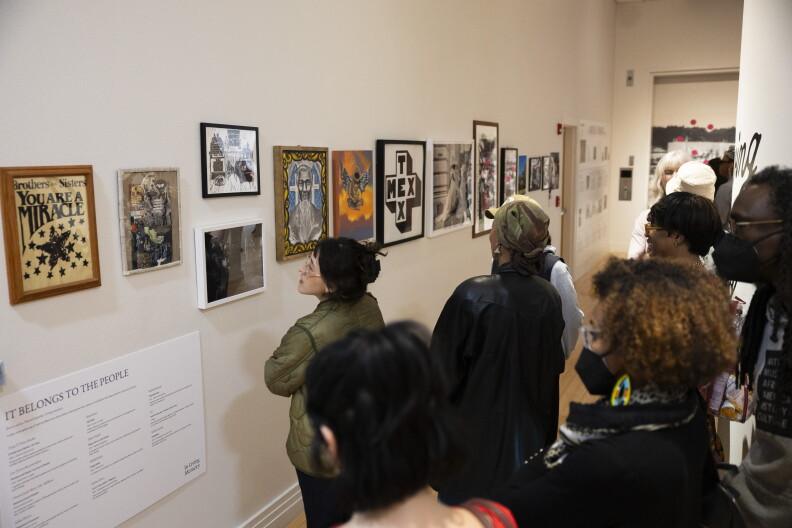
The “In Living Memory” exhibit at the George Washington Carver Museum in East Austin has opened, showcasing the rich narratives of the community through art. Spearheaded by Austin archivist Reneiss Ilisha Garcia, the exhibit is a celebration of the stories of residents’ ancestors, collected over the summer and woven into a unique art installation.
Garcia’s centerpiece, titled “Threaded Memories, a Collective Heirloom,” features a quilt made from recycled paper, with each square showcasing a different collage created by community members. The installation is designed to evoke the warmth of a living room, complete with a rotary phone for recording personal stories and a CD player for visitors to listen to these narratives.
“I aimed to create a space reminiscent of a grandmother’s home,” Garcia explains, reflecting on her own experiences with family memories. She recalls a hallway in her grandmother’s house filled with family photographs, which she considers her first introduction to archiving.
Garcia is among ten artists featured in the exhibit, which seeks to amplify the voices of Black and Hispanic artists and alter perceptions of the city’s identity.
The exhibit includes two films by Faiza Kracheni, who presents a deeply personal reflection through her work. Her first film, “Everything I Loved Was Already Changing,” utilizes experimental footage to document her childhood neighborhood in East Austin, which has been significantly impacted by gentrification. “It’s a solitary return to my old neighborhood that has been completely ravaged,” she shares, discussing her emotional journey through familiar streets.
Kracheni’s family had lived in their East Austin home since the 1930s, until they were forced to sell it in 2013 due to rising costs. Her second film, “If I Die,” takes a more structured approach, reflecting on her battle with stage 3B ovarian cancer. “It’s a reflection on my diagnosis and the treatment I’ve been undergoing,” she explains, noting the profound impact her work has had on viewers.
Laura Vargas Ortiz, an emergency medicine resident who attended the exhibit’s opening, connected emotionally with Kracheni’s work. “It’s refreshing, sad, and powerful to read these stories, reminding me that even an ordinary day for me might be someone else’s worst,” Ortiz reflects.
The artist collective ECHOES ATX orchestrated the “In Living Memory” exhibit with the aim of highlighting the significance of art within Austin’s Black and Hispanic communities. Funded by a grant from the city’s Arts, Culture, Music and Entertainment division, the exhibit showcases a diverse array of artistic expressions.
Shania Montúfar, the head curator, selected the ten featured artists, emphasizing their collective representation of Black and Hispanic histories in Austin. “These artists truly embody the essence of the prompt, connecting past and present experiences,” she states.
The mediums showcased in the exhibit are diverse, ranging from painting and photography to mixed media. Via Madison Ceaser, for instance, incorporates elements like chicken wire and braids in her work, reflecting on her relationship with her hair as a symbol of identity. “My hair has evolved alongside my personal growth,” she notes, paralleling her experiences with the changing dynamics of Austin.
Photographer Larry Choyce aims to capture the resilience of East Austin through his piece, “What the City Couldn’t Take.” His eight black-and-white photographs depict moments of community life, including one that portrays a group gathered in their front yard, asserting their presence in a rapidly changing neighborhood. “I love that they were open to being seen, reminding us that they are part of this space,” Choyce remarks.
For many of the artists, this exhibit marks their first opportunity to display their work in a museum setting. Montúfar believes it is essential to foster discussions about representation and visibility within the arts. “It’s worth considering who receives funding and recognition in the art world. When you think of Austin, who gets to define its narrative?” she questions.
The “In Living Memory” exhibit will be on display at the George Washington Carver Museum until January 9, inviting visitors to engage with the evolving stories of the community.