








Subscribe to The Brief, the daily newsletter from The Texas Tribune that keeps you informed on the most important news in Texas.
To enhance accessibility, audio recordings are automated. The content has been crafted by humans, with adherence to our AI policy. We welcome your feedback.
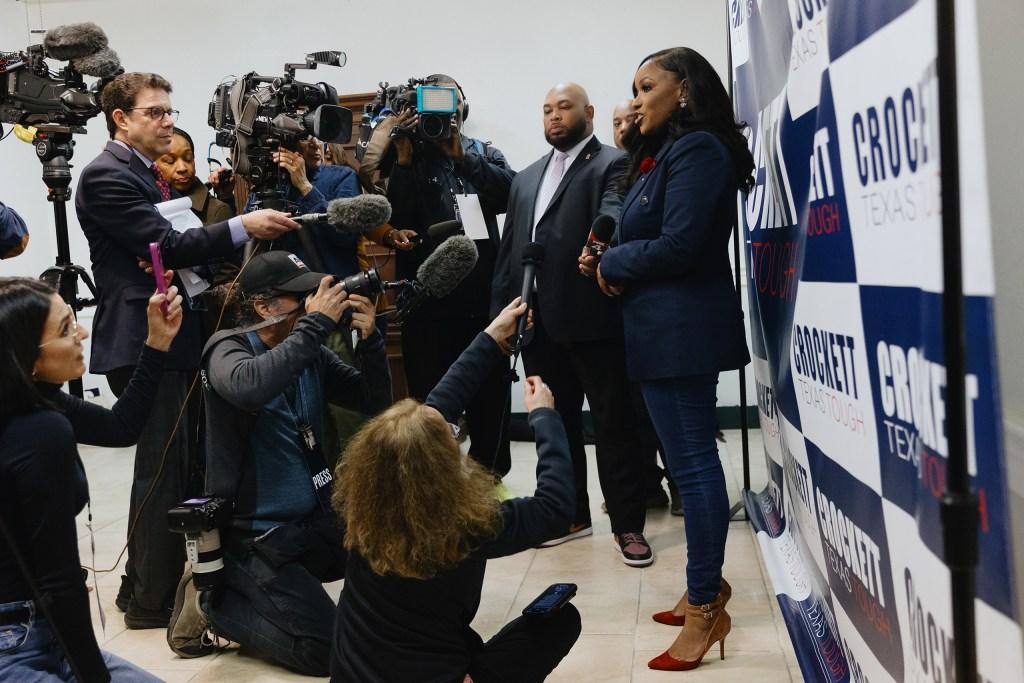
This week, U.S. Representative Jasmine Crockett’s announcement to run for the Senate elicited mixed reactions, depending on who you asked.
Some political analysts and insiders viewed the Dallas Democrat’s candidacy as a potential setback for her party, jeopardizing their chances of securing a statewide victory for the first time in over thirty years. Conversely, others see her as a dynamic advocate and effective communicator whose strategy to engage underrepresented voters is worth pursuing in a state where Democrats have historically struggled.
In conversations with more than a dozen Texas Democratic strategists, opinions varied regarding Crockett’s strengths and weaknesses and their implications for a general election. She believes her ability to engage with infrequent voters could help her overcome any Republican opponent emerging from the GOP Senate primary. Supporters argue that her authentic communication style and established reputation for confronting Republicans could be instrumental in achieving this goal.
However, others argue that she must also appeal to voters who supported former President Donald Trump, particularly in a state where he won by nearly 14 percentage points last November. Some critics contend that high Democratic turnout alone may not be sufficient to close this gap and that Crockett’s polarizing image could hinder her efforts.
Crockett, currently in her second term in Congress, has built a reputation that inspires both passionate support and significant criticism. On the final day for candidates to file for the 2026 ballot, she officially entered the U.S. Senate primary, setting the stage for a prominent contest on March 3 against state Representative James Talarico, an Austin Democrat and progressive who is also a social media savvy candidate with a robust fundraising network.
The stakes extend beyond the U.S. Senate race; they encompass competitive positions further down the ballot for the U.S. House and the state Legislature. Despite the aftermath of a series of significant defeats last year, 2026 presents the first midterm with Trump back in the White House since 2018, a year that saw Beto O’Rourke’s narrow loss in the Senate race catalyze a surge of down-ballot victories for Democrats.
With her fiery demeanor and sharp wit, Crockett is already a familiar face to the Democratic base in Texas and beyond. As the party struggles with unscripted interactions and establishing an authentic digital presence, Crockett stands out as a compelling communicator, often appearing on cable news and participating in in-depth interviews. Party operatives agree she has the potential to be an effective fundraiser and a strong contender in the primary. Supporters believe her name recognition, even reaching the White House, is a significant asset.
“Jasmine Crockett is the most talked-about member of Congress, in either chamber,” declared Harris County Commissioner Rodney Ellis during Crockett’s campaign launch. “And why is that? Because she is not afraid to speak her mind. She will broaden our base. She’s an excellent communicator, and she has proven her ability to raise funds.”
Nevertheless, critics caution that while Crockett may energize disengaged Democrats, she could simultaneously motivate independents and Republicans to oppose her—a risky scenario in a predominantly red state. Concerns have been raised that 2026—a midterm year for Trump, coupled with a fiercely contested Republican primary that may leave the eventual nominee weakened—presents too favorable an opportunity to deploy a candidate known for her confrontational style against the state’s dominant party.
Nancy Zdunkewicz, a Democratic pollster based in Austin and not affiliated with either campaign, expressed concern about Crockett’s recognition among Republican voters, many of whom may harbor negative sentiments towards her. She emphasized that a successful candidate must energize the base, persuade swing voters, and dishearten Republicans. On the latter point, she fears that Crockett may do the opposite.
“In a year where we anticipate increased Democratic turnout and enthusiasm in response to the current administration, are we inadvertently providing Republicans with motivation to show up when they might have stayed home?” Zdunkewicz asked.
Monique Alcala, a former executive director of the Texas Democratic Party, echoed concerns about Crockett’s electability and her ability to mobilize or convert enough occasional voters necessary for a statewide victory. Alcala expressed doubts that Crockett’s approach and her limited record of legislative accomplishments would resonate with those populations.
“I don’t believe they are looking for someone who is simply a firebrand,” Alcala stated. “They want someone who can deliver results. And I worry that Crockett hasn’t prioritized that in her Congressional career.”
Crockett has asserted that she is running because she believes she can indeed turn out infrequent voters and broaden the electorate. She claims her internal polling supports this belief and has maintained for several weeks that she would only pursue a statewide campaign if the data indicated a viable path to victory; however, she has not disclosed any of those figures publicly. Her campaign is advocating for a high-turnout election, convinced it would work in her favor.
In a recent CNN interview, when questioned about her strategy to appeal to Trump supporters, Crockett stated that her focus would be on affordability, adding, “I don’t necessarily expect to convert all of Trump’s supporters. That’s not our goal.”
Republicans have openly expressed their preference for facing Crockett over Talarico, linking her candidacy to vulnerable down-ballot Democrats in competitive races. Senator John Cornyn, a Texas Republican who would likely face Crockett in November if he overcomes his primary challenge, referred to her campaign as a “gift.” One Republican operative remarked that the sentiment within the GOP felt akin to “Christmas morning.”
Crockett’s past comments regarding critical voter demographics in Texas are likely to be highlighted in Republican advertisements, including her characterization of some Latino voters’ anti-immigration sentiments as indicative of a “slave mentality” during a Vanity Fair interview last year. Additionally, she has previously labeled the right as a “violent group” that attracts “violent actors.”
Despite the skepticism, Crockett remains resolute.
“We are accustomed to being told what we cannot achieve,” she declared during her campaign kickoff event. “But they have no idea what my team can accomplish. So let me make it clear to all the naysayers: We’re going to make this happen.”
Balancing turnout and persuasion is crucial.
The history of failed statewide Democratic candidates in Texas over the last three decades encompasses a diverse range of profiles—moderates, progressives, significant fundraisers, national figures, military and law enforcement veterans, unconventional celebrities, lawyers, business owners, and individuals from various racial and ethnic backgrounds.
None have succeeded.
Many operatives assert that a successful statewide campaign in Texas necessitates a dual approach: maximizing Democratic voter turnout—including infrequent voters—and persuading swing voters. Some believe Crockett can accomplish both; others concede she might boost turnout but struggle to appeal to independents and Trump supporters.
Katherine Fischer, director of the Democratic-aligned Texas Majority PAC, expressed her belief that Crockett could indeed motivate infrequent voters to cast their ballots. However, she cautioned that achieving this goal would be a significant challenge that could only succeed if the candidate also gains the trust of swing voters.
<p“I have confidence that she will motivate Democrats to turn out and vote,” Fischer remarked. “But will she possess the persuasive skills needed? That remains to be seen.”
Rebecca Marques, a seasoned player in Texas Democratic politics who previously worked on O’Rourke’s gubernatorial campaign, expressed her faith in Crockett’s ability to resonate with infrequent Democratic voters and swing voters, many of whom are younger, Latino, or Asian. She noted that Crockett’s approach is reminiscent of both O’Rourke and, paradoxically, Trump.
“I genuinely believe her arguments and communication style resonate more closely with those voters,” Marques stated. “She seems better equipped to connect with the unlikely voter base and swing voters we hope to attract—Latinos, Asians, and possibly economically disadvantaged young white individuals—who don’t align ideologically with one camp or another and are primarily concerned about their financial stability.”
Marques also suggested that Crockett would not uniquely galvanize Republican turnout if she secures the nomination, as the right is already energized by their contentious primary and the potential candidacy of Attorney General Ken Paxton—a GOP firebrand popular among the base—who aims to challenge Cornyn in March.
Some strategists have dismissed Crockett’s chances entirely, noting that she did not require cross-party appeal to win in her strongly Democratic districts in the Texas House and Congress. In contrast, Talarico flipped a state House seat in 2018 before transitioning to a safer blue seat in Austin for the 2022 cycle after redistricting altered the boundaries in favor of Republicans.