








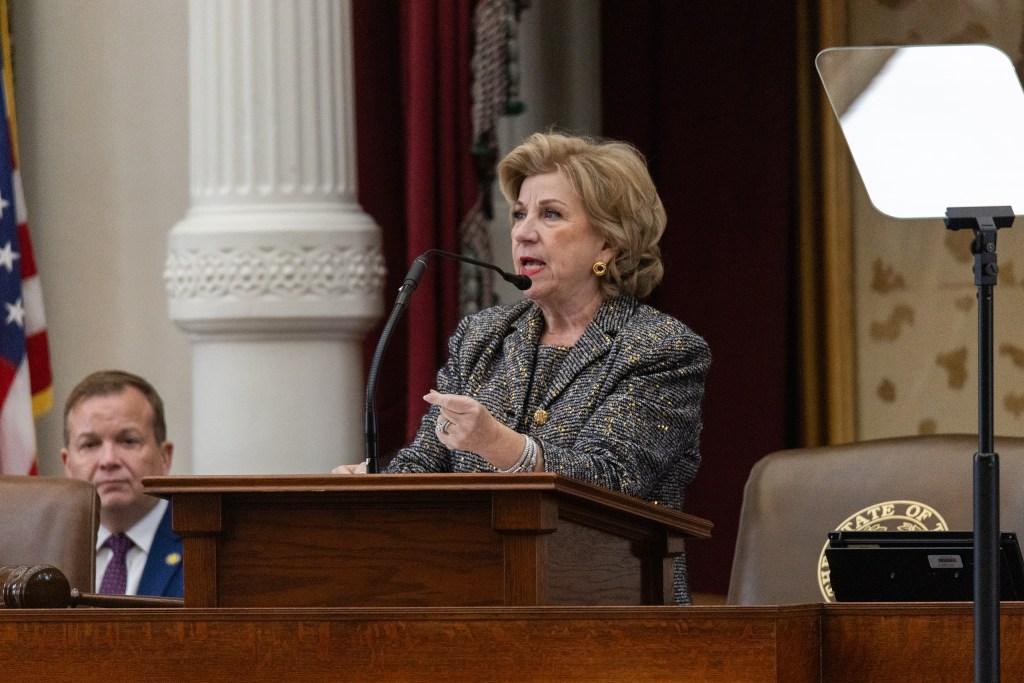
Texas Secretary of State Jane Nelson announced her resignation on Tuesday, effective July 17, marking the end of her tenure as the state’s chief election official after three and a half years.
In a press release, Nelson expressed her commitment to ensuring that voting in Texas remains secure, accessible, and fair. “We have worked extensively to ensure accurate voter rolls and to educate voters about what they need to know to vote with confidence,” she stated.
The announcement did not clarify the reasons behind Nelson’s resignation, and her office has not responded to inquiries for further information.
Under state law, Governor Greg Abbott is required to nominate a successor promptly. However, it remains uncertain how soon he will act or whom he may consider for the position.
Abbott’s office did not provide immediate comments, but he praised Nelson in the release, describing her as “a true champion for the people of Texas and an extraordinary Secretary of State.” He expressed gratitude for her dedicated service and leadership.
Nelson, a Republican, previously served for three decades in the Texas Senate before taking on the role of Secretary of State in 2023. She holds the distinction of being the longest-serving Republican woman in Senate history and was the first woman to lead the Senate Finance Committee, responsible for crafting the state budget.
Additionally, she was the first Secretary of State since 2017 to receive confirmation from the Senate, as her three immediate predecessors resigned without undergoing a full confirmation vote.
During her tenure, Nelson oversaw seven successful statewide elections, with a total of 27 million ballots cast, and facilitated the distribution of millions of dollars in grants to local counties.
Her office complied with a request from the U.S. Department of Justice to provide access to the state’s complete voter roll, making Texas one of 15 states to do so. This data release included personal information of the state’s 18 million registered voters, which drew criticism from election security experts and voting rights advocates, who expressed concerns over voter privacy violations.
Last year, Nelson’s office began utilizing a federal database known as the Systematic Alien Verification for Entitlements (SAVE) to verify the citizenship status of registered voters. Although the review identified 2,724 potential noncitizens, county election officials later confirmed that many of those flagged were, in fact, citizens. Some had registered through the Texas Department of Public Safety, which mandates proof of citizenship and maintains copies of such documentation.
The implementation of SAVE has resulted in at least two lawsuits from voting rights groups, who argue that the database’s inaccuracies could lead to eligible voters being disenfranchised. They contend that the state should have cross-referenced the flagged individuals with DPS records before forwarding the list to county election officials for further investigation. Last month, Nelson’s office requested that the DPS verify the entire list against its driver’s license records.
These lawsuits are currently pending in federal court.
In the past year, Nelson’s office has faced criticism from county election officials following a major overhaul of the state’s election management and voter registration system known as TEAM. Since its launch, election officials have repeatedly urged Nelson’s office to address significant functionality issues that have hindered the efficiency of voter registration processes.