






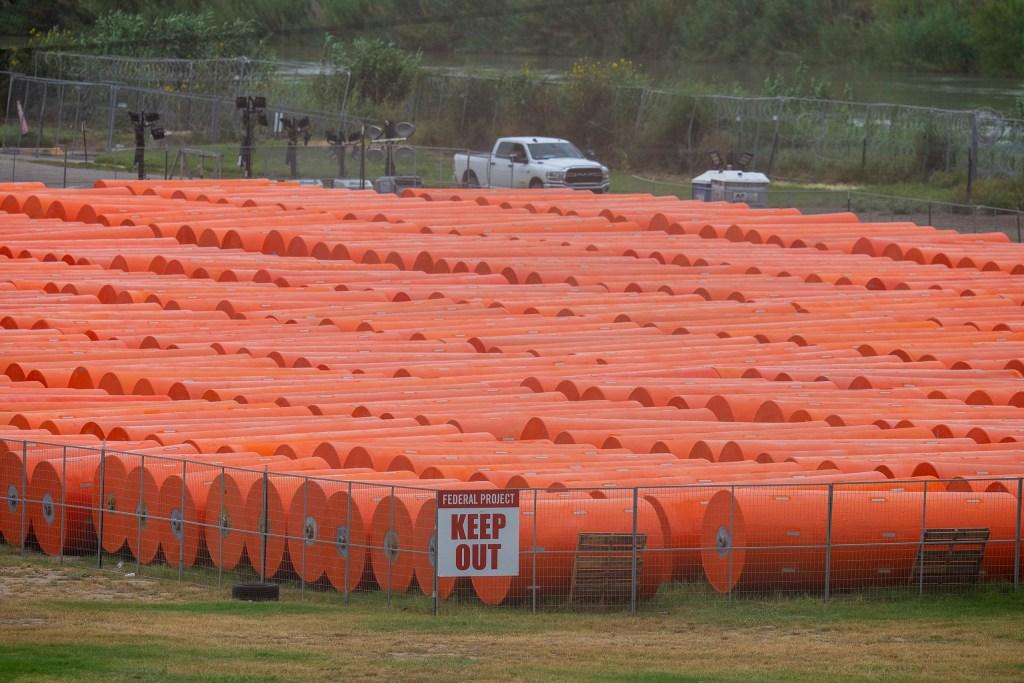
Buoys intended for use as anti-immigration barriers by the federal government have been swept into the Rio Grande due to severe flooding, prompting the closure of several crucial bridges along the U.S.-Mexico border. The closures affected Eagle Pass on Thursday and Laredo on Sunday.
In Eagle Pass, two bridges were shut down for approximately three hours on Thursday while officials assessed the potential risks posed by the drifting buoys, according to City Manager Homero Balderas. These bridges are vital for local transit, with around 9,000 vehicles crossing daily between Eagle Pass and Las Piedras.
“The bridges are the primary source of funding for the city,” Balderas noted, emphasizing that while the floating buoys did not pose an immediate threat to the structures, the situation was still detrimental. “We were fortunate to temporarily close the bridges to ensure there were no safety issues with the buoys moving downstream and potentially passing underneath.”
Rising water levels in the Rio Grande began on Thursday after heavy rains battered the Hill Country and parts of southeastern Texas, according to the National Weather Service.
A representative from U.S. Customs and Border Protection stated that a contractor responsible for the buoys, which were stationed at Shelby Park in Eagle Pass, was coordinating efforts to retrieve them. The buoys were not fully prepared for deployment or anchoring in the river.
“Waterborne barriers are designed to enhance safety for patrol agents and discourage migrants from attempting perilous crossings,” the spokesperson explained.
State Representative Eddie Morales Jr., representing Eagle Pass, shared on social media that efforts were already underway to remove the buoy obstacles. He noted that shipping containers and temporary fencing had been cleared from Shelby Park.
In a formal statement, Morales criticized the buoys for creating “unnecessary obstacles for first responders,” expressing his long-standing opposition to their implementation. “I have always believed these buoys would be ineffective, and we are now witnessing further ramifications,” he stated. “There are serious concerns about not just the buoys, but also the extensive razor wire that may have been dislodged from the riverbank. It’s time to discuss removing these barriers and restoring normalcy to our communities while ensuring our border remains both secure and safe.”
Some of the buoys were later found in Laredo, a significant border city located over 100 miles southwest of Eagle Pass.
Consequently, the City of Laredo reported on Sunday afternoon that federal crews were engaged in efforts to remove the buoys lodged at the World Trade Bridge, leading to the diversion of commercial traffic to the Colombia Solidarity Bridge. The two bridges are approximately a 40-minute drive apart, with traffic advisories indicating “slower than usual” conditions.
The city reported that there was no indication of structural damage to the World Trade Bridge, one of the busiest commercial ports of entry in the United States. However, the buoys needed to be cleared to enable engineers to conduct a thorough assessment of the bridge. Later in the day, officials announced that normal commercial operations would resume on Monday.
“The safety of our community is our top priority,” stated Laredo Mayor Victor D. Treviño. “I appreciate the cooperation of our local, state, federal, and Mexican partners, as well as the understanding of the trade community, as we worked together to safeguard this crucial international crossing.”