







In East Austin, a new housing initiative aims to tackle the persistent issue of housing instability among local musicians, who often face challenges in sustaining their careers due to rising rents and low earnings. The Austin Art Village, spearheaded by the Blackland Community Development Corporation (CDC), is a forthcoming community designed specifically for artists, featuring homes that range from 400 to 500 square feet.
Backers of the project emphasize that it is not a comprehensive solution to Austin’s housing crisis, but rather a model that could inspire similar initiatives aimed at supporting musicians. The goal is to provide long-term affordable housing that enables residents to establish roots in the community.
“Our aim is to create permanent housing that allows individuals to settle down. We’re not building transitional units; these are homes for residents who qualify based on income and need,” stated Andy Bucknall, executive director of Blackland CDC.
Thor Harris, a prominent Austin musician and board member of Blackland CDC, has been a passionate advocate for this project, which plans to develop ten homes at the intersection of Chicon and 22nd streets. He noted the challenges faced by young artists trying to balance part-time jobs with their music careers in an increasingly expensive city. “If young people stop coming here to kickstart their music careers, we risk losing the vibrant scene that has attracted many of us to Austin,” he expressed.
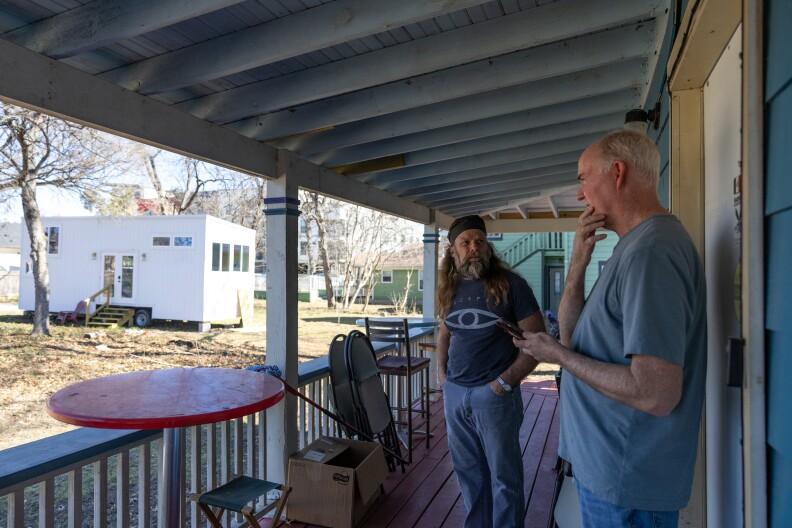
Currently, the project is in its preliminary phase, with one demo home constructed and essential groundwork completed. Bucknall revealed that Blackland CDC has finalized key predevelopment tasks, including appraisals and site clearing. A call for construction proposals was announced in January, with submissions expected by early February.
The development will feature nine additional homes on land owned by Blackland CDC, a community land trust that has provided affordable housing in the historically Black neighborhood for over 40 years. These homes will cater to income-eligible households earning at or below 50% of the area’s median family income, which is set at $93,000 for individuals and $133,000 for families of four in 2025. Rent will be capped at 30% of household income.
Harris highlighted the increasing difficulty for young musicians to find affordable housing in Austin. The overall cost of the project is estimated at around $2 million, with Blackland CDC securing $200,000 from St. David’s Foundation and actively seeking additional public and private funding to fill the gap.
Bucknall mentioned plans to apply for funding through the city’s Rental Housing Development Assistance and Home Options for Mobility and Equity programs. If successful, this funding could be available later this year, allowing for the continuation of permitting, site preparation, and construction.
While affordable housing is a critical component, stakeholders in Austin’s music community acknowledge that it alone does not fulfill the needs of working musicians. Challenges such as restrictive lease terms, noise complaints, and limited rehearsal space can render affordable units incompatible with their lifestyles. To address these issues, Blackland CDC has partnered with architects to create homes with sound insulation and thicker walls, as well as designs that include communal areas to limit noise disruption.
Derrick Lesnau, CEO of the SIMS Foundation, noted that housing instability is a prevalent concern among musicians. He pointed out that while mental health issues affect roughly 20% of the general population, that figure is significantly higher among music industry professionals due to financial instability and housing insecurity. “When individuals are constantly worried about their living situation, it hampers their ability to thrive in other aspects of life,” he remarked.
Organizers believe that the Austin Art Village will not only provide housing but also foster an environment conducive to creativity, along with access to essential services and networks within the music community. Blackland CDC has collaborated closely with the SIMS Foundation and Housing Opportunities for Musicians and Entertainers (HOME) to refine the project.
Hanna Cofer, who leads HOME, stated that even small-scale initiatives can significantly influence future policy. “When housing is unstable, everything else tends to crumble, affecting health and the ability to perform consistently,” she said. “The true value lies not just in the housing units, but in demonstrating a replicable model for policymakers and funders.”
Supporters of the project maintain that the Austin Art Village is not intended as a comprehensive fix but rather as a pilot initiative that may inform future developments focusing on artist-centric housing. Bucknall reaffirmed that the project aligns with Blackland CDC’s mission to promote long-term affordability and stability.
“Our objective is to create permanent housing that allows individuals to establish roots. These are homes designed for residents who qualify based on their income and needs,” he reiterated.
By maintaining ownership of both the land and homes, Blackland CDC aims to ensure long-term affordability and safeguard the development from market pressures that have historically displaced residents in East Austin. The organization currently manages 26 properties in the Blackland neighborhood, totaling 51 affordable housing units, and offers in-house property management and optional support services for residents.
For Harris, the initiative represents a crucial step toward preserving the cultural fabric of Austin’s music scene. “We still have a culture where people engage with live music, where musicians support one another and build vibrant communities. This can only continue if they can afford to live here,” he noted.
“While providing stable housing for a handful of musicians may seem like a small contribution, if it helps maintain Austin as a destination for emerging artists to collaborate and innovate, then it’s a worthwhile endeavor,” he concluded.