









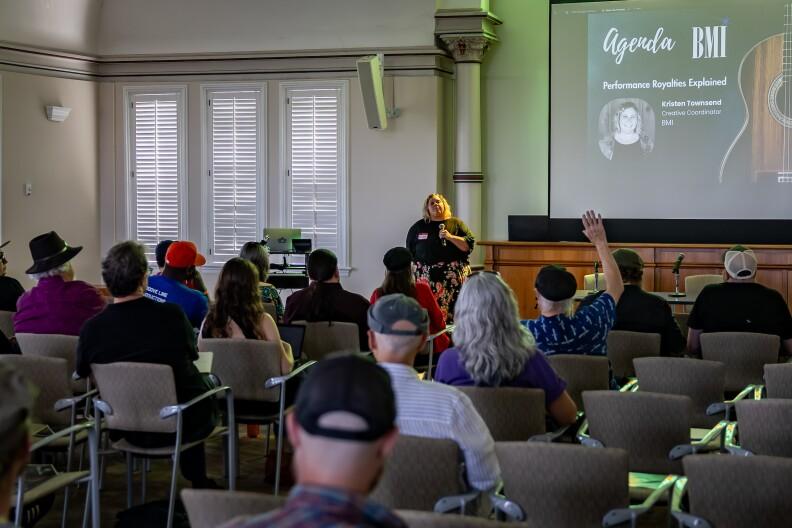
Musicians in Austin are seizing the opportunity to enhance their understanding of the music industry through a series of free classes hosted at St. Edward’s University. These sessions, organized by Austin Texas Musicians, aim to demystify the business side of music for local artists.
Among the participants is Alex Hartley, a seasoned musician who has grappled with the complexities of earning a living from his craft. Recently, he attended an introductory course that addressed crucial topics such as royalties, publishing, and the myriad organizations responsible for managing music income from both live performances and recorded works. By the conclusion of the class, Hartley was equipped with a roadmap for setting up accounts and familiarizing himself with the necessary systems.
“I’ll be on the computer tonight,” remarked the pianist and songwriter, who released an album the previous year. He acknowledged that he had yet to register with professional organizations that could facilitate royalty payments for his music. “It would be great to register and discover some funds waiting for me,” he added.
Pat Buchta, the executive director of Austin Texas Musicians, emphasized the intricacies of the U.S. music system. He noted, “When you write a song and record it, you have to register it in multiple places to ensure you collect everything you’re entitled to.” This process often involves performance rights organizations, digital distributors, and licensing groups, making it easy for artists to overlook or postpone these essential administrative tasks.
Hartley’s situation reflects a common challenge faced by many of Austin’s musicians, who often dedicate years to writing and performing without a comprehensive grasp of how to secure income beyond standard gig fees or streaming royalties. The contemporary music economy is characterized by a complex framework that requires artists to navigate various income streams, from live performance royalties to mechanical rights payments for digital streams and other uses of their recorded music.
The master class Hartley attended was the inaugural session in a series of four scheduled for this year, each concentrating on different aspects of the music industry. The classes featured insights from representatives of the BMI performance rights organization and The MLC mechanical licensing organization, who provided valuable lessons on royalty collection.
Future topics in the series are set to include entertainment law, sync licensing for film and television, and marketing strategies—areas deemed essential for establishing a sustainable career in music, alongside the creative process of writing and performing.
This initiative aligns with St. Edward’s University’s broader goal of connecting academic resources with Austin’s vibrant creative community. Collin Gillenwater, the director of partnerships and professional studies at the university, explained that the collaboration arose from a desire to foster real-world partnerships that reflect the city’s unique identity and economic landscape.
“If education can provide solutions to existing challenges, that’s where the university can contribute,” Gillenwater stated. While other institutions like the University of Texas and Austin Community College offer technical training in performance and production, this partnership specifically targets the business dimensions of a musician’s career.
“What’s lacking is a holistic approach to support the artist entrepreneur,” Gillenwater continued, highlighting the importance of skills such as financial management, contract comprehension, professional networking, and strategic decision-making regarding music releases.
The master class series is being piloted to assess both content and format before potentially evolving into a long-term program. Organizers envision a future offering that may include an affordable certificate program combining online coursework, in-person sessions, and small-group coaching.
Gillenwater assured that the pilot will be adaptable based on what participants find most beneficial. Unlike traditional degree courses, these free classes are open to the public and cater to musicians at varying stages of their careers, from students to mid-career artists striving to hone their business acumen.
“We don’t know what we don’t know,” Gillenwater remarked. “Our goal is to create a program that evolves as we discover what is truly useful.”
Buchta underscored that this effort is part of a larger mission to assist musicians in navigating an increasingly challenging industry landscape. He noted that performance pay rates have stagnated over the years, while streaming has transformed revenue models for recorded music. This reality makes it crucial for artists to understand and tap into every available income avenue, even if it requires confronting a convoluted and sometimes opaque system.
Following the initial session, some participants still found the complexities daunting. Kevin Jones, a live sound engineer aspiring to transition into recording and releasing his own music, acknowledged the clarity gained but recognized the considerable amount still to learn. “A lot of it is still a bit over my head,” he admitted, indicating that his engineering background had provided him more consistent income than he might expect as a novice performer. “I have the music. This is the part I need to learn… to build the system so it makes sense when I’m ready to release it.”