



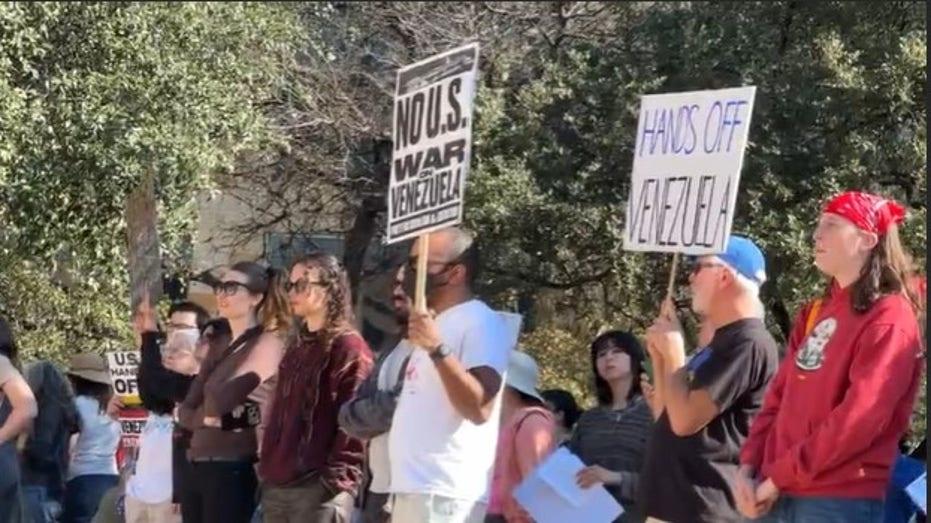
A wave of protests surged in Austin following the capture of Venezuelan President Nicolás Maduro by U.S. Special Forces over the weekend. The military operation, which was part of a larger campaign orchestrated by the Trump administration, has ignited passionate reactions from various factions within the community.
On Sunday, demonstrators gathered outside Austin City Hall to voice their opposition to the U.S. military strike in Venezuela and the subsequent arrest of Maduro and his wife, who are now facing narco-terrorism charges in New York. The operation, which took place in Caracas, has been met with criticism, particularly from groups like the Party for Socialism and Liberation, who allege that the true motives behind the military action are rooted in resource acquisition rather than genuine concern for Venezuela.
“We understand that the narrative of narco-terrorism is not the real reason for this intervention,” stated Scarleth Lopez, an organizer with the Party for Socialism and Liberation. “This is fundamentally about oil and a land grab, not about liberating the Venezuelan people.”
Maduro’s presidency, which began in 2013, has been marred by controversy, with more than 50 nations, including the United States, refusing to recognize his leadership following disputed elections in 2018 and 2024. The ongoing political turmoil has prompted a massive exodus from Venezuela, with over 7 million people fleeing the country since 2014, according to data from the UN Refugee Agency.
Among the protesters was Maria Ribers, a Venezuelan refugee who attempted to share her perspective during the demonstration. “This is just propaganda,” she asserted. “They don’t understand our reality. They don’t even talk to us.” Ribers sought to distribute informational materials detailing the dire conditions in Venezuela, including rampant poverty and a collapsing healthcare system, as she faced resistance from event organizers.
“This is our reality in Venezuela. We are suffering,” she emphasized, reflecting on her ten years of exile due to persecution for her anti-regime stance. Despite the hardships, Ribers expressed newfound hope with Maduro’s removal, saying, “We have hope for Venezuela. Finally, we will be free. We need to thank Trump for taking the dictatorship from our country.”
While some Venezuelan exiles see the U.S. intervention as a positive step toward freedom, organizers of the protest maintained their stance against the actions taken by the Trump administration, labeling them illegal. The divide within the Venezuelan community in the U.S. underscores the complexity of the situation as the world watches the fallout from Maduro’s abrupt ousting.