








Have you ever dined at a restaurant in Austin and spotted a cockroach? Or perhaps you’ve questioned whether the dishes on your table are truly clean? These concerns highlight the essential role of food inspectors like Alicia Wilcox, an environmental health officer with the city of Austin, who has dedicated five years to ensuring food safety.
Wilcox and her colleagues at the Environmental Health Services division oversee a wide range of responsibilities, from inspecting pools and spas to monitoring farmers markets and even conducting mosquito surveillance. “Our daily tasks vary significantly,” Wilcox explained. “We might begin our day with pool inspections while it’s still cool, then switch to food inspections later on. This variety is something many of us appreciate about our jobs.”
It’s important to note that not every restaurant in Austin is represented in the inspection data, as the city’s Public Health Department transitioned to a new database last year, resulting in some inspection locations being omitted.
On average, inspectors like Wilcox evaluate three to five restaurants daily, a number that can fluctuate based on the size of the kitchens being inspected.
Recently, Amaya’s Taco Village permitted KUT News and Austin Public Health to conduct a mock inspection, providing an opportunity to observe the inspection process firsthand. The restaurant has a solid track record, scoring 94 out of 100 in November 2025 and an 88 in its most recent inspection in July 2026, as per Austin’s public records.
“The only time they know we’re returning is if there’s a failure,” Wilcox noted. “While we don’t disclose the exact date of our return, they can expect us within two to four weeks.”
Upon entering Amaya’s Taco Village, Wilcox was greeted by owner Richard Amaya, and together they began the mock inspection in the kitchen. Inspectors within the division rotate their assigned areas every two years. Prior to her current role, Wilcox was responsible for restaurants including Amaya’s Taco Village, Bartlett’s, Titaya’s Thai Cuisine, and Enchiladas Y Mas. She now focuses on assisting struggling establishments seeking to improve their scores.
During her tenure inspecting Amaya’s Taco Village, Wilcox developed a rapport with the owners, which she considers one of the most rewarding aspects of her job. “If they don’t understand the importance of what we’re doing, they might perceive it as simply punitive,” she stated. “But by explaining the risks involved, they’re more inclined to address the issues.”
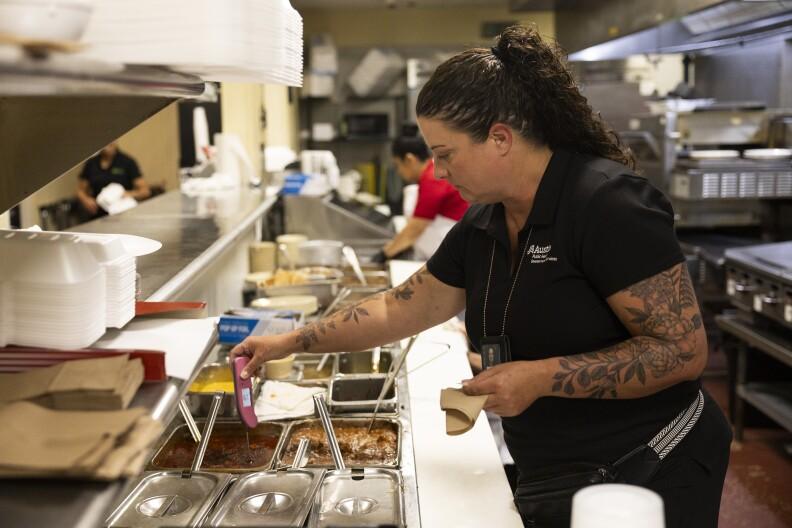
During the lunch rush at Amaya’s Taco Village, the kitchen staff worked diligently. Wilcox navigated through the kitchen, checking the temperatures of various ingredients, including refried beans, and inquiring about when the tomatoes had been diced. As she moved about, employees maneuvered around her, grilling food, serving plates, and transporting containers.
While inspecting cleaning supplies, Wilcox discovered several unlabeled bottles, which she promptly handed to Amaya for labeling. She emphasized that minor issues like this could be resolved immediately.
Wilcox utilizes a checklist during her inspections, evaluating factors such as cleanliness of cooking surfaces, proper food separation, food labeling, updated permits, and dishwasher efficacy. The scoring system ranges from 0 to 100, with scores below 69 classified as failing. A passing score is anything 70 or above.
Each infraction contributes to a lower score. If a restaurant fails an inspection, it incurs a $134 fee and must undergo a re-inspection, typically within ten days. Furthermore, the establishment is placed on a compliance list for three years. A second failure within that timeframe results in a criminal complaint and additional fees, alongside another re-inspection. Should a restaurant fail a third time, it faces closure and must develop an action plan with a program manager from Austin Public Health.
Inspectors also have the authority to shut down a restaurant immediately. “If we find a roach, it doesn’t necessarily mean we’ll close the establishment,” Wilcox clarified. “Closure would only occur if a pest infestation directly impacts food intended for customers. Signs of rodent activity, such as chewed food packages in storage, would prompt pest control intervention. Restaurants can also face closure due to sewage backups.”
In her five years in the role, Wilcox has had to close approximately 10 to 15 restaurants. Customers are often unaware of the violations occurring behind the scenes, she noted. “Common issues include temperature violations and improper cooking practices. Occasionally, customers alert us to pest issues they’ve observed, but this is not always the case.”