









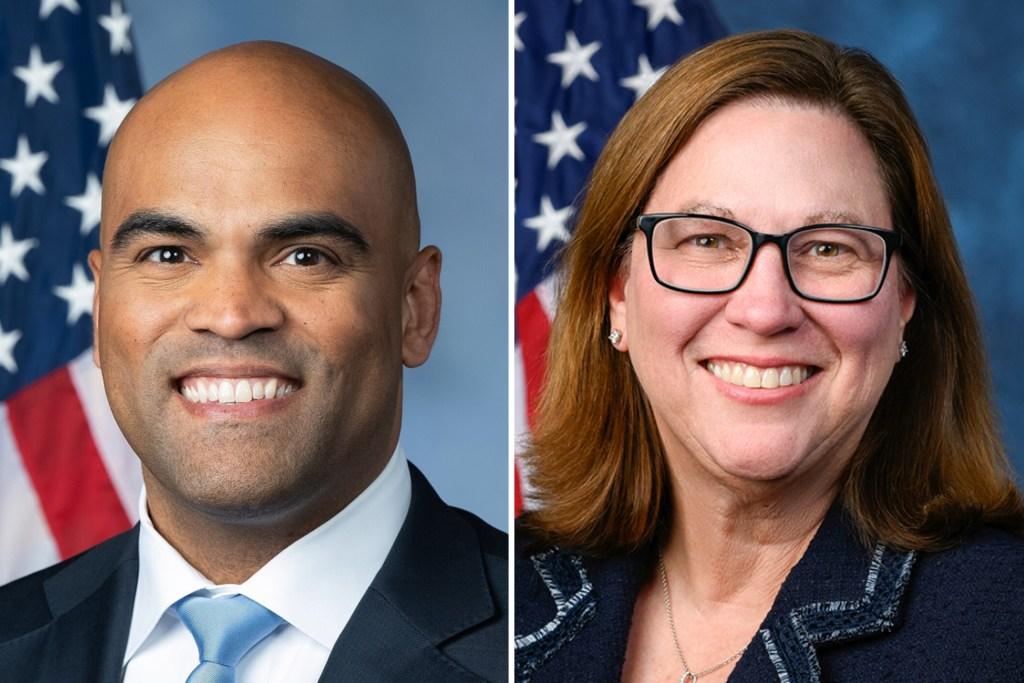
In a rare political showdown, U.S. Representative Julie Johnson is competing against her predecessor, Colin Allred, for the Democratic nomination in a newly reconfigured congressional district in North Texas. This unusual race will culminate in a runoff election on May 26, following a primary where neither candidate secured the required 50% of the votes.
Colin Allred, a former NFL player and civil rights attorney, previously held Texas’ 32nd Congressional District seat until he vacated it to pursue a Senate campaign for 2024. Julie Johnson, a former state representative, succeeded him. However, in a strategic move by Texas Republicans last year, the district was redrawn to heavily favor the GOP, which involved shifting around a third of its population, including some of its most Democratic-leaning areas, to the adjacent 33rd Congressional District. The revised TX-33 is projected to favor Democratic candidates significantly, as indicated by a projected margin of nearly 33 points for Kamala Harris in the upcoming election.
Initially, Allred aimed to make a second attempt at the U.S. Senate seat, setting his sights on Republican Senator John Cornyn’s position. However, as Dallas Representative Jasmine Crockett prepared to enter the Senate race, Allred abruptly shifted his focus to contesting Johnson for the newly drawn 33rd District.
The race has turned contentious, with Johnson criticizing Allred’s effectiveness during his three terms in Congress and claiming to have been more productive, particularly in addressing the Biden administration’s immigration policies through her role on the House Homeland Security Committee. Conversely, Allred has targeted Johnson for her financial ties to Palantir Technologies, a federal contractor involved in immigration enforcement under the Trump administration.
In the primary held on March 3, Allred finished nearly 11 points ahead of Johnson and has outspent her significantly throughout the campaign.
The demographic composition of the district reveals a diverse electorate: 55% Hispanic, 22.5% white, 15.8% Black, and 6.3% Asian. Recent presidential election results show a substantial Democratic tilt, with Harris receiving 65.2% of the votes compared to Trump’s 32.6%.
Among the counties included in the district are Dallas, Grand Prairie, Irving, Balch Springs, and Cockrell Hill. The financial aspects of both candidates’ campaigns are noteworthy. Allred has raised a total of $6.4 million, with $5.8 million spent and $679,000 remaining in cash. Key backers include the New Leadership PAC and the Jobs and Democracy PAC.
Allred’s experience includes his tenure as a linebacker for Baylor University and the Tennessee Titans, along with a career in civil rights law, where he focused on voter protection and litigation. He made history in 2018 by defeating Republican Pete Sessions, becoming the first Democrat to represent the 32nd Congressional District.
Johnson, on the other hand, has raised $2.1 million, spent $1.8 million, and has $487,000 cash on hand. Her notable donors include the Equality PAC and Nuestro PAC. With a background as a trial lawyer, she has served in the Texas House and currently represents the 32nd Congressional District. In Congress, she is active on multiple committees, including Homeland Security and Foreign Affairs.
Both candidates have received endorsements from prominent figures and organizations within the Democratic Party, underscoring their respective platforms and positions on critical issues such as healthcare, immigration, and economic policy. Johnson advocates for expanding Medicaid and reducing prescription drug costs, while Allred supports a pathway to citizenship for undocumented immigrants.
This primary reflects the shifting political landscape in Texas and the ongoing battle for influence within the Democratic Party as both candidates seek to secure their positions in a potentially pivotal congressional district.