









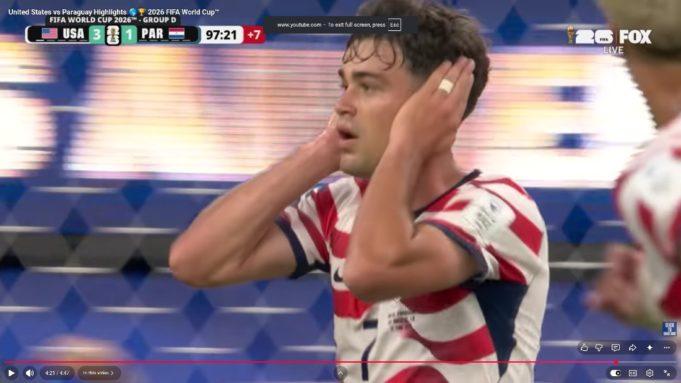
For a brief moment, Gio Reyna’s stunning goal against Paraguay muted the surrounding controversies. The recent World Cup has seen a blend of traditional soccer and American influences, particularly with hydration breaks dividing matches into segments reminiscent of American football. In this context, the United States men’s national team (USMNT) delivered a thrilling opening match, showcasing both skill and strategy.
The USA’s 4-1 victory over Paraguay was a striking departure from typical World Cup narratives, where the team has historically dominated weaker CONCACAF opponents in qualifying matches. This time, players like Christian Pulisic and Folarin Balogun dismantled Paraguay’s defense, which was previously thought to be a strong point for the South Americans. Reyna’s goal, marked by a meticulous 26-pass buildup, was a dream realized for American soccer enthusiasts who have long waited for such a moment on the grand stage.
Reyna’s celebration, where he placed his hands to his ears, symbolized his defiance against the noise surrounding his off-field issues during this World Cup cycle. His goal not only elevated the team’s goal differential to +3—surpassing Australia’s +2—but also served as a powerful statement from a player who has often been in the spotlight for reasons beyond his on-field performances.
While enthusiasm might be building for a celebratory parade for the soccer team, it may be wise to temper expectations. This victory came against a Paraguay team that has struggled under pressure, despite previously defeating giants like Argentina and Brazil in qualifying rounds. Nevertheless, the clinical execution displayed by the USMNT was reminiscent of performances by traditional powerhouses like Germany and England, which surely caught the attention of global soccer fans.
In the spotlight was Vozinha, the 40-year-old goalkeeper from Cape Verde, who delivered an incredible performance against Spain, saving seven shots and earning a clean sheet. His sudden rise in popularity has led to a surge of followers on social media, and even the U.S. State Department has arranged for his mother to attend the next match against Uruguay in Miami. Vozinha’s heroics transformed a scoreless game into a thrilling spectacle for fans.
Credit for the USA’s success also goes to coach Mauricio Pochettino, who managed to rally the team after a series of disappointing friendlies. Under his leadership, the players appeared focused and prepared, successfully navigating the pressures of being the host nation and delivering a performance that exceeded pre-tournament expectations.
Looking ahead, the USA will face Australia, who recently pulled off a surprising 2-0 victory over Türkiye. This win has infused the Socceroos with confidence, making them a potential threat to the USMNT. Despite being perceived as the least talented team in Group D, Australia is now buoyed by their victory and will be eager to challenge the Americans.
In North Texas, the opening match between the Netherlands and Japan delivered an exciting second half, culminating in a thrilling 2-2 draw. Fans were treated to a dynamic finish, as Japan’s late equalizer showcased their determination and tactical prowess. This match provided valuable insights for both supporters and critics of each team.
England also had a successful outing, defeating Croatia with FC Dallas’ Petar Musa scoring an impressive goal. While the Croatian team struggled to maintain their defensive structure, England’s offensive strength proved overwhelming. This match even saw Luka Modrić, a stalwart of Croatian soccer, taken off the pitch, a sight few expected to witness.
On a lighter note, the most disappointing aspect of the England-Croatia game was Anthony Gordon’s haircut. After sporting a retro blonde style, he opted for a more subdued look, reminiscent of past World Cup players. This shift in appearance sparked discussions about potential omens for the tournament.
Meanwhile, Mexico finally broke a long-standing curse by winning their opening match against South Africa, with Raúl Jiménez scoring his inaugural World Cup goal. This victory was a significant emotional moment for the player and the nation. Canada, on the other hand, salvaged a draw against Bosnia-Herzegovina thanks to a goal from substitute Cyle Larin, while they await the return of Alphonso Davies from injury.
In other notable outcomes, South Korea rallied to overcome the Czech Republic, with goalkeeper Kim Seung-gyu making crucial saves. Lionel Messi continued to etch his name in World Cup history with a hat trick against Algeria, while Tunisia faced a heavy defeat to Sweden, resulting in the firing of their coach.
Historically, Tunisia has made headlines for coaching changes during tournaments, having previously sacked their coach in 1998 under similar circumstances. This pattern speaks to the high stakes and pressures associated with the World Cup.
Lastly, the diversity in Sweden’s team has proven to be an asset, with players of varied backgrounds contributing to their success. The partnership between forwards Alexander Isak and Viktor Gyökeres could pose significant challenges for opposing teams.
Portugal’s recent draw against the Democratic Republic of the Congo highlighted both the strengths and weaknesses of the team. While the Leopards earned a historic point, Cristiano Ronaldo’s performance raised concerns about his ability to adapt to the evolving pace of the game. His missed opportunities and frustrations on the field have drawn parallels to the political landscape surrounding Portugal’s national team.
The upcoming match between the USA and Australia is set for Friday afternoon in Seattle, where fans are expected to rally in support of the national team, echoing the energy of the city’s Super Bowl champions.