









Shakespeare’s personal tragedy transforms into a profound theatrical experience in this emotionally resonant historical drama.
The narrative begins with the undeniable truth: William Shakespeare had a son named Hamnet, who tragically succumbed to the bubonic plague at just 11 years old. This devastating loss coincided with Shakespeare’s creative journey, as it was shortly thereafter that he began crafting the play known as Hamlet.
This poignant detail has long captivated scholars of Shakespeare, and it has also stirred the imagination of literary figures like James Joyce, who delved into the subject through the character of Leopold Bloom in Ulysses after the loss of his own son. The question lingers: what significance does this hold? It seems there must be a deeper meaning at play. While it is true that the source material Shakespeare drew from, written by Saxo Grammaticus, featured a hero named Amleth, the parallels cannot be mere coincidence.
Despite being regarded as the greatest writer in history, Shakespeare was also a father who faced the heart-wrenching task of burying his only son. The weight of this experience must have weighed heavily on him, yet he left no direct record of his thoughts on the matter. Unlike many of his contemporaries who expressed similar grief, we are left to piece together the fragments of his reflections. Did he hint at this sorrow in his 33rd sonnet? In Constance’s lamentation for her deceased husband in King John? Or could Hamlet itself be a contemplation of the man Hamnet might have become?
In her speculative fiction, Maggie O’Farrell explores this theme, and now Chloé Zhao has brought it to life in a stunning film that compellingly argues that Hamlet embodies Shakespeare’s transformation of his grief into artistic expression. Having previously won Oscars for her work on Nomadland, Zhao has surpassed herself with this latest endeavor.
The film unfolds in 1584, depicting Will Shakespeare (Paul Mescal) as he languishes in his hometown of Stratford, struggling to find work despite his education. To repay his father’s debts, he tutors local boys in Latin. During this time, he encounters Agnes “Anne” Hathaway (Jessie Buckley), whose expertise in herbal medicine captivates him even before he discovers that she is the eldest daughter of a wealthy landowner. Their union produces three children: the eldest, Susanna (Bodhi Rae Breathnach), and twins Hamnet and Judith (Jacobi Jupe and Olivia Lynes). Ironically, Agnes becomes particularly protective of Judith, who was initially believed to be stillborn and becomes the first in the family to contract the plague.
For those familiar with O’Farrell’s novel, it is important to note that the film takes a different approach. While O’Farrell weaves through various characters’ perspectives, Zhao opts for a linear narrative, primarily focusing on Agnes as Will travels to London to join a theater troupe. The novel’s keen insights into Elizabethan daily life give way to Zhao’s impressionistic style, often linking Agnes with nature — her first appearance finds her sleeping among the roots of an ancient tree. Cinematographer Łukasz Żal, using only natural light, captures interior scenes that evoke the paintings of Dutch masters from the period.
Any fictional interpretation of Shakespeare inevitably fills in the gaps of his life due to the many unknowns. In a manner reminiscent of Tom Stoppard’s Shakespeare in Love, this film is rich with Easter eggs, featuring lines that would later appear in Shakespeare’s plays. A particularly charming moment unfolds when the three Shakespeare children entertain their mother by dressing as witches and reenacting the opening scene of Macbeth.
Hamnet’s decision to sacrifice himself for Judith may come across as somewhat heavy-handed—though this theme is mirrored in the novel—but the young actor Jacobi Jupe delivers a compelling performance. The film’s Irish lead actors, especially Buckley during the heart-wrenching scene of Hamnet’s death despite Agnes’s desperate attempts to save him, lend a depth that enhances the storytelling. Additionally, the emotional rollercoaster peaks when Will rushes home after hearing of Judith’s illness, only to find her well, yet confronted by the tragic sight of his son’s body being prepared for burial.
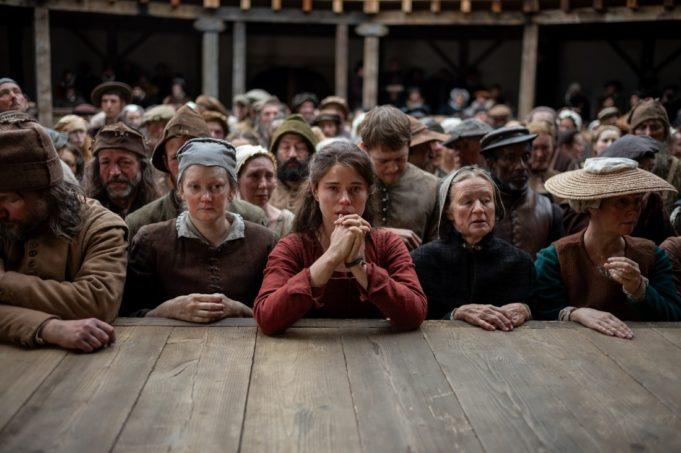
Just as Shakespeare in Love found its stride with the production of Romeo and Juliet, this film reaches extraordinary heights when Anne journeys to London to witness Hamlet, oblivious to the plot and having never attended a play before. The haunting image of Will, adorned in white makeup as the ghost of Hamlet’s father, addressing a young Hamlet (Noah Jupe, the real-life brother of Jacobi Jupe) with hair styled like Hamnet’s, is particularly chilling.
No one embodies a mournful ghost quite like Mescal, especially as his character relives his recent trauma while delivering the ghost’s speech about his death by poisoning. The moment Hamlet reenacts his own demise, with Agnes and other audience members extending their hands towards him, powerfully conveys the enduring impact of Shakespeare’s tragedy, regardless of how many interpretations one has encountered. Much like last week’s Sentimental Value, Hamnet serves as a tribute to the capacity of drama to provide solace amid life’s myriad afflictions. In light of all this, it deserves a standing ovation.
Hamnet
Starring Jessie Buckley and Paul Mescal. Directed by Chloé Zhao. Written by Chloé Zhao and Maggie O’Farrell, based on O’Farrell’s novel. Rated R.
TAGS: bereaved, grief, hamlet, historical fiction, Jessie Buckley, Maggie O’Farrell, Paul Mescal, theater, William Shakespeare