








Sign up for The Brief, The Texas Tribune’s daily newsletter that keeps readers up to speed on the most essential Texas news.
Automated audio recordings are provided for accessibility. Human writers and editors have crafted the story. Please review our AI policy and provide feedback.
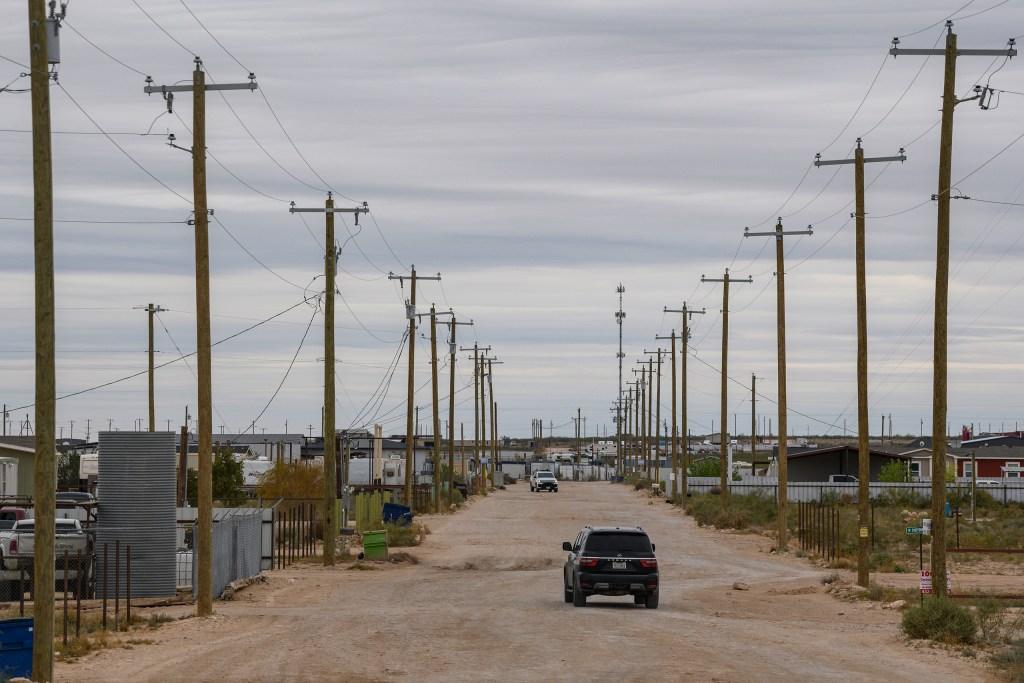
WEST ODESSA — When Paula Graham’s family relocated to this unincorporated area of Ector County in the 1980s to pursue the oil boom, the region was sparsely populated, with unpaved roads and no running water. Over the years, the once desolate landscape has filled with trailer homes, yet the issue of access to clean and reliable drinking water persists.
Families like Graham’s depend on self-installed wells and pumping systems, which they must maintain themselves. Graham is concerned that the increasing population is putting a strain on her well, raising fears that it may soon run dry.
For the past four years, Graham has sought assistance from the local water utility to extend water lines from nearby Odessa, but her efforts have yielded little success—until now.
With cautious optimism, Graham looks toward a new $17 million project funded by the Texas Legislature aimed at expanding water infrastructure in West Odessa. However, she is apprehensive that the utility district may not extend the lines all the way to her home.
This one-time state investment serves as a stark reminder that many Texans still lack access to running water and highlights the immense financial challenges local governments face in building and maintaining water systems. Most residents without running water tend to live outside municipal boundaries, such as in West Odessa or in border colonias.
To facilitate the expansion, improvement, and maintenance of water systems in communities, the Legislature and the Texas Water Development Board have launched financial assistance programs. These initiatives are expected to see significant growth over the next two decades following the approval of $20 billion in water spending by voters in the last election.
However, the available funding often falls short of meeting demand, with long wait times and, in many instances, limited eligibility for areas lacking a water utility or city government.
This year, several state lawmakers proactively designated funds for projects in their districts as part of the state’s two-year budget. Nearly $600 million has been allocated for water-related expenses, a significant increase compared to the $106 million set aside in 2023 for similar projects. A notable project in Lynchburg, an unincorporated community near Houston, will receive $100 million for a new water pumping station, while Bellaire, a city of approximately 17,000 residents also close to Houston, has secured $54 million for flood mitigation efforts.
State Representative Brooks Landgraf, a Republican representing West Odessa, emphasized that the Legislature’s approval of his request highlights the urgent need for improved water access in his district.
“Whenever there’s a clear need, I will always advocate for it,” Landgraf stated. “I am confident that we can effectively utilize that funding.”
However, this promised state funding is merely an initial step.
Ector County Judge Dustin Fawcett has prioritized enhancing the quality of life in West Odessa as a central focus of his role as the county’s chief executive.
“More and more people have moved out there, and its population is arguably comparable to that of Odessa,” Fawcett remarked, noting that Odessa has approximately 114,000 residents. “Yet, the number of water lines connecting residents to a water supply has remained relatively unchanged, leaving new arrivals unaware that they will lack access to water.”
“It is unacceptable that residents still live without water in 2025,” Fawcett asserted.
The Ector County Utility District, which serves around 5,200 customers, does not levy taxes on its residents, even though it holds the authority to do so. Instead, it relies entirely on customer fees, which has limited its ability to expand services to more households within its jurisdiction.
Officials from the utility district have not responded to requests for comment.
Ector County officials will oversee the $17 million investment aimed at developing water infrastructure, which includes conducting a $250,000 study to assess the county’s needs and apply for future grants and loans. The remaining funds will be allocated for new pipelines and connections, with residents needing to opt in to connect to the water lines. The county plans to launch a public awareness campaign to inform residents.
Despite this funding, Fawcett noted that it will not suffice to provide water for every resident in West Odessa, as the estimated cost to fully implement such a project exceeds $100 million.
Securing funding for water projects often requires millions of dollars from local governments and water systems, making significant upgrades unattainable for smaller and rural areas.
The competitive nature of available state dollars for assisting these systems remains a challenge, even after the recent $20 billion boost approved by voters. The Texas Water Development Board, responsible for managing the state’s water resources, administers various programs designed to help local governments fund projects, primarily through low- or no-interest loans.
However, qualifying for these loans can be challenging for certain regions. For instance, West Odessa does not meet the population criteria to be classified as a colonia, which affects its eligibility for specific grants. Additionally, since the utility district encompasses only a small part of the area, it disqualifies the community from other funding opportunities, Fawcett explained.
To address the needs that do not align with the Water Development Board’s criteria, state lawmakers are negotiating solutions within the budget. Lawmakers consistently request billions for water projects and infrastructure improvements, including parks, roads, and airports. The amount of funding lawmakers can request—and the approval rate—varies with each budget cycle. Demonstrating the urgency of the need is crucial for lawmakers to persuade their peers to approve the funding.
Water-related expenses accounted for nearly $600 million in the 2025 budget, making it one of the largest allocations. For comparison, parks received $60 million, while airports secured $106 million. In 2023, lawmakers had previously requested $106 million for water projects.
“Texas’s documented water needs now exceed $200 billion over the next 50 years,” stated Alan Leonard, director of policy at the Texas Water Foundation. “Lawmakers are increasingly recognizing the urgency of Texas’ water requirements and the escalating costs associated with them.”
Perry Fowler, executive director of the Texas Water Infrastructure Network, acknowledged the pressing need for funding in many communities but expressed concern about bypassing the water development board with individual project allocations.
“By doing so, you risk losing the ability to leverage and maximize available funds,” Fowler cautioned. “This isn’t just about immediate needs; we should ensure that future funding channels are optimized.”
Residents of West Odessa remain cautious, preferring to wait for tangible construction before celebrating. Many agree that the area, now more densely populated, requires additional services, including paved roads and water access.
Prudencio Rivera, a resident of West Odessa for eight years, has relied on a water well that has never failed him. Yet, every month, he and his wife purchase 20 gallons of drinking water.
Unaware of the new water infrastructure plans, he believes the county must act swiftly to accommodate the growing population.
“There was hardly anyone here before,” he remarked about his neighborhood. “This would greatly benefit the newcomers.”
Graham, who settled in the area in the 1980s, has long worried about the sustainability of her water well with the influx of new residents. She conserves every drop but is skeptical that others will do the same, which has led her to keep her garden small.
Regarding the county’s plans, she was unaware of the developments but hopes that her next request for a water line to her home will receive a positive response.
Disclosure: The Texas Water Foundation has financially supported The Texas Tribune, a nonprofit, nonpartisan news organization funded in part by donations from members, foundations, and corporate sponsors. Financial supporters do not influence the Tribune’s journalism. A complete list of contributors can be found here.
Learn about The Texas Tribune’s policies, including our partnership with The Trust Project to enhance transparency in news.
You have read this article this month. You have unlimited access to articles because there is no paywall.
Texans need the truth. Help us report it.
Independent Texas reporting requires your support. The Texas Tribune provides fact-based journalism for Texans, by Texans. Our community of members, the readers who donate, makes our work possible. Help us deliver in-depth news and information to you and millions of others. Will you support our nonprofit newsroom with a donation of any amount?
Support Independent Texas News. Become a member. Join today.
Independent Texas reporting requires your support. The Texas Tribune delivers fact-based journalism for Texans, by Texans. Our community of members, the readers who donate, makes our work possible. Help us deliver in