


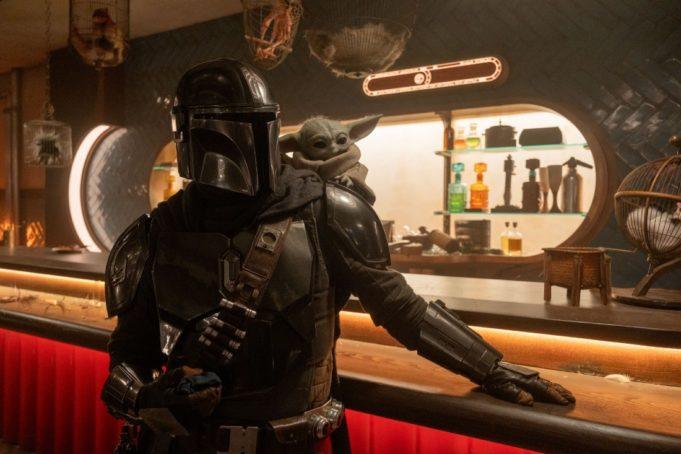
The latest installment of the Star Wars franchise, titled “Star Wars: The Mandalorian and Grogu,” is being hailed as one of the best spinoffs to date. Despite not having revisited all three seasons of the original series, the film offered a more gratifying experience compared to previous entries like “Rogue One” and “Solo.” Originally intended as the fourth season of the television series, the film presents a coherent story that translates well to the big screen, despite some shortcomings.
The narrative picks up a few years after “Return of the Jedi,” introducing a new character played by Sigourney Weaver, who assigns Din Djarin, portrayed by Pedro Pascal, a new spaceship and mission. The plot unfolds as the criminal Hutts agree to deliver a high-profile fugitive to the authorities, contingent upon the Mandalorian rescuing their kidnapped heir, Rotta, voiced by Jeremy Allen White. However, Din Djarin and Grogu, affectionately known as Baby Yoda, quickly discover that Rotta is not a victim, but rather a celebrated gladiator on an urban moon, enjoying the perks of his status even as an indentured servant to a gang leader.
For those unfamiliar with the series, the film clarifies the cultural taboos surrounding bounty hunters like Din Djarin, particularly the significance of concealing their faces. However, this thematic element doesn’t entirely compensate for the fact that Pascal remains masked for most of the film, leaving his expressive face hidden. While Ryan Reynolds managed to convey emotions through his mask in “Deadpool,” the Mandalorian’s helmet offers no such luxury, leaving a gap in emotional depth that might have benefitted from a different actor adept at deadpan humor.
One of the film’s standout moments occurs when Din Djarin, gravely injured, is tended to by Grogu in a swampy setting. This nearly dialogue-free sequence includes the film’s comedic highlight, as Grogu constructs a mud shelter and uses his levitation abilities to maneuver Din Djarin inside, only to discover it lacks sufficient length. Director and co-writer Jon Favreau deserves recognition for his skill in balancing world-building, character development, action, and humor within the film, managing to ensure that the larger set pieces do not overshadow the more intimate moments.
Additionally, the film features the return of Babu Frik, voiced by Shirley Henderson, alongside fellow mechanics from his species. Their less fluid movements serve to emphasize their alien nature, while also injecting humor into the storyline, particularly as Grogu perceives them as toys. This aspect could have come off as overly sentimental, yet Favreau and his team execute it effectively.
Despite these strengths, “The Mandalorian and Grogu” fails to reach the heights one might hope for. While it is unreasonable to expect every Star Wars film to be a groundbreaking event, this installment misses the mark on several opportunities for greater emotional resonance. The action scenes, though well-executed, lack the awe and visceral excitement often associated with the franchise, and the visuals, while competent, do not achieve true beauty. The antagonists fall flat, and Rotta’s journey toward self-discovery lacks the necessary depth.
Ultimately, the film could have benefited from more screen time for Pascal’s face, allowing for a better connection with his character. However, it is worth noting that my initial expectations were low, and this latest chapter of the saga exceeded them. That, in itself, is a commendable outcome.
Star Wars: The Mandalorian and Grogu
Starring Pedro Pascal. Voice by Jeremy Allen White. Directed by Jon Favreau. Written by Jon Favreau, Dave Filoni, and Noah Kloor. Rated PG-13.