







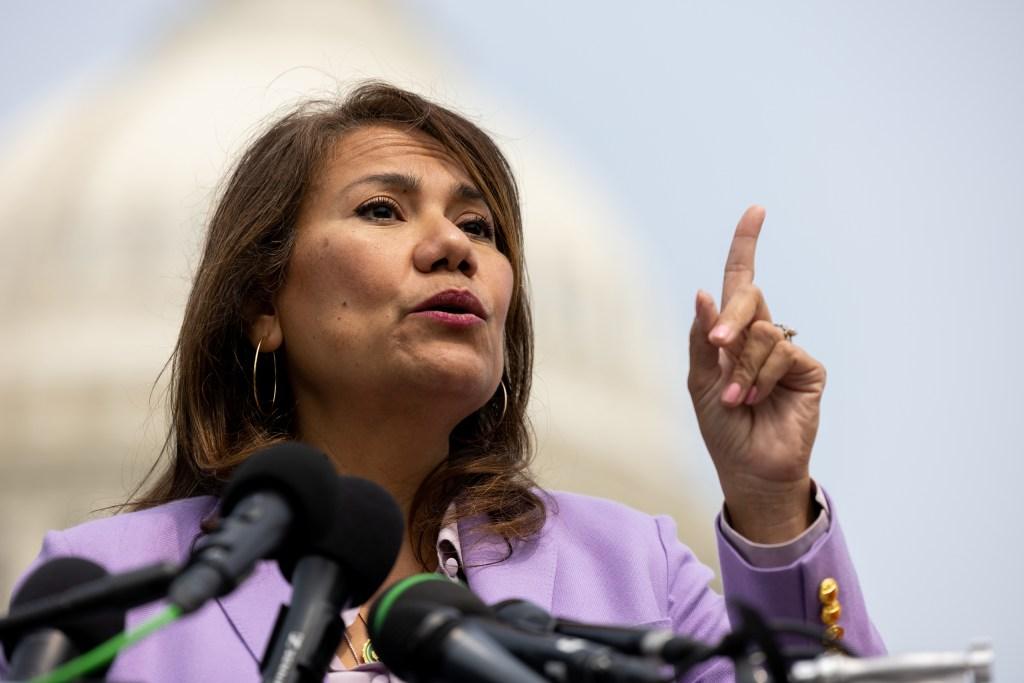
More than 25 congressional Democrats, spearheaded by U.S. Representative Veronica Escobar from El Paso, have urged the Trump administration to close the beleaguered Camp East Montana immigrant detention center located at Fort Bliss. This call to action was articulated in a letter addressed to leaders at the Department of Homeland Security.
In a troubling series of events over a six-week period beginning in mid-December, three fatalities occurred at the hastily erected facility at the El Paso Army base. Notably, one death was classified as a homicide involving facility staff, a situation that former Immigration and Customs Enforcement (ICE) officials noted has not been seen in over 15 years.
Initially, ICE reported that 55-year-old Geraldo Lunas Campos, a father of three who had resided in the U.S. for nearly two decades, succumbed to “medical distress.” However, the situation shifted as ICE later claimed it was a suicide attempt, only to change the cause of death again after the medical examiner ruled it a homicide. They subsequently stated that his death resulted from a “spontaneous use of force” to prevent him from self-harm.
The lawmakers highlighted numerous grievances regarding the conditions at the camp, including spoiled and inadequate food, unsafe drinking water, and sewage issues affecting the facility housing over 3,000 detainees. Among their primary concerns is the alleged “inadequate” medical care provided to detainees.
The first reported death at the camp involved 48-year-old Francisco Gaspar-Andres, who the lawmakers asserted “appears to partially be the result of poor medical care by staff.” Gaspar-Andres, a father of five, passed away on December 3 from liver and kidney failure after being hospitalized for more than two weeks following his detention. An autopsy confirmed organ failure as the cause of death.
ICE officials maintained that Gaspar-Andres had a history of health issues, including liver complications, and received continuous medical attention for various symptoms such as bleeding gums, body aches, fever, jaundice, and hypertension. They stated that he had “constant, high-quality care” during his detention.
However, lawmakers contend that despite his repeated requests for medical assistance as his symptoms worsened, Gaspar-Andres was only sent to the hospital after his condition had severely declined. His family shares this sentiment, believing that inadequate treatment at the El Paso facility contributed to his rapid health deterioration and subsequent death.
His daughter recounted, “My father told me he was suffering greatly there in that jail, from lack of food, lack of medical attention and the conditions of the place.” They informed local media that he had been relatively healthy before his detention but experienced a rapid decline, requiring hospitalization two months after his arrest.
In their letter, the lawmakers insisted that the administration must take immediate steps to close the tent camp, which currently stands as the largest ICE facility in the nation. Constructed in a record two months under a $1.2 billion contract awarded to a Virginia-based firm lacking relevant experience, the facility is viewed as a prototype for over two dozen additional ICE centers planned nationwide, including several in Texas.
Escobar emphasized that the troubling incidents at Camp East Montana should not only serve as a cautionary tale for the proposed expansion of ICE facilities but also necessitate the immediate closure of the site. She and her colleagues stated, “For the safety of everyone at the facility, for an end to abuses to detainees, and for fiscal responsibility to the American people, the site cannot continue to operate.”
Moreover, over 45 individuals detained at Camp East Montana have reported instances of abuse and serious injuries to their attorneys, as noted in a letter from the American Civil Liberties Union (ACLU) and other advocacy organizations sent to DHS and ICE officials in December. Among these allegations is that of a teenager who was hospitalized after claiming staff had physically assaulted him. He reported that detention staff obstructed security cameras and inflicted severe physical harm.
Conditions at the facility have reportedly worsened since those initial complaints, according to Savannah Kumar, a senior staff attorney with the ACLU of Texas, who is visiting the camp this week. “The situation was already at a breaking point,” Kumar remarked. “It continues to be a very dire situation for people who are kept there and who are having to live in a detention center where multiple deaths have already occurred. It creates an environment where they are scared for their own lives.”