








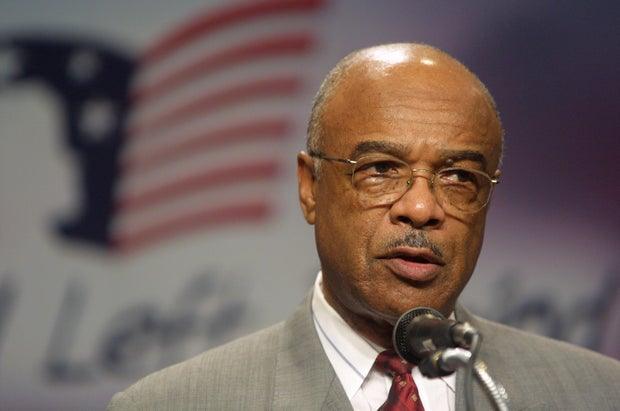
Rod Paige, a prominent educator and the first African American to serve as U.S. Secretary of Education, passed away on Tuesday at the age of 92. He was notably recognized for implementing the landmark No Child Left Behind law during his tenure.
Former President George W. Bush, who appointed Paige to the position, confirmed his death in a statement but did not disclose additional details. Under Paige’s guidance, the Department of Education rolled out the No Child Left Behind policy in 2002, which became a signature piece of Bush’s educational agenda, building on Paige’s prior experience as a school superintendent in Houston. This law mandated universal testing standards and imposed penalties on schools that did not meet specific performance benchmarks.
“Rod was a leader and a friend,” stated Bush. “Unsatisfied with the status quo, he challenged what we called ‘the soft bigotry of low expectations.’ Rod worked tirelessly to ensure that a child’s birthplace did not dictate their chances of success in school and life.”
Born in the small Mississippi town of Monticello to two educators, Paige was the eldest of five siblings. He served two years in the U.S. Navy before transitioning to a career in coaching at both high school and junior college levels. He quickly advanced to become the head coach at Jackson State University, a historically Black college, where his team made history by being the first to integrate the Mississippi Veterans Memorial Stadium during a 1967 football game.
In the mid-1970s, Paige moved to Houston to coach at Texas Southern University, but soon shifted his focus to education, starting as a teacher before assuming various administrative roles, including the dean of the college of education from 1984 to 1994. His commitment to educational excellence led to his appointment as superintendent of the Houston Independent School District, one of the largest in the nation.
His significant educational reforms caught the attention of influential Texas politicians, particularly Bush, who highlighted Paige’s efforts during his presidential campaign as the “Texas Miracle.” Once elected, Bush appointed Paige as Secretary of Education.
During his term from 2001 to 2005, Paige championed the idea that high expectations were crucial for children’s development. He stated, “The easiest thing to do is assign them a nice little menial task and pat them on the head. That is precisely what we don’t need. We need to assign high expectations to those people, too. In fact, that may be our greatest gift: expecting them to achieve, and then supporting them in their efforts to achieve.”
While some educators praised No Child Left Behind for establishing a standardized approach across diverse student populations, others criticized it for creating a convoluted system of testing and excessive emphasis on “teaching to the test.”
In 2015, lawmakers revised many elements of the No Child Left Behind act, reducing the Education Department’s role in setting testing standards and eliminating the federal agency’s power to penalize underperforming schools. This overhaul was signed into law by then-President Barack Obama, marking a shift in accountability and teacher evaluation strategies.
After his tenure as education secretary, Paige returned to Jackson State University in 2016, stepping in as interim president at the age of 83. Throughout his 90s, he continued to voice his passionate concerns and hopes for the future of education in the United States. In a 2024 opinion piece for the Houston Chronicle, Paige called upon readers to “look to Houston not just for inspiration, but for hard-won lessons about what works, what doesn’t, and what it takes to shake up a stagnant system.”