








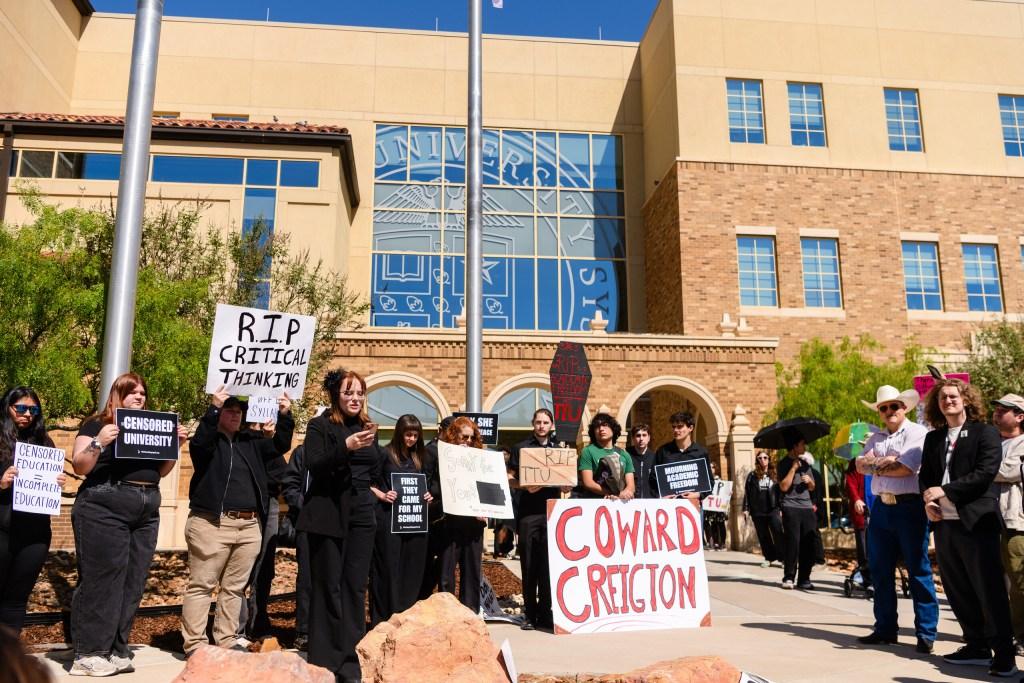
Faculty members at Texas Tech University have reported significant changes to their courses due to new restrictions on teaching about race, gender identity, and sexual orientation. A recent survey conducted by the Faculty Senate revealed that 277 courses were either modified or requested for modification as a direct result of these guidelines.
The survey indicated that nearly half of the faculty respondents made adjustments to their course content independently, motivated by concerns regarding directives from university administration. Approximately 25% reported that they were directly asked by administrators or other university staff to alter their courses.
Furthermore, the findings highlighted a growing dissatisfaction among faculty, with over half of the 367 respondents stating they were exploring job opportunities outside Texas Tech. This sentiment contrasts sharply with the narrative presented by Texas Tech System administrators earlier this spring, who claimed that fewer than 60 out of over 14,000 courses across the system required changes following reviews.
The discrepancy arises from different methodologies: administrators focused on formal reviews, while the Faculty Senate aimed to capture the informal adjustments made by professors at the flagship campus in Lubbock. Alan Barenberg, chair of the Faculty Senate committee responsible for the survey, emphasized the importance of documenting the current situation, stating, “We really just want to capture for posterity what’s going on here.”
Chancellor Brandon Creighton has defended the restrictions, asserting they comply with state and federal law and ensure that students receive degrees that prepare them for lucrative job opportunities. Erin Wilson, a spokesperson for Creighton, questioned the survey’s relevance, arguing that the university relies on robust methodologies and representative data rather than self-selected samples.
In September, the previous chancellor, Tedd Mitchell, informed university leaders that faculty members must adhere to an executive order from former President Donald Trump, as well as directives from Governor Greg Abbott and new state legislation recognizing only two genders. He instructed faculty to review their course materials and adjust them as necessary.
After Creighton assumed the chancellorship in November, he intensified the scrutiny on course content. In December, he mandated that faculty submit materials related to gender identity and sexual orientation for review by the system’s regents. He also prohibited faculty from endorsing specific concepts regarding race and sex, including the notion of inherent superiority among races or sexes.
In April, Creighton issued a sweeping directive that called for the phasing out of academic programs focused on sexual orientation and gender identity. This memo restricted such content in core and lower-level undergraduate courses while allowing limited inclusion in upper-level courses, and also imposed limitations on graduate theses and dissertations concerning these topics.
While Barenberg acknowledged that the Faculty Senate’s survey, which was conducted in May, lacked scientific rigor, he noted that faculty had few alternatives after their request to email the survey to all faculty members was denied. Instead, the survey was posted on the Faculty Senate’s website, accessible only to individuals with Texas Tech credentials, and responses could be submitted anonymously.
As of the fall semester, Texas Tech had 2,157 faculty members, and the survey garnered more responses than the university’s annual IT satisfaction survey, which received just 237 responses last year. Barenberg argued that while the survey may not be statistically representative, its findings are significant and noteworthy.
The impact of the new directives varied across different colleges within the university. Faculty members from the colleges of education, media and communication, and visual and performing arts reported higher instances of modifying their teaching materials compared to their peers, while engineering faculty indicated fewer changes.
Additionally, the survey found that about 18% of faculty altered their research due to the restrictions, with 7% stating that administrators had requested changes to their research as well.
Recently, administrators from the provost’s office met with various departments and distributed written feedback from the regents’ academic, clinical, and student affairs committee. Multiple professors reported that this feedback was generated by an artificial intelligence tool, which flagged specific readings from Barenberg’s graduate seminar on European historiography that focused on gender and sexuality.
Barenberg described how the AI tool mischaracterized at least one reading and initially included instructions intended for a different course. After seeking clarification from the provost’s office, he was provided with corrected guidance that instructed him to teach the course without those readings, with no option to appeal the decision.
Although Barenberg is not scheduled to teach the course again in the fall, he expressed his intention to defy the directive if given the opportunity, stating, “I’m ethically bound by my discipline to teach history to the best of my ability, and that includes not censoring particular texts because of someone’s political preferences.”
Before his appointment as chancellor, Creighton served as a Republican state senator and was a proponent of Senate Bill 37, which aimed to limit the influence of faculty senates on campuses and grant greater authority to governor-appointed regents over curriculum matters.
Historically, the Texas Tech Faculty Senate had a cooperative relationship with university administrators. However, the recent legislation compelled the senate to reorganize, and the April memo shifted the campus atmosphere from one of fear to one of anger, according to Barenberg.
In response to these developments, the Faculty Senate has formally criticized Creighton’s April memo, passing a resolution stating that it would adversely affect Texas Tech, restrict students’ learning opportunities, and impose viewpoint discrimination on students, faculty, and staff. The resolution also raised concerns about infringement on free inquiry and the potential for political interference in academic matters.
Other universities in Texas are also implementing similar restrictions on programs and courses related to race, gender, and sexuality. The Texas A&M University System has prohibited professors at its 12 universities from advocating for race or gender ideology without prior approval from university presidents. Additionally, Texas A&M officials have eliminated its women’s and gender studies program and made revisions to courses after extensive reviews of syllabi.
The University of Texas System has adopted a rule requiring its 14 universities to ensure students can graduate without taking courses that involve “unnecessary controversial subjects.” While this rule mandates instructors to maintain a “broad and balanced approach” when discussing controversial issues, it lacks a clear definition of what constitutes such subjects. At UT-Austin, seven ethnic and gender studies departments are being consolidated.
At Texas Tech, university presidents have until June 15 to identify academic programs, majors, minors, and certificates focused on sexual orientation and gender identity. Creighton has stated that universities must freeze admissions to these programs while allowing current students to complete their degrees.