







Subscribe to The Brief, the daily newsletter from The Texas Tribune that keeps readers informed about the most important news in Texas.
To enhance accessibility, audio recordings are automated. The story has been crafted and refined by human writers. Feedback is welcomed as part of our AI policy.
In a historic move, a Democrat will be contesting every state and federal race on the Texas ballot next year, marking the first time in modern history that either party has presented a complete slate of candidates, as stated by the Texas Democratic Party.
This unprecedented candidate lineup is the result of a recruitment initiative spearheaded by a coalition of the state’s leading Democratic organizations and figures, including Texas Majority PAC, the Texas Democratic Party, former U.S. Representative Beto O’Rourke, and former state Senator Wendy Davis.
Collectively, these groups have successfully enlisted 104 candidates to contest every congressional, state House, and state Senate seat that will be up for election in 2026. This initiative has also ensured that Democratic candidates will participate in all statewide judicial and State Board of Education elections.
“No Republican gets a free ride in Texas,” declared Texas Democratic Party Chair Kendall Scudder in a recent interview. “If you’re a Republican seeking public office in this state, you’ll have to contend with us.”
The decision to field a candidate for every available seat, regardless of how traditionally Republican the district may be, is part of a strategic effort by Texas Democrats to harness electoral turnout and capitalize on discontent with the Trump administration. Organizers believe that running candidates in all areas will not only enhance the party’s potential to flip lower-tier positions but also boost Democratic engagement in regions where high-profile candidates may struggle to make an impact, potentially creating a ripple effect that benefits statewide Democrats.
“Even the most tireless statewide candidate won’t reach every voter they need to,” remarked Texas Majority PAC Director Katherine Fischer. “We require a network of skilled, persuasive Democratic communicators throughout Texas to articulate the message that Republican leadership has let us down, encouraging Texans to consider alternative voting choices this election cycle and beyond.”
Out of Texas’ 38 congressional districts, Republicans currently hold 25, with a newly redistricted map designed to secure an additional three to five seats for the GOP. The Republican Party also holds a commanding majority in the state Legislature, controlling 88 of the 150 Texas House seats and an 18-to-11 lead in the state Senate, where two Republican-leaning districts are presently vacant. All statewide offices, including both U.S. Senate seats, are occupied by Republicans.
Democrats have not claimed a statewide office since 1994. Since that time, the party has consistently left an average of 50 state and federal seats uncontested in each election cycle, as reported by the TDP. Even during the 2018 midterms, which saw President Trump in office and resulted in Democrats flipping two congressional and 12 state House districts, the party left 20 seats without candidates.
Following a challenging election cycle last year, Fischer emphasized that for Democrats to succeed statewide, they must improve their appeal to “essentially every type of voter in every part of the state.”
A common strategy for turning Texas blue involves maximizing Democratic turnout in the state’s liberal urban centers. However, Fischer noted that the level of turnout required to flip the state — which saw Trump win by 14 points last year — is “so high that it’s, if not impossible, quite improbable” to achieve solely through urban and suburban areas, especially given the party’s poor performance in rural Texas.
What accounts for Democrats’ struggles in rural regions? One theory the party has considered is that they have simply not been campaigning in these areas.
“When there are no Democrats running, there are no Democrats engaging with communities to explain our platform,” Scudder noted. “This gives Republicans the chance to define us, rather than allowing our message to come directly from us.”
Longtime Republican strategist Dave Carney described the Democrats’ candidate slate as “merely a gimmick unless it is supported by substantial resources.”
“When they start providing funding for these candidates, let me know,” Carney, who serves as chief strategist for Governor Greg Abbott, stated in an email.
Meanwhile, Abbott has pledged to invest significantly in efforts to turn Harris County red. He has encouraged Republicans to contest every state House seat in the county, as noted by the Houston Chronicle, including those in traditionally blue districts.
Fischer explained that Texas Majority PAC — one of the state’s most financially robust Democratic organizations, backed by millions from liberal megadonor George Soros — intends to allocate approximately $1 million towards recruitment efforts and assisting candidates with various campaign expenses. She argued that even a modest increase of 2 to 3 percent in Democratic turnout could translate to thousands of votes at the top of the ballot.
O’Rourke observed this upward effect during his 2018 Senate campaign, where he narrowly lost to U.S. Senator Ted Cruz by less than three points, marking the closest statewide margin for a Democrat in years.
“Candidates were running all over Texas in places where Democrats were either not expected to compete or had no chance of winning,” O’Rourke reflected in an interview. “While many didn’t win, all contributed to bringing in new voters that I, as a Senate candidate, would never have had the opportunity to meet or mobilize.”
However, attempts by Democrats to replicate this strategy in the subsequent election cycle largely fell flat. The party launched a comprehensive and well-funded initiative aimed at capturing 10 GOP congressional seats and flipping the state House; they ended up losing every contested U.S. House race and failed to gain any seats in the lower chamber of the state Legislature, while Republican U.S. Senator John Cornyn won by nearly 10 points at the top of the ticket.
O’Rourke acknowledged the challenge of asking Democrats to run in predominantly Republican areas, such as Amarillo or Waco, where GOP dominance is strong and district lines have been manipulated to make these seats nearly unattainable for Democrats. Nonetheless, he encouraged hesitant potential candidates by stating that, regardless of the outcome, “just stepping up, putting your name on the ballot, and running for office is an act of service and patriotism, and it will yield positive results for everyone on the ticket.”
Davis also personally reached out to potential candidates, particularly women who were apprehensive about running while balancing their roles as working mothers. “We aimed to inspire belief in the possibility of success and to counteract the cynicism that has long been present in Texas,” she remarked.
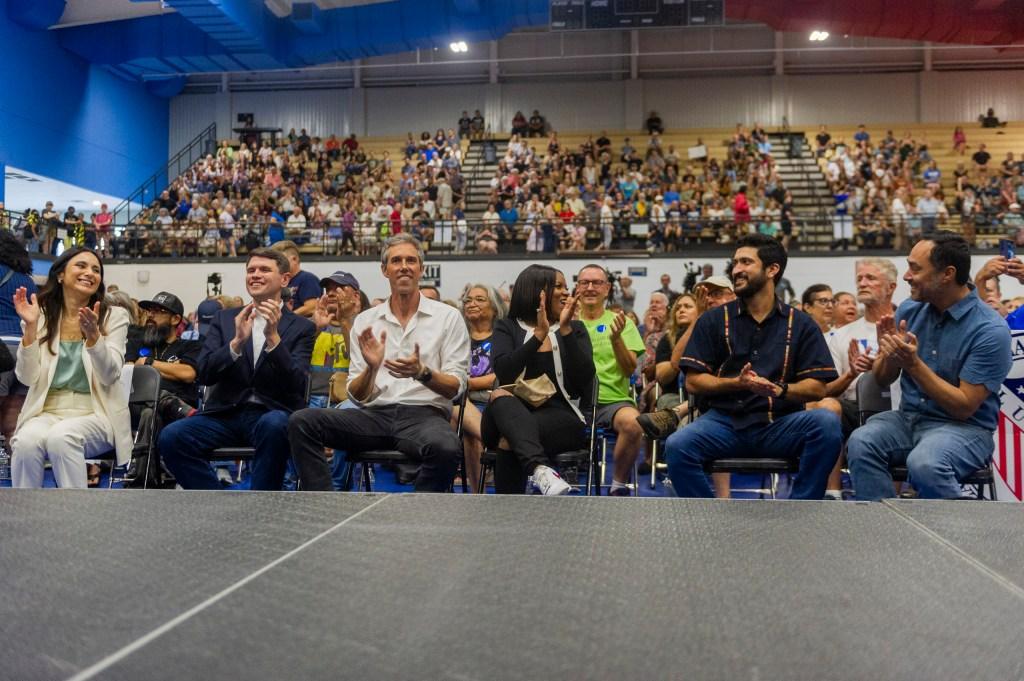
To ensure a Democrat is running in every uncontested race, Texas Majority PAC and the TDP leveraged the influence of O’Rourke, Davis, state Representative James Talarico, and former U.S. Representative Colin Allred, who helped attract prospective candidates to 40 recruitment rallies held mostly in rural communities across the state. In districts that were particularly difficult to fill, the groups reached out to local officials and community members for recommendations on potential candidates.
To identify and evaluate potential candidates, Texas Majority PAC sent out 2.3 million text messages, made 105,631 phone calls, and interviewed 1,385 candidates in targeted districts.
The final candidate lineup, as reported by Texas Majority PAC, features “everyday Texans.” One-third of the recruited candidates have backgrounds in education; 20 percent have experience in the oil fields, chemical refineries, factories, and other labor-intensive jobs; 15 percent are military veterans; 10 percent are union members, and a notable 90 percent are first-time candidates for public office.
“Our focus was on recruiting ordinary individuals, those with compelling stories about how Republican leadership in Texas has personally affected them,” Fischer stated.
Among these recruits is Diana Loya, an educator at Dumas Independent School District in the Panhandle, who is venturing into politics for the first time.
Loya, whose husband was also recruited by Texas Majority PAC to run for land commissioner, is challenging state Representative Caroline Fairly, R-Amarillo, for her significantly Republican Texas House seat. Fairly won House District 87 in 2024 with 79 percent of the vote, while Trump carried the district by a similar margin over Vice President Kamala Harris.
During a campaign video shoot for Loya’s husband, Fischer encouraged Loya to contemplate running for Fairly’s seat. Initially, she declined, preferring to focus on supporting her husband during his campaign.
However, after researching the district’s representation in Austin, she decided that she could not “just sit by.” “I’m not very familiar with politics, and I’m not a politician at all,” said Loya, who has taught in public schools in the region for 20 years. “But I understand the needs we have here.”
She expressed concern that Fairly prioritized banning certain books in public school libraries over addressing more pressing educational issues during the recent legislative session. “I’m sorry, but if you step foot in our schools —