








Savion Horn observed a striking transformation on the screen in his classroom: black-and-white photographs of young boys and girls, first displaying their long hair and traditional attire, then revealing them with cropped hair and dressed in high-necked dresses and formal button-ups.
For Horn, a senior at Grand Prairie High School near Dallas and a member of the Citizen Potawatomi Nation, this marked his first comprehensive lesson on the boarding schools established by the U.S. government to forcibly assimilate Native American children and suppress their cultural identities during the 19th and 20th centuries.
“They were prohibited from speaking their native languages and expressing themselves through their music or art,” Horn reflected, recalling the impactful lesson he experienced in the American Indian/Native Studies class offered at his school. “It was deeply emotional for me, and it would resonate with anyone genuinely interested in learning.”
The American Indian/Native Studies course (AINS) was introduced in the Grand Prairie school district in 2021, thanks to the efforts of Indigenous parents and educators across Texas who developed the curriculum from the ground up. This initiative aimed to build on the success of a Chicano/Mexican American studies class approved by the state in 2015. In 2018, the Texas State Board of Education called for the establishment of additional ethnic studies classes, including one focusing on Native American studies. Following certification as an “innovative course” two years later, AINS became available for adoption by other districts.
However, by 2025, when the course underwent its routine five-year renewal, the political climate in Texas had shifted significantly. Starting in 2021, the state implemented measures to restrict educational discussions on race, ethnicity, and gender. That year, Governor Greg Abbott enacted Senate Bill 3, which limits instruction on “controversial issues” and mandates an objective, politically neutral approach to such topics. In June, just a week prior to the committee’s review, the state enacted SB 12, allowing parents to scrutinize and object to K-12 educational materials while banning policies or programs that reference race, ethnicity, gender identity, or sexual orientation.
On a federal level, former President Donald Trump issued executive orders aimed at eliminating diversity, equity, and inclusion (DEI) practices in public K-12 schools and colleges. Additionally, leadership changes within the Texas education board resulted in heightened scrutiny of course content.
Advocacy groups, including the Ethnic Studies Network of Texas and Native-led organizations like the Society of Native Nations, rallied to support the AINS course. Four Native nations from Texas and Oklahoma endorsed the class, asserting that it provides students with a more comprehensive and accurate understanding of tribal histories than what is typically found in K-12 education.
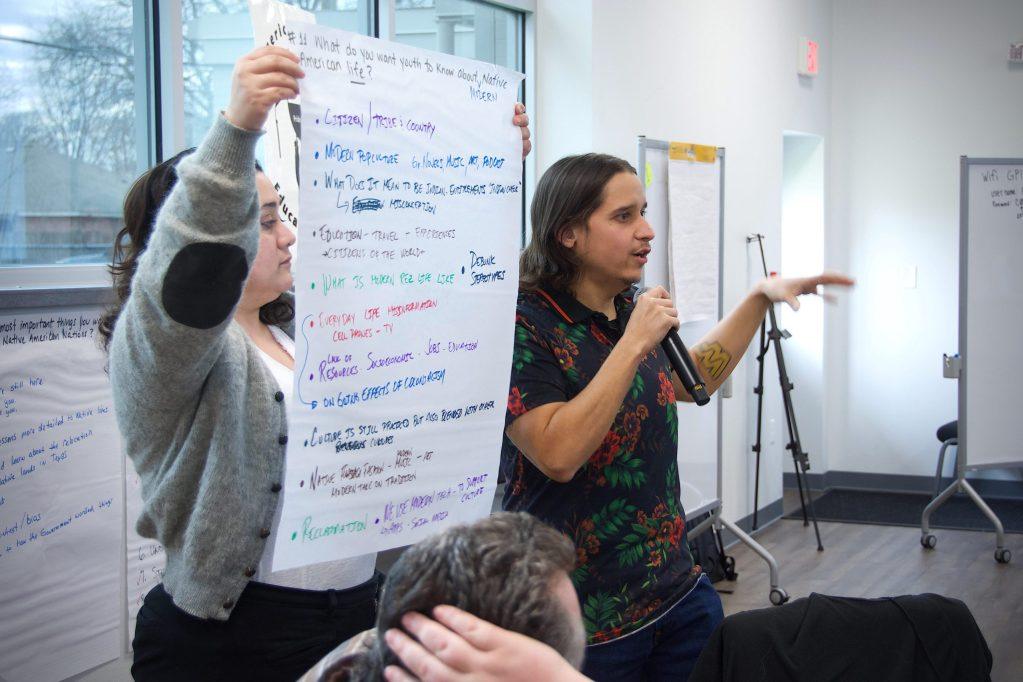
During a planning session in February 2020, community members, educators, and advocates convened to discuss the American Indian/Native Studies course. At the June hearing of the Texas education board, many members expressed support for the class and empathy for the frustrations of course organizers regarding the lengthy renewal process. However, some board members raised concerns about the course’s content, arguing that discussions regarding the Catholic Church’s role in the mistreatment of boarding school students could lead to feelings of shame among Christian students. Another representative questioned the value of land acknowledgments that recognize Indigenous peoples as the original inhabitants of an area, suggesting that some land was traded or unclaimed.
After two days of deliberation, the board voted 9-5 to renew the course, contingent upon the removal of a passage from a reading about George Washington that the board found objectionable. This decision allows the course to continue as an innovative class for another five years. At a time when DEI initiatives face opposition nationwide, supporters of the Native studies course view this outcome as a beacon of hope for similar programs across the country.
“This is an incredibly significant victory,” stated Sarah B. Shear, an associate professor of social studies and multicultural education at the University of Washington-Bothell. She noted that her research has shown that K-12 social studies curricula often overlook contemporary contributions from Indigenous peoples.
Inspired in part by research like Shear’s, several other states and districts have begun to expand Native studies programs. In 2015, Washington state mandated that every school district teach tribal history, culture, and government, becoming the second state to enact a Native Education for All law, following Montana’s lead in 1999. In 2025, California enhanced its history curriculum to incorporate more Native perspectives on the Gold Rush and Spanish colonial periods. Arizona also requires students to complete at least two social studies courses addressing Native American history, one in elementary school and another in high school.
In Texas, educators, parents, and tribal members collaborated via Zoom during the pandemic to develop the course, which encompasses lessons on geography, arts, culture, and the modern achievements of Indigenous peoples in Texas and beyond. The curriculum includes discussions on significant Supreme Court rulings affecting tribal affairs, boarding schools, and the Indian extermination policies of Stephen F. Austin, alongside topics such as mascots and Indigenous scholarship.
The course’s creators, a diverse group of 22 individuals from both Indigenous and non-Indigenous backgrounds, conducted training sessions to equip educators with the necessary content and teaching strategies for implementing the course. Lanette Aguero, the social studies coordinator for the Grand Prairie district, was among those who participated. Her interest in introducing the class was sparked by attending an ethnic studies conference at Texas Christian University in 2019.
Although the Native American student population in the 27,000-student Grand Prairie district is relatively small—only about 120 students identified as Native American in the 2023-24 school year—the larger Dallas area has a significant Native American community. The inaugural year of the class in 2021 saw 12 students enroll, a number that grew to 48 by 2024. Additionally, two other districts, Robstown and Crowley, adopted the course in 2024.
Kimberly Rafalski, one of the first instructors of the AINS class and a long-time social studies teacher in Grand Prairie, shared that she often felt she was learning alongside her students. Together, they explored pre-contact histories and the ongoing narratives of Indigenous peoples that are frequently omitted from traditional textbooks.
“Some days were particularly challenging,” Rafalski recalled, noting that she left school in tears after discussing the boarding school history, often picturing her own young children. Throughout the year, however, she observed the class bond over reflections on Indigenous resilience, celebrating it through art.
“There are many difficult topics in this class,” Rafalski said. “We don’t sensationalize any of it. But we also don’t dwell on trauma. For every challenging subject we tackle, we engage in an activity that highlights resilience.”
When the Texas education board called for the adoption of ethnic studies classes in 2018, most members supported the initiative but held differing opinions regarding whether such content should be integrated into existing courses or taught as standalone classes. Advocates for ethnic studies referenced research indicating that including diverse representation in textbooks can enhance student performance. Conversely, some members expressed concerns that specialized ethnic classes might foster division. Ultimately, Texas approved a Mexican American studies course that year, marking the first high school ethnic studies class sanctioned in the state, followed by the approval of the Native studies course three years later and an Asian American studies class in 2024.
Feedback from students about the AINS class has been overwhelmingly positive: 97 percent of the 63 participants who completed a Texas Education Agency survey reported feeling “more positive about Native American/Indigenous culture than before taking the class.” One student remarked that the course “helped me embrace my identity as a Native American.”
Walter Dougherty, a 10-year-old from Conroe Independent School District near Houston, testified in favor of the course, sharing that prior to AINS, his classes focused more on ancient civilizations than on contemporary Native American issues. “People often talk about us as if we are extinct, but we are not. I’m right here,” Dougherty stated. “My brother and I are Cherokee children growing up in Texas, and we want people to understand our culture and history. Learning about my Cherokee heritage makes me proud and empowers me.”
Cheyenne Rendon (Diné and Apache), a senior policy officer for the Society of Native Nations and a lifelong resident of Texas, expressed her concern for future generations. “I can’t imagine my son growing up without understanding his ancestors,” she said, emphasizing that AINS offers hope against erasure.
Discussions surrounding the reauthorization of the American Indian/Native Studies course revealed ongoing concerns about its compliance with Texas’s recent anti-DEI policies. At the hearing, Orlando Lara, co-founder of the Ethnic Studies Network of Texas, defended the course’s legality, citing a letter from the federal Department of Education stating that “American Indian, Alaska Native, and Native Hawaiian history is not classified as diversity, equity, and inclusion (DEI) or critical race theory (CRT).” This classification recognizes Native Americans as distinct political identities, separate from racial or ethnic classifications.
Despite this, board members continued to question Lara regarding the definitions of race and ethnicity in relation to the new state legislation. Due to the lack of guidance from the Texas Education Agency concerning the 2021 “controversial issues” legislation, many districts were uncertain about potential legal repercussions related to course content. Lara noted that