







The Foilies 2026: Recognizing the Worst in Government Transparency
For the past six years, journalism students at the University of Nevada-Reno have embarked on a unique semester tradition: filing Freedom of Information Act (FOIA) requests. Their assignment is simple yet enlightening: they seek out complaints lodged with the Federal Communications Commission (FCC) regarding their favorite TV shows, local radio stations, or significant broadcasting events like the Grammys or the Super Bowl. This exercise serves to instill in students an understanding of the public’s right to access government records, a fundamental aspect of democracy. If the government is meant to serve the people, then its documents should be accessible to them.
Historically, the FCC has been prompt in fulfilling these requests, often providing records within days. However, that changed in September when students sought consumer complaints against NPR and PBS stations to determine if there was any legitimate cause for defunding public media. Seven months later, the students are still waiting for a response, illustrating the challenges of navigating a system where officials often disregard transparency obligations. This is where The Foilies come into play.
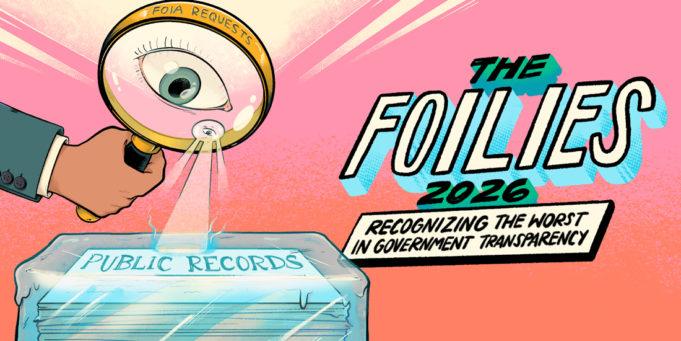
Launched in 2015, The Foilies is an initiative by the Electronic Frontier Foundation and MuckRock that humorously highlights the agencies, officials, and contractors who obstruct the public’s right to information. These “awards” are presented during Sunshine Week (March 15-21), a campaign aimed at promoting open government.
This year, several “winners” have been identified for their astonishing lack of transparency, but it’s not all negative. In a positive twist, the same Reno students have also been tasked with filing public records requests for restaurant health inspections, and this semester, they received responses within just 20 minutes, showcasing an example of efficient governmental communication.
The Love Letters Award — Gov. Greg Abbott
Last spring, Texas Governor Greg Abbott’s office withheld communications between him and Elon Musk, one of the state’s most influential business figures. The office claimed that these communications were exempt from public records law due to their confidential nature, which purportedly included sensitive legal and policy discussions. The justification provided was vague and based on standard exemptions in Texas’ public records law. However, the public may be left wondering what “intimate” and “embarrassing” exchanges occurred between Abbott and Musk.
In the fall, the Texas Attorney General ordered Abbott’s office to release nearly 1,400 pages of communications, of which about 1,200 were completely redacted. The limited information that was made available included benign invitations to social events and reminders about SpaceX launches.
The Shady Screenshot Award — Department of Homeland Security (DHS)
The DHS had a notably disappointing year in terms of transparency, particularly as it rolled back its obligations. In a response to a request from American Oversight, the DHS announced it would no longer automatically archive text messages sent by officials. Instead, it implemented a new records retention policy requiring officials to take screenshots of relevant text communications on their work phones.
This shift raises concerns, as the Federal Records Act mandates that all records created by officials during their public duties must be retained, regardless of the format. It seems unlikely that DHS officials will consistently take the necessary steps to properly document their communications.
The Discardment of Government Efficiency Award — DOGE
As the Trump administration took office, a perceived threat to government transparency emerged in the form of the Department of Government Efficiency, or DOGE. Elon Musk, who assumed an influential role in DOGE, claimed that FOIA requests should be unnecessary and that all government data should be publicly available for maximum transparency. However, it soon became clear that there might be no FOIA officers left to process any requests.
DOGE swiftly moved to streamline federal operations, which included restricting access to the U.S. Institute of Peace’s FOIA system and terminating the employees responsible for handling such requests. When CNN asked for information regarding Musk and DOGE’s security clearance through FOIA, the response was a dismissive “Good luck with that,” due to the absence of FOIA personnel.
Additionally, DOGE claimed that its records were exempt from FOIA under the Presidential Records Act, meaning they wouldn’t be available until five years after Trump left office. Although DOGE is reportedly defunct according to the Office of Personnel Management, its legacy casts a long shadow over FOIA practices and records management.
The Secret Eyes in the Sky Award — Chula Vista Police Department, California
In 2021, Arturo Castañares at La Prensa San Diego sought access to videos recorded by drones responding to 911 calls from the Chula Vista Police Department (CVPD) as part of their “drone as first responder” program, which aimed to evaluate the technology’s effectiveness and its impact on civil liberties. However, the city worked diligently to keep this footage under wraps, even as officials publicly praised the drones as a groundbreaking advancement in policing.
CVPD argued that all drone footage was exempt from public disclosure as law enforcement investigative records. Initially, a trial court accepted this reasoning, but an appellate court later determined that the exemption applied only to footage related to criminal investigations. Consequently, recordings of non-criminal incidents, such as wildfires or traffic accidents, had to be released.
The California Supreme Court ultimately rejected CVPD’s appeals, and the city was forced to pay over $400,000 in legal fees to outside counsel, in addition to more than $500,000 to Castañares after he prevailed in court. What were they trying to hide? Routine service calls, including unverified reports of a vehicle fire and a minor collision. Following this, officials attempted to tap into a public safety fund established by voters to cover the costs of their misguided efforts at secrecy.
The Flock You Awards — Taunton Police Department, Massachusetts
In cities where surveillance firm Flock Safety has partnered with local law enforcement, residents may have noticed the installation of small black cameras that capture automated license plate readings (ALPRs), documenting details about every vehicle that passes by. These images are stored on Flock’s servers, and the company encourages police to share this data with agencies nationwide.
In 2025, journalists and privacy advocates began filing public records requests to obtain “Network Audit” spreadsheets, which track every search conducted, including the rationale behind them. This initiative revealed several abuses of the system, such as targeting individuals who had received abortions, surveilling immigrants, and engaging in racially biased investigations.
While some jurisdictions have terminated their contracts with Flock Safety in response to these findings, others, including Taunton Police Department, took a different approach. The department presented the ACLU of Massachusetts with a staggering $1.8 million fee to access its network audit logs, the highest public records fee recorded this year. Although many agencies complied with requests for free, Taunton claimed it would take an exorbitant 20,000 hours to process the request at a cost of $86.57 per hour.
In response to mounting criticism, Flock Safety attempted to silence its detractors through legal threats, including a dubious trademark claim against DeFlock.me, a crowdsourced map of ALPR installations, which the Electronic Frontier Foundation represented. They also sought to pressure the hosts of HaveIBeenFlocked.com, a site designed to search network audits, to remove it from the web.
The Foilies were crafted by EFF’s Beryl Lipton, Dave Maass, and Aaron Mackey, alongside MuckRock’s Dillon Bergin, Kelly Kauffman, and Anna Massoglia.