







MIAMI — The Trump administration is reinstating a controversial rule that could prevent immigrants from obtaining green cards if they utilize public assistance programs, including food stamps, Medicaid, and housing vouchers.
This policy, known as “public charge,” was announced on Thursday in the Federal Register. It is set to be formally published on July 20 and will take effect on September 18. Under this rule, green card applicants must demonstrate that they will not become a burden to the United States.
The public charge rule was first introduced in February 2020 as part of President Donald Trump’s broader strategy to restrict legal immigration but was reversed following the inauguration of President Joe Biden.
The revival of this policy coincides with the Republican administration’s robust efforts to tighten both illegal and legal immigration amid rising healthcare and food costs.
U.S. Citizenship and Immigration Services emphasized in a post on its X account that the government is reaffirming the importance of self-sufficiency, safeguarding public resources, and eliminating policies that foster dependency on taxpayers. The post stated, “Under President Trump, USCIS is restoring the basic principle that immigrants must be able to support themselves.”
While the administration has intensified immigration enforcement, focusing on deportations and crackdowns in urban areas and at borders, it is also targeting legal immigrants and families with mixed immigration statuses, where parents are foreign nationals and children are U.S. citizens.
The revised rule broadens the criteria for disqualification. Although federal law already mandates that individuals seeking permanent residency must prove they will not become public charges, the Trump administration’s version expands the definition significantly.
Crucially, the new rule does not specifically list the benefits or programs that will be considered in assessing public charge status. Instead, it instructs officials to make “individualized, fact-specific public charge inadmissible determinations based on the totality of the alien’s circumstances.”
Furthermore, it states that officers will use “good judgment and discretion” to assess an applicant’s likelihood of becoming a public charge.
The Trump administration initially promoted this rule in 2018 to ensure that only self-sufficient individuals could immigrate to the U.S. Critics, including immigrant rights advocates, have argued that it amounts to a “wealth test,” while public health experts warn it could negatively impact health outcomes.
Manatt Health, a consulting group for state and federal governments, estimated that the policy might deter up to 26 million individuals from accessing healthcare, food, housing, or other forms of assistance for which they are eligible under federal law. About half of those affected were U.S. citizens, primarily children or adults in mixed-status households.
Experts have pointed out that the majority of individuals receiving public benefits are already legal residents. A 2020 study by the Migration Policy Institute indicated that, while the potential “chilling effects” of the rule could be extensive, the number of immigrants who might be deemed ineligible for permanent residency based on their current use of public benefits is relatively small—estimated at no more than 167,000 individuals, which is less than 1% of the 22.1 million noncitizens residing in the U.S. at that time.
As of 2023, the Census Bureau reports that there are approximately 22.8 million noncitizens living in the United States.
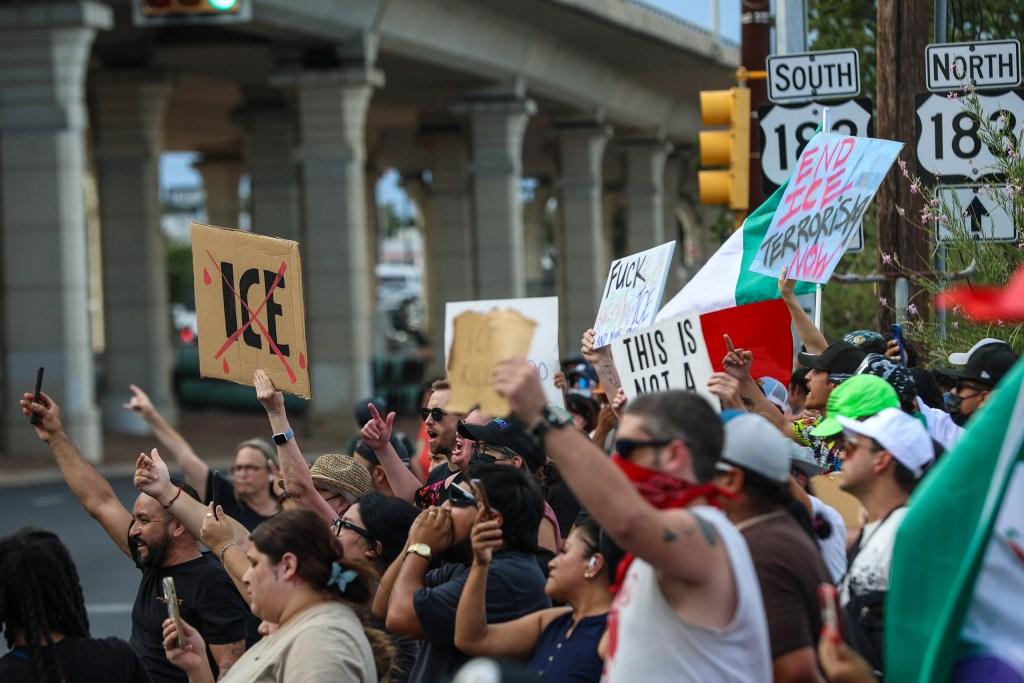
Critics assert that the rule fosters fear within immigrant communities. Nonprofit organizations have reported that the policy has caused confusion and anxiety, leading many immigrants and their U.S.-born family members to forgo applying for benefits and services they are entitled to receive.
Advocates for immigrants have condemned the government’s decision to revive the public charge rule, highlighting their concerns about its implications. “This regulation is a direct assault on immigrant families and poses a threat to our nation’s health and economic security,” stated Adriana Cadena, executive director of the Protecting Immigrant Families Coalition. “The Trump administration is making immigration decisions based on bias and politics, regardless of the harm that results.”
Sarah Krieger, senior policy counsel at the National Immigration Law Center, expressed that the rule instills fear among immigrants regarding seeking medical care, purchasing groceries, and filing taxes. “With this new rule, they are sowing fear and chaos to ultimately reshape America into a country where only the few who are white and ultra-wealthy are welcome,” Krieger remarked. “The rule is not only deeply harmful but also violates the law.”