







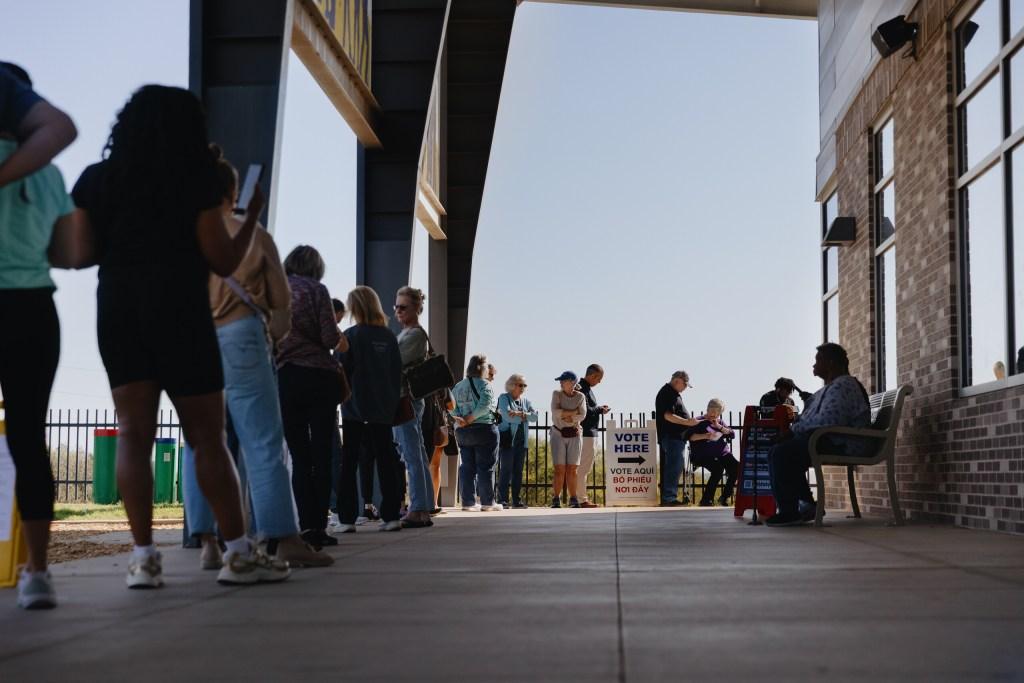
Election results in Texas will start to emerge on the evening of Election Day. While winners will be announced and victory speeches delivered, the official results will only be confirmed after a certification process that takes place weeks later.
This critical final stage involves solidifying the election results and issuing a “certificate of election” to the victors. Historically, this certification has been a straightforward and unremarkable process. However, following the 2020 Capitol riots, which aimed to disrupt the certification of the presidential election, the procedure has come under increased scrutiny.
In Texas, the governor, the House speaker, and county commissioners are responsible for certifying state and local elections. Experts indicate that their role primarily involves approving the results without significant intervention.
Jonathan Diaz, director of voting advocacy and partnerships at the nonpartisan Campaign Legal Center, stated, “There is no discretion. The certification of election results is a ministerial duty under the law, which means it’s mandatory.” He added that this step usually follows a methodical process that verifies the accuracy of the results.
Joshua Blank, research director of the Texas Politics Project at the University of Texas at Austin, echoed this sentiment, emphasizing that the Texas Election Code mandates public officials to “shall certify the tabulations.” He highlighted that this is not optional; it is an obligation.
Despite the clear legal framework, voting rights advocates are closely monitoring the certification process in Texas. Kenneth Parreno, counsel at Protect Democracy, remarked that many are watching with cautious optimism, yet prepared for any potential issues, citing concerns over disinformation about voting and election integrity from state and federal officials.
Parreno warned, “Just because they’ve called into question the integrity of the vote, we’ve been concerned that these rogue officials may try to mess with Texas elections.” However, he noted that legal provisions within the Texas Election Code should prevent such actions.
On October 27, the Potter County Republican Party filed a lawsuit aimed at halting the certification of the November 3 midterm elections unless all machine-cast paper ballots were counted by hand. The lawsuit, which lacked substantial evidence, raised alarms about interference from artificial intelligence and foreign adversaries, yet the existing certification process already mandates hand counting a portion of paper ballots to ensure the accuracy of machine counts.
The certification is the final piece of the canvassing process, which encompasses tabulating ballots and verifying counts. The Election Code specifies that anyone who “knowingly or intentionally makes any effort to… refuse to count votes the person knows are valid or alter a report to exclude votes the person knows are valid” is committing a felony. Failing to certify the results would constitute a violation of this law, according to Parreno.
He further explained that if a public official refuses to certify the election results, candidates and voters may seek a court order to rectify the situation, as state law entitles them to do so.
The responsibility for certifying Texas election results varies based on the type of race. Local elections, such as city council and mayoral races, are typically certified by local canvassing authorities, usually a county commissioners court. For statewide and congressional races, Secretary of State Robert Howden oversees the tabulation and verification, followed by Governor Greg Abbott issuing certificates to the winners. Notably, the races for governor and lieutenant governor will be certified by House Speaker Dustin Burrows.
There are specific deadlines for certification: local races must be confirmed by the 14th day after Election Day, or November 17. Abbott and Howden have until December 7 to act on statewide races, while Burrows must certify the gubernatorial races on the first day of the legislative session, January 12, 2027.
Voting advocates anticipate that challenges to election results may arise between Election Day and the official certification. Diaz suggested that candidates closely aligned with former President Donald Trump might attempt similar tactics to contest the results.
Nevertheless, voting rights advocates remain hopeful that the certification process in Texas will proceed smoothly and without incident. Diaz remarked, “Certification should be like a boring bureaucratic government task that nobody thinks about.”