








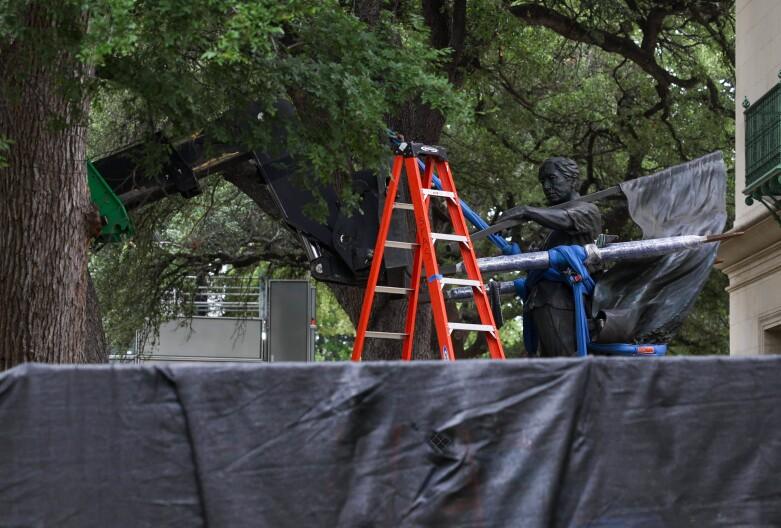
The University of Texas at Austin has commenced the removal of a statue commemorating labor rights activist Cesar Chavez. This action follows a recent investigation by a major publication that included allegations of sexual abuse against Chavez, prompting significant backlash within the Latino community in Austin and raising complex discussions about the future of honoring the labor movement.
The investigation’s revelations have led to the cancellation of celebrations in honor of Chavez by the Austin Independent School District, and the city is contemplating a potential renaming of Cesar Chavez Street. Community reactions are mixed, with some advocating for the erasure of Chavez’s legacy while others argue for a more nuanced approach.
When the statue was unveiled in 2007, it was celebrated as the first statue of a Latino on the university campus, crafted by Bolivian artist Pablo Eduardo and installed near Battle Hall. Juan Gonzáles, a professor in the education department at UT who played a key role in funding and installing the statue, noted that it was the result of years of student advocacy aimed at honoring labor workers and Chavez’s contributions.
Gonzáles expressed concern that the university did not consult students or faculty prior to the statue’s removal. “I’m not in opposition to the removal,” he stated, “but I believe there should have been a more engaged conversation and debate. The community, consisting of faculty and students, could have offered recommendations on how to continue honoring the ongoing struggles of farm workers.”
Officials at UT have yet to publicly address the decision to remove the statue, marking a departure from the university’s previous approach to handling controversial statues. In 2017, the university took down three Confederate statues after extensive consultations with students, holding public hearings, and deliberating with a task force.
Alfonso Ayala III, a third-year doctoral student in the Mexican American and Latina/o Studies Department, expressed a desire for the university to replace the Chavez statue with one that celebrates the labor movement. He has reached out to UT for clarification on the rationale behind the statue’s removal but has not received a response. “I’m curious about how decisions are made regarding what is remembered and what is allowed to be forgotten,” Ayala remarked.
Members of the Mexican American and Latina/o Studies Department have indicated that the university did not inform them of the statue’s removal plans. This department is among seven that UT President Jim Davis announced will be consolidated within the College of Liberal Arts.
Karma Chávez, the department chair, noted that she was not consulted about the statue’s removal. “I hope they consulted members of the Chicano community before taking the statue down,” she said. She emphasized that while statues should honor movements rather than individuals, it is crucial to consider the current political climate, particularly as this statue is taken down amidst broader efforts to marginalize queer, trans, and people of color communities in Texas.