






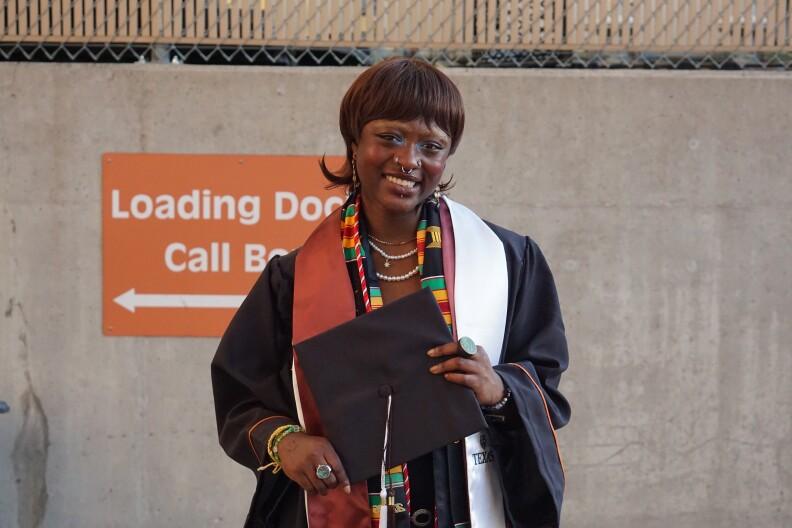
Otofu Ayaku, a recent graduate of the University of Texas at Austin, has shared a harrowing account of their experience in immigrant detention, which they describe as “dystopian.” After being released from a detention facility, Ayaku returned to Austin to celebrate graduation on May 9, joining thousands of other graduates. Just two months prior, their circumstances were drastically different.
<pHaving spent nearly a month confined in two detention centers in the Houston area, Ayaku provided a glimpse into the conditions they faced. At one facility, they were crammed into a large room with approximately 40 other immigrants, where privacy was nearly nonexistent, and basic amenities were limited.
“I would say that my experience in detention was dystopian,” Ayaku reflected. “Dystopian in the sense that you’re living, but you don’t really have control over anything.”
<pOriginally hailing from Nigeria, Ayaku arrived in the U.S. with their family in 2018 at the age of 13. Their troubles began in March when a routine traffic stop led to their arrest and subsequent transfer to the Austin County Jail in Bellville. Despite having documentation proving their legal status in the U.S., Ayaku was moved to the Montgomery Processing Center and later to the Houston Contract Detention Facility. Although the criminal charges against them were eventually dismissed, their immigration case remains unresolved. They returned to Austin after being released on bond and fitted with an ankle monitor.
<pAyaku is actively involved with a local organization known as the Indigo Collective, which has been instrumental in providing updates on their legal situation and fundraising for associated costs.
<pDuring their time in detention, Ayaku formed connections with fellow detainees from diverse backgrounds, including individuals from Africa, the Caribbean, and South Asia. "I made a bunch of friends," they remarked, noting the difficulty of communication as they were unable to place calls to them.
<pTo help alleviate the monotony of detention, guards would occasionally distribute coloring pages, and some detainees ingeniously crafted bracelets from trash bags, dyeing the plastic with pencil shavings and weaving them together. Since their release, Ayaku has continued to wear several of these handmade bracelets, a testament to the bonds formed during their confinement.
<p"Honestly, the only difference between [the other detainees] and me right now is that I'm out and they're in," Ayaku stated. "But we're all fighting cases. It's just easier to do it when you're not in detention."
<pMany immigrants, Ayaku explained, face the agonizing decision of remaining in detention indefinitely or opting to leave the country voluntarily. "They call it 'going home,'" Ayaku noted, emphasizing that for those detained, "home" is defined by the location from which they were apprehended.
<pAlthough Ayaku is grateful to have attended graduation, they are now working with the University of Texas to catch up on coursework missed during their detention. With an uncertain future in the United States, Ayaku is trying to manage their expectations.
<pAyaku recounted their experiences in detail during a recent episode of Austin Signal, shedding light on the challenges faced by many in similar situations.