





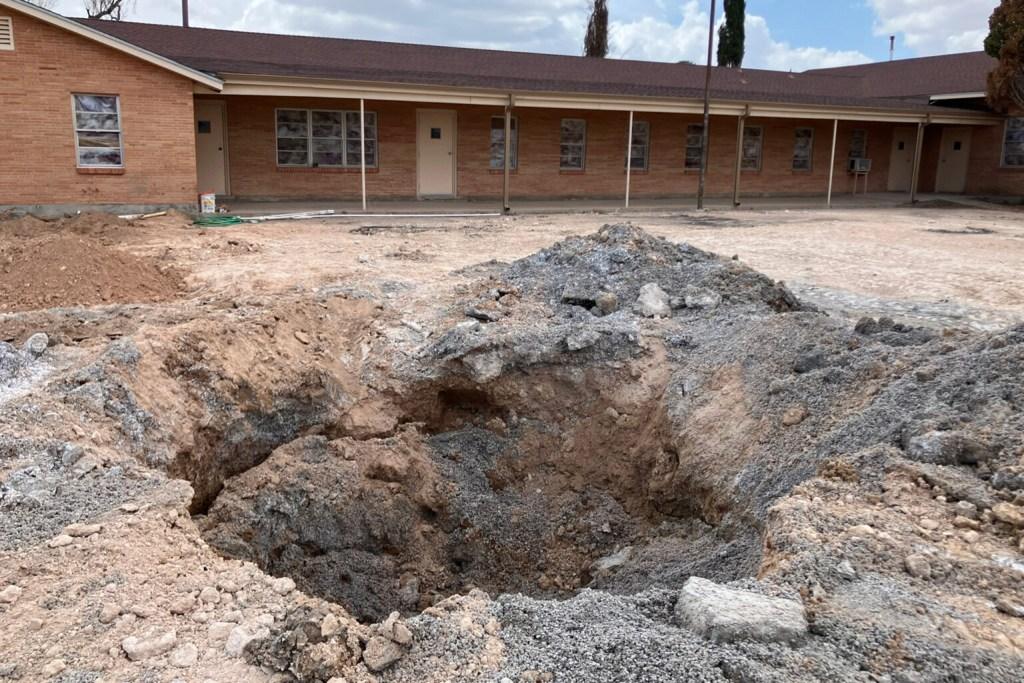
GRANDFALLS — An abandoned oil well unexpectedly began leaking beneath the parking lot of the First Baptist Church of Grandfalls in April, resulting in a significant environmental incident. Over the course of eight days, more than 1.5 million gallons of toxic wastewater escaped into the surrounding area, as documented by state records. The Railroad Commission of Texas, the state’s regulatory body, allocated $1.49 million to seal the leak and an additional $1.16 million for the disposal of the contaminated water. By early June, crews successfully halted the flow and sealed the wellbore.
Fortunately, the toxic wastewater did not infiltrate the church, alleviating immediate concerns. However, lingering questions remain for Pastor David Tucker and local residents regarding the safety of old wells in the region. What could happen if a future leak occurs beneath a home or school?
The Permian Basin, a major oil-producing region, generates vast amounts of wastewater, often referred to as produced water. This saline and toxic byproduct is typically injected underground into designated wells, which has increased subterranean pressure. This pressure has been known to force its way to the surface through older, compromised wells, resulting in eruptions of wastewater.
In response to the leak, the Railroad Commission ordered a halt to the injection of wastewater at wells within a five-mile radius of Grandfalls while the situation was being addressed. Agency spokesperson Bryce Dubee noted that the investigation into the older well beneath the church parking lot is ongoing.
When David Tucker assumed the role of interim pastor at the First Baptist Church last summer, his primary concern was upgrading an outdated air conditioning system. However, with the leak’s emergence, Tucker, who has a background in the oil and gas sector, found himself in a position to advocate for change. He views the incident as a critical opportunity to highlight the ongoing issues associated with oilfield leaks in the Permian Basin.
“This situation has drawn attention to the challenges we face,” Tucker remarked, referencing the recent spate of oilfield leaks and geysers. He commended the Railroad Commission for its prompt response but emphasized that the agency requires additional financial resources to effectively tackle such problems.
“They’re trying to do a good job, but they lack the funding,” he stated. “The state needs to allocate more money to address these issues.”
Dubee confirmed that the Railroad Commission’s State Managed Plugging program is focused on resolving the situation in Grandfalls.
Injection wells are intended to securely contain wastewater underground. However, in recent years, there have been alarming instances of wastewater erupting at the surface, resulting in geysers, leaks, and sinkholes.
Tucker is not unfamiliar with these issues. At his own property near Grandfalls, he has reached out to the Railroad Commission for assistance with leaking old wells. Areas surrounding Grandfalls, particularly in Crane, Pecos, and Ward counties, have been hotspots for such incidents, including a notable geyser in 2022 and another blowout earlier this year.
“We’re doing something subsurface, and it’s clear to everyone,” Tucker commented. “We have turned much of the shale play into one large fracture. Everything is interconnected.”
The April 21 leak was notably located in the heart of Grandfalls, a significant departure from previous incidents. The First Baptist Church, established in 1955, is situated along Avenue D, the town’s main road, just a short distance from the only gas station and across from a K-12 school. This gusher represents the most significant oilfield wastewater incident to occur in a populated area of Texas to date.
With a population of 375, Grandfalls faces socioeconomic challenges, with over 20% of residents living below the poverty line, and nearly half identifying as Hispanic.
Records obtained reveal that water testing conducted by a Midland lab indicated the wastewater was heavily contaminated with chloride and sulfate, boasting total dissolved solids measuring 138,771 parts per million — approximately four times saltier than seawater. These findings align with the characteristics of produced water.
Daily reports from the Railroad Commission outline the extensive efforts to manage the leak, detailing how vacuum trucks swiftly removed wastewater from the site. From the night of April 21 into the following morning, trucks transported away 2,280 barrels, or 95,760 gallons, of wastewater. In the subsequent 24-hour period, an additional 6,600 barrels, totaling 277,200 gallons, were taken offsite, followed by over 10,000 barrels, or 42,000 gallons, in another 24-hour timeframe.
“We are witnessing a release of seven barrels per minute from the leak site,” a Railroad Commission employee noted in a report. At that point, 21 vacuum trucks were actively engaged in managing the overflow.
In addition to the wastewater, oil was also observed leaking from the ground. Contractors worked diligently to pinpoint the source of the leak, and by April 29, they succeeded in locating a wellbore and filling it with concrete to cease the flow.
While the location of the well is marked on Railroad Commission maps, the exact drilling date remains unclear. Numerous wells in Grandfalls were established as far back as the 1930s.
“The RRC has located historical well records for the area, but we have yet to definitively identify the well in question,” Dubee stated, emphasizing that the investigation is ongoing.
Hawk Dunlap, a well control specialist and former Railroad Commission candidate, expressed relief that injection activities were suspended in the vicinity. He noted that residents often have to decipher the agency’s communications to fully grasp their response to emergencies.
However, he highlighted the paradox of transporting wastewater to injection wells only to pump it back underground, questioning the efficacy of the practice.
“You’re removing it from one location and placing it back into another,” he remarked.
State Representative Brooks Landgraf, a Republican from Odessa, visited the First Baptist Church on April 24, assuring the community that the situation was under control and posed no immediate threat to public safety. He acknowledged the concerns regarding a leak from a well plugged in the 1930s.
Landgraf is advocating for Texas to issue permits for the use of treated produced water beyond the oil industry, aiming to alleviate the volume of wastewater injected underground. He has engaged with officials from the Texas Commission on Environmental Quality (TCEQ) to discuss the permitting process for applying treated produced water on land.
“Every gallon of produced water permitted for safe land application reduces the amount injected into the ground in the Permian Basin,” he noted. Landgraf did not respond to further inquiries.
Commission Shift, a nonprofit advocating for improved oversight of the oil and gas sector in Texas, has urged caution in permitting uses of produced water outside the industry. The organization argues that incidents like the Grandfalls leak underscore the need for restrictions on injection activities.
“It’s time to cease injections in areas that are overpressurized, where problems continue to arise,” stated Julie Range, policy manager at Commission Shift. “The combination of overpressurized fluids and unplugged conduits is leading to these costly disasters.”
The gusher incident has confirmed surveyor Jackie Portsmouth’s concerns about the potential dangers posed by old wells beneath residential properties.
Portsmouth, affiliated with G-Forensic, noted that Railroad Commission records are often incomplete, particularly for wells drilled prior to modern record-keeping practices. He aims to raise awareness about the risks associated with aging oil wells situated beneath homes and other structures.
His research into the legacy of oil wells in Midland neighborhoods revealed instances where plugged wells are found beneath residential foundations, unbeknownst to homeowners.
“I’m not trying to alarm anyone,” he said. “But they should at least be made aware of these wells’ existence.”
In Oklahoma, a ProPublica report highlighted a leak originating from an old well beneath a family’s home, leaving them still searching for answers after being displaced.
Tucker, the pastor, mentioned that he has received calls from residents across the Permian Basin who are now proactively investigating the locations of old wells near their homes. He remains grateful that no injuries resulted from the leak and is hopeful that it will increase awareness about the risks.
The highly saline water from the leak caused damage to several trees on church property. In the rush to manage the situation, crews inadvertently severed the church’s sewer line. Tucker noted that securing insurance for an old, rural church like First Baptist is nearly impossible and does not expect the damages to be covered.
Currently, the congregation is meeting at the Union Church across the street. Tucker is optimistic that they will return to their sanctuary by the end of summer, relying on the Railroad Commission to assist with repairing the parking lot and reconnecting the church’s sewer line.
“I hope the commission uses this incident as an opportunity to demonstrate their support for our small congregation in this little town,” he concluded.