





Austin is a city where the sight of deceased animals on the roads is a common occurrence. Whether it’s a squirrel or a more unusual creature like an armadillo, these unfortunate beings often fall victim to the city’s bustling activity. An anonymous resident, troubled by the sight of a squashed opossum in the bike lane outside his home, sought to uncover the fate of these animals once reported to the city.
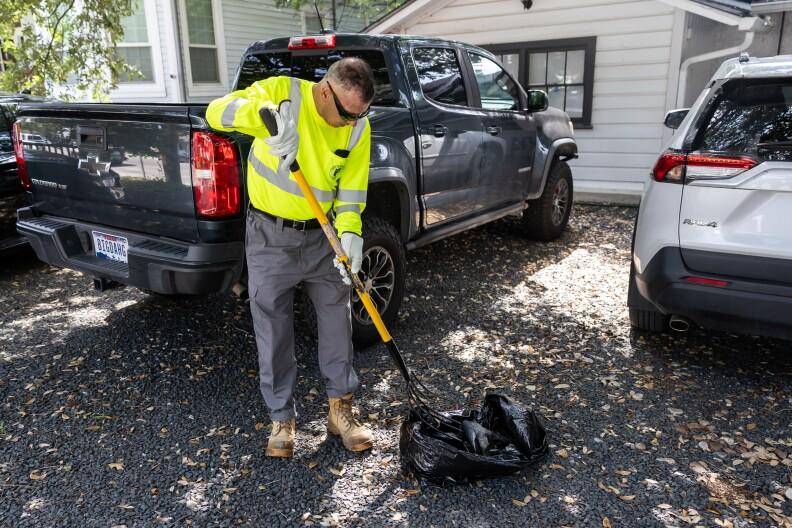
To answer this question, I joined a team from Austin Resource Recovery, the city’s waste management department, tasked with the grim job of collecting these deceased animals. Marvin LeVaughn, a dedicated driver for the department, shared insights about the variety of creatures they handle.
“Most of the animals we pick up are opossums and raccoons, but we also see quite a few cats,” Marvin noted, revealing that last year alone, the department removed 2,780 dead animals from Austin’s roads.
Equipped with microchip readers, the team can identify lost pets, allowing them to notify owners when a beloved animal is found. Marvin’s day began with the collection of a deceased dog, which had been carefully placed in a makeshift coffin by its owners. He gently loaded the box into his truck, reflecting on the somber nature of his work.
“It gets sad sometimes, but I’m just glad to tidy them up and put them away properly,” he explained, emphasizing the importance of not leaving the animals to decay on the streets.
At another stop, driver Dwight Leonard collected a dead squirrel that had been placed in a paper bag—a rare act of kindness from a passerby. Typically, the animals are still on the road, often requiring more effort to load due to their condition.
As the day continued, Marvin responded to another call about a dog left in a recycling cart. Upon opening the lid, he found the body wrapped in plastic among empty cans. His matter-of-fact approach contrasted with the emotional weight of the task, prompting me to ask if he ever offers a few words for the animals he collects.
<p“Maybe a little prayer or something inside my head,” he admitted. “Sometimes I’ll talk to them if nobody’s around and say, ‘I’m going to take good care of you.’” His routine continued as he utilized a winch to lift the heavy dog into the truck, before heading out to respond to additional calls.
In one instance, a search for a reported opossum yielded nothing—likely due to scavengers like coyotes or foxes that thrive on such meals. Marvin, undeterred, continued his work, usually collecting more than a dozen animals daily.
The final destination for these deceased creatures is a landfill operated by Texas Disposal Systems, located just outside Austin. I was unable to accompany Marvin on this leg of the journey, but his supervisor provided a ride through the sprawling mounds of trash, eventually arriving at an active dumping area.
As Marvin backed his truck to the pit, he prepared to unload the animals. One by one, they slid into the abyss of refuse, becoming part of the landfill’s vast expanse.
In the midst of this task, I asked Marvin for his thoughts on disposing of the bodies in this manner. “I think it’s better for them to go out to a place like that than just be left on the side of the road rotting,” he replied thoughtfully. “Eventually, they fill it in with dirt, and green grass grows over the top. It’s just unmarked graves for those animals.”
Marvin’s perspective shifted towards a more philosophical reflection on life and death. “I guess they go back into the Earth or whatever. Just like they say, ‘man is made from dust,’ animals turn back into dust after they’re long gone.” In his view, this process might represent a form of kindness toward these forgotten lives.