








The Hideout Theatre in Austin is currently navigating a transitional phase as it seeks a new permanent home after being displaced from its long-standing location on Congress Avenue. Following 26 years in that space, the theater was forced to relocate when the new property owner decided to transform the building into a bar. Although a lease for a new venue in South Austin was initially secured, plans fell through, prompting the Hideout to pivot to its annex on North Lamar, a space previously designated for classes and workshops.
Artistic director and co-owner Roy Janik expressed the theater’s commitment to transforming the annex into a suitable performance venue. “Now that we’re using it as our home base, we’ve completely transformed it,” he noted.
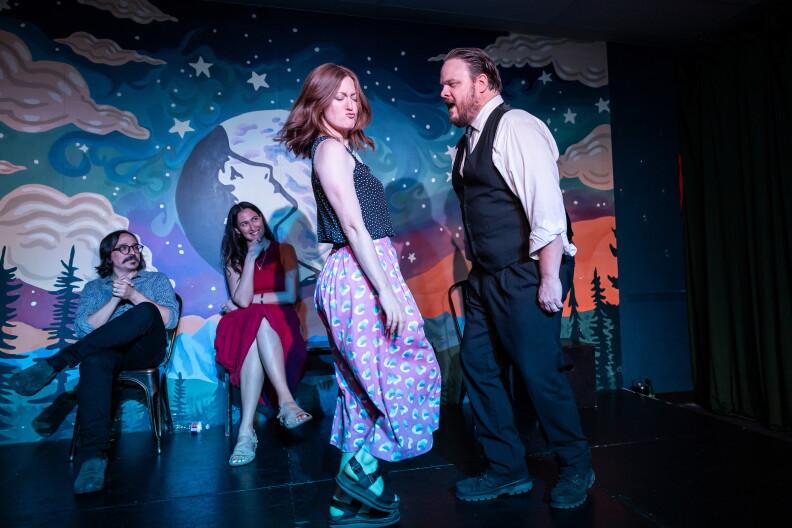
The annex, which was once a typical office space, has undergone significant renovations, including the creation of the Stargazer Lounge and a 40-seat theater. The front room has been adorned with decorations reminiscent of a forest, while a mural painted by designer Kaci Beeler in 2009 has been reinstalled to provide a sense of continuity from the former location.
“That same mural that everyone walked past for, you know, 16 years, is here to provide some continuity,” Janik said, emphasizing the importance of retaining a piece of the Hideout’s history.
The stage used in the annex was repurposed from the old location, where it had been part of the upstairs theater. Beeler also created a new mural for the back wall, enhancing the atmosphere of the space. Education director and co-owner Jessica Arjet remarked on the transformation, stating, “It’s so enlivening that having our little stage and our risers there just transformed the space into feeling like it really is a space dedicated to creating improv.”
While the annex is smaller than the previous venue, which featured an 89-seat theater downstairs and a 49-seat theater upstairs, Janik highlighted the benefits of the more intimate setting. “Until we did the first show here, I was really worried that it wasn’t going to work,” he admitted. However, he noted that the smaller space has fostered a stronger connection between performers and their audience, creating a sense of coziness and intimacy.
Janik described the annex as a metaphorical “outpost” in their journey, reflecting the Hideout’s current position in the broader landscape of Austin’s arts scene. The theater is currently engaged in a program called Immersion, organized by Artspace, a nonprofit dedicated to assisting arts organizations with their space needs and real estate literacy.
This initiative, funded by the Moody Foundation, includes six selected arts organizations from Austin and runs until December. Participants are encouraged to reassess their core values, with Janik emphasizing the importance of focusing on what truly matters to the Hideout as they plan for the future.
Arjet shared her perspective on the current phase, describing it as a “weird middle place” that has unexpected potential. “It’s very improv-like, you know? Instead of choice A or choice B, you go choice banana,” she said. “And we’ll see how that plays out. I really have a lot of profound hope and vision that this is gonna be really cool.”
As the Hideout continues to adapt in the annex, it is also committed to its educational mission. Recently, students gathered for an advanced improv class, where performer Danielle Devorona emphasized the importance of self-exploration in the theater’s environment.
Looking ahead, Janik envisions a future Hideout that includes a 200-seat theater, additional performance spaces, classrooms, and a coffeehouse. Meanwhile, Arjet finds joy in the current transition, stating, “It’s just gonna maybe take us a little bit longer to get there, but even this transition process, even being in this smaller space, is just, it’s a kick.”
The annex serves as a temporary venue for the Hideout as its owners work toward a larger vision, with Janik noting, “We’re laying the foundations now. We’re doing that work of figuring out what’s important to the Hideout and showing the community that we have a place to perform, and the magic is still there.”