







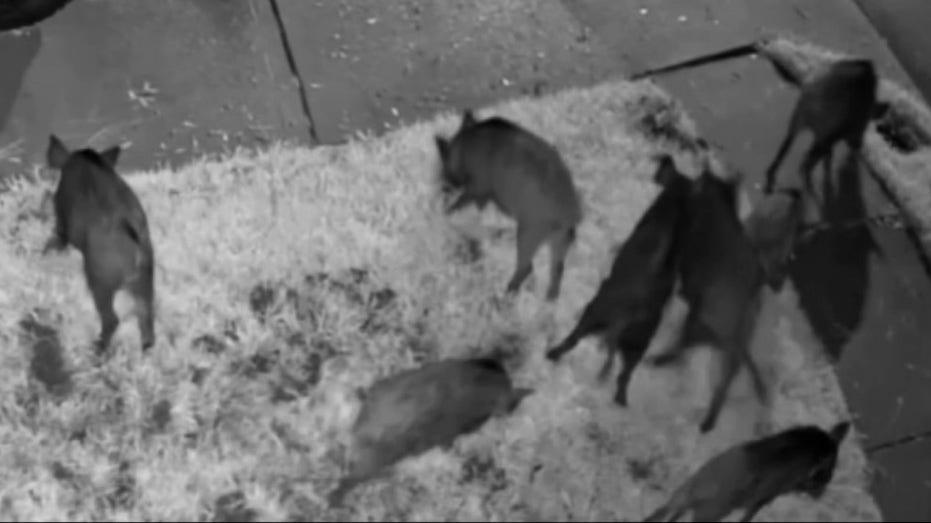
A suburban community in Montgomery County is grappling with an unwelcome invasion of wild hogs that have been wreaking havoc on residential lawns during the day. The presence of these animals has raised significant safety concerns among local residents.
The increase in wild hog sightings is largely attributed to ongoing development along I-45, which is driving these animals out of their natural habitats and into the lawns of Conroe and The Woodlands. Homeowners are facing potential costs of up to $3,500 for professional trapping services, but many are hesitant to proceed due to the need for official permission to set up traps on adjacent township land where the hogs roam.
Janis Douglas, a resident of the Conroe area near The Woodlands, recently experienced the frustration firsthand when she discovered her newly landscaped yard had been torn apart by the hogs. “This spring, I had new soil and new grass brought in. And I woke up the other morning and came out to this,” she explained, showing the considerable damage done to her lawn.
Surveillance cameras and resident reports indicate that groups of up to five wild hogs have been spotted roaming through the neighborhood, with some appearing as late as 10:30 a.m. While feral hogs typically forage at night, the encroachment into suburban areas has become more frequent.
Edward Dickey, owner of Texas Wild Hog Control, attributes this surge in hog encounters to the rapid growth of commercial and residential development in Southeast Texas. “As the city tends to grow, the neighborhoods tend to grow,” he noted, explaining that land clearing for new construction often disturbs the hogs and drives them into surrounding areas. Weather patterns, including droughts and heavy rains, also influence the hogs’ behavior, drawing them closer to well-watered lawns.
For Douglas, the issue is not just aesthetic; it poses a serious safety risk, especially with a nearby bus stop serving local children. “It’s important to control the hog population because their breeding rate is extremely high—they can have up to three litters per year,” Dickey warned. “They are very destructive and can also carry diseases like brucellosis and anthrax, posing a threat to both humans and pets.”
Many homeowners have attempted various DIY methods to deter the hogs, such as using water sprayers or deterrent scents, but Dickey cautions that these strategies often backfire. “Some people try shooting at them, which just scatters the groups and doesn’t resolve the issue,” he explained. He emphasized the importance of hiring a professional trapper who can effectively manage the capture process to ensure all hogs are removed from the area.
However, finding a lasting solution has proven challenging for residents like Douglas, who expressed frustration over the high costs of professional trapping, which can exceed $3,500. Additionally, since the hogs inhabit land owned by local developers, obtaining permission to set up traps has been a difficult process. “Most of the response I got was, ‘This is not my department, I suggest you call so-and-so,’” Douglas recounted. “I can’t afford to just throw out $3,500… I don’t feel like it’s my responsibility to protect the entire neighborhood.”
Dickey suggests that homeowners should collaborate to address the issue collectively. “The best option is to get in touch with the HOA and unite with your neighbors,” he advised. “Present the damage to the HOA board and educate them about the hog problem. They will continue to invade if not dealt with.”
Local trappers recommend that homeowners refrain from replanting damaged landscaping until the entire group of hogs has been captured and relocated, ensuring that the problem does not recur.