






Pam Gaskin, a 79-year-old resident of Galveston County, reflects on a time when her father had to pay poll taxes in the 1960s to exercise his right to vote—an obligation not often imposed on many white men in the South. She has witnessed the strength of a united Black community at the polls, which has historically set state records for representation, as well as the repercussions of disunity.
This year, Gaskin sees the emergence of a younger generation ready to take charge. “I cannot fight this fight much longer. I think it’s time,” said Gaskin, co-founder of the Houston Voting Initiative, a nonpartisan organization dedicated to voter resources.
Meanwhile, on the other side of the generational divide, 40-year-old Erika Harrison, an attorney and social media influencer known as @blackgirlswhobrunch, has shifted her platform from food content to mobilizing her audience to participate in the electoral process. “I do believe there is a changing of the guard, but I also think we aren’t doing what they used to do. There are so many generational differences,” she noted.
The eyes of the nation are fixed on Texas, as major polls indicate that key down-ballot Democratic candidates are in tight races against their Republican counterparts. For Democrats to secure victories, they will need an exceptional turnout from their base, particularly from Black voters—especially in Harris County and East Texas.
Young Black voters, ranging from high school students to millennials, have played a significant role in driving record turnout in primaries and during early voting periods in Harris County, which boasts the largest Black population in the state and is among the largest in the country.
According to Pew Research, Texas is home to more Black voters than any other state, with an estimated 2.9 million eligible Black voters comprising about 14% of the total eligible voting population as of 2022. This demographic is crucial for Democrats, making up roughly one-fifth of likely Democratic primary voters and between 11% and 13% of the general electorate.
Unlike their older counterparts, who focused primarily on civil rights and equality, younger Black voters are more concerned with issues that impact their everyday lives, such as economic stability, environmental concerns, and job security. “There has been too much foolishness,” stated Evan Robinson, a junior at Texas Southern University and vice president of the campus NAACP chapter. “For a long time there was a feeling that our voice doesn’t matter, but now we are waking up to the fact that if we don’t do something, it will only get worse. Politics affects you whether you like it or not.”
Voting rights advocates believe this shift indicates that the Black vote may once again become pivotal in determining the outcomes of state and national elections. This time, however, a younger and more energized electorate is stepping up, potentially reigniting the momentum that once characterized Black voting strength in the 1970s and 1980s.
<p"Every generation needs to determine what freedom means to them. We have to redefine what freedom means in this current climate," remarked Annie Benifield, Gaskin's co-founder at the Houston Voting Initiative.
The Black vote in Texas has historically been led by individuals over the age of 55, with younger generations often lagging since the conclusion of Barack Obama’s presidency. However, analysts and advocates are now observing a notable shift in Harris County and throughout the state, as younger individuals become increasingly involved not only in voting but also in organizing efforts.
Stephanie Williams, senior state organizing manager for Black Voters Matter, recently noted the enthusiasm among students at Texas Southern University, who were actively inquiring about voting procedures for the midterm elections. “We’ve registered over 60,000 young people to vote. That is the energy we’re creating,” Williams said. “Now that we’ve got all these young people on the voting rolls, the next step is educating them on how to vote, where to vote, and creating a vote plan.”
The younger generation is particularly concerned about a range of issues, including the layoffs of young, educated Black women from federal jobs due to cuts, economic downturns, and the lack of affordable housing. “When this country gets a cold, Black Americans get the flu,” Williams pointed out.
Michael Adams, a political science professor at Texas Southern University, emphasized that the Black vote is concentrated in urban areas like Houston, San Antonio, and Dallas, making these regions critical for candidates seeking election. Historically, the power of the Black vote in Texas was most pronounced between 1965 and 2012, following the passage of the Voting Rights Act, fueled by a community that understood the importance of their participation in elections.
“My parents didn’t get to vote until their 50s when the Voting Rights Act was passed. I remember the marches; I marched in college back in Alabama to prevent a prison being built next to an HBCU,” Benifield recounted. “I have always known the importance of the vote.”
Nationally, Black voter turnout peaked in 2008 and 2012 during Barack Obama’s campaigns, with turnout surpassing that of white voters in several Southern states—a historic milestone. However, since then, Democratic candidates have struggled to regain the same level of engagement from Black voters, a challenge attributed to generational shifts and a failure to connect with younger demographics.
For instance, while Joe Biden secured a 13-point victory in Harris County in 2020, Kamala Harris only managed a 5.5-point lead in the 2024 election cycle. “We stopped engaging and participating,” Benifield reflected. “We thought we had overcome, but we hadn’t.”
Experts have also identified various challenges, including the end of party-line voting in 2020, ongoing redistricting, and a scarcity of young candidates, which have contributed to confusion and disillusionment among younger voters.
Despite these obstacles, younger Black voters appear to be returning in significant numbers this year. Harris County Clerk Teneshia Hudspeth reported a record turnout for a non-presidential primary, with over 565,000 voters participating in just 12 days. Estimates suggest that approximately 118,650 of those votes came from Black voters.
“The message we found that has resonated with young people is not being candidate-specific but speaking about healthcare and then folding in candidates,” explained Brianna Brown, executive director of the Texas Organizing Project.
Williams attributes the renewed enthusiasm among younger voters to innovative engagement strategies and a shift in readiness among younger Black voters to assume leadership roles. “Black women will always do our thing, especially to save democracy, so you can count on that,” she asserted. “But we also understand the assignment too. It can’t just be us. We got to get our brothers. We got to bring our kids.”
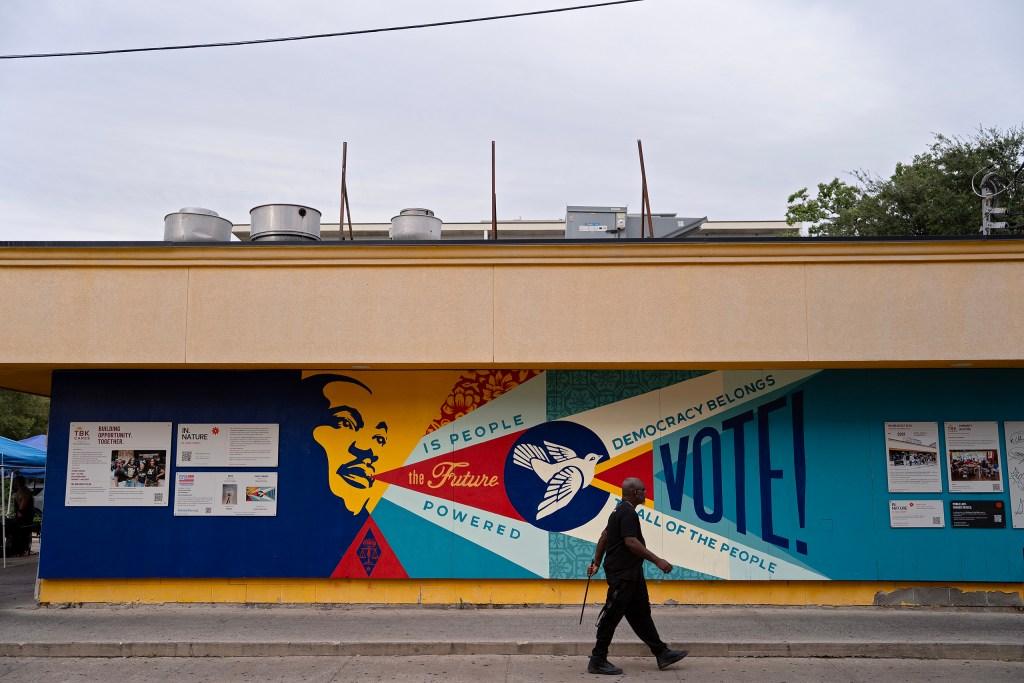
At a recent community event in Houston’s historic Midtown neighborhood, Svante Myrick, president of the People For the American Way Foundation, emphasized the critical importance of voting in the upcoming elections. “The entire world hinges on what happens here in Houston and Texas,” he stated.
The block party and mural unveiling, supported by local officials, exemplifies how organizations are encouraging civic participation among younger generations through creative outreach beyond traditional campaign events.
Artist Preston Gaines, who played a role in creating murals promoting voting, noted, “Given the current state of the world, we got to do our part, whatever that might be.”
Across Texas, voter engagement organizations are reaching out to younger Black voters through collaborations with social media influencers, producing voter guides, and hosting community events, all of which have garnered positive responses from younger generations.
“We are seeing Gen-Zers across the world changing the way our future looks,” remarked 25-year-old Marshall Bradley, an architectural assistant who has been voting since 2020. “It has become almost irresponsible for us to not vote.”
U.S. Representative Jasmine Crockett, D-Dallas, highlighted the need for multiple generations of Black voters to unite during this pivotal time. “The fight for the ballot box right now is there, but I think that the fight looks a little different,” she observed.
Traditionally, politicians have engaged Black voters by addressing congregations in churches, expecting their messages to resonate throughout the community. However, this approach has evolved, and older advocates have recently begun adapting to the changing dynamics.
“How the Democratic Party engages with Black voters, especially when Millennials become the largest voting bloc, is going to require a lot more work,” Harrison noted.
Candidates have recognized the need for a shift in strategy this election cycle. For example, state Rep. James Talarico has appeared on popular Black podcasts and engaged directly with communities, demonstrating a more proactive approach to outreach.
Despite the generational shift, older voters are still valued, and Crockett underscores the importance of collaboration among all age groups. “No matter where I meet some of our seniors, I know they were active,” she stated.
While this year’s enthusiasm among young Black voters appears to