








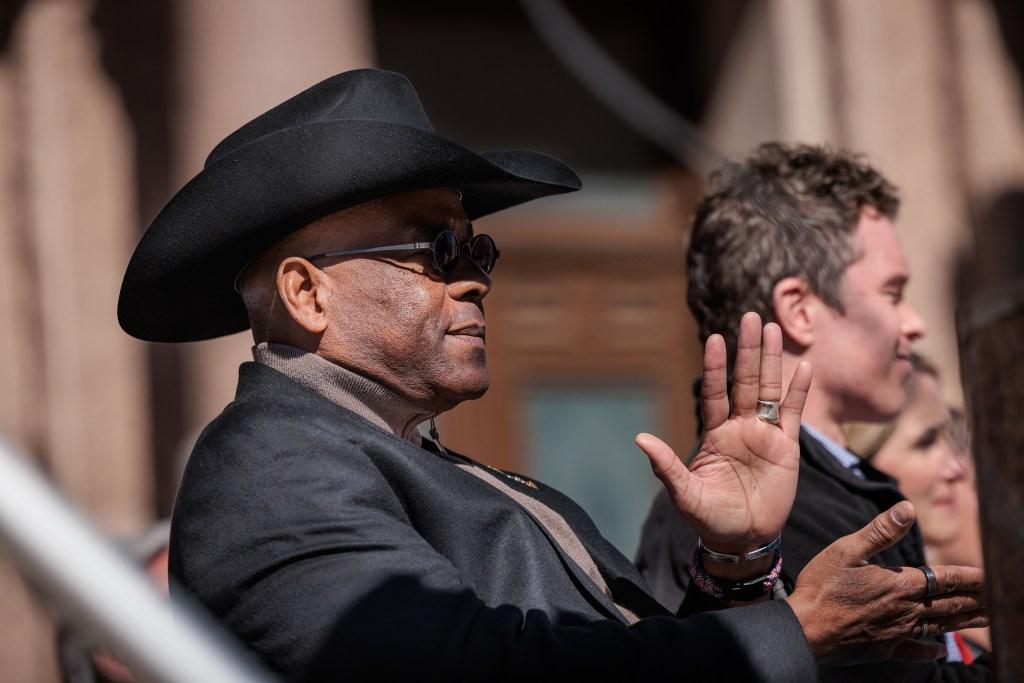
DALLAS — After several months of preparation for a hand-count of thousands of ballots in the upcoming March 3 primary, the Dallas County Republican Party has announced its decision to collaborate with the county elections department instead. This choice allows the election to proceed using existing voting equipment, thereby sidestepping potential complications that could arise from a hand-count.
This decision alleviates the pressure the party would have faced if a hand-count resulted in delayed reporting, particularly important in the highly scrutinized GOP primary for U.S. Senate and other key positions.
In a statement shared on social media, Dallas County Republican Party Chair Allen West articulated the rationale behind this decision, emphasizing that it would facilitate a “precinct-based, community, separate Election Day electoral process.” He noted that this approach would “reduce the liabilities” associated with a hand-count, concluding that “discretion is the better part of valor.”
This announcement marks a significant shift from earlier indications that the party was earnestly preparing to manually count a substantial number of Election Day ballots, a move that would have impacted all voters in Dallas County regardless of their political affiliation.
According to Texas law, if one political party opts for a hand-count, both parties must forgo countywide Election Day voting at centralized vote centers, requiring voters to cast their ballots at designated neighborhood precincts. While Democrats had planned to utilize voting equipment for their results, they would have been compelled to switch to precinct-only voting had Republicans proceeded with a hand count. It remains uncertain whether the GOP’s decision to adopt precinct-based voting would also bind Democrats to the same conditions; the Dallas County Elections Department has not yet provided clarity on this matter.
In recent years, Republicans in Dallas County and beyond have advocated for hand-counting ballots, spurred by diminishing trust in voting machines fueled by unsubstantiated claims about their reliability. However, election officials and experts have consistently cautioned against the feasibility of large-scale hand-counting, citing its higher costs, labor intensity, slower result delivery, and increased susceptibility to human errors compared to machine tabulation. Furthermore, state regulations do not mandate audits of hand-counted ballots and significantly restrict public oversight during the counting process.
Earlier in December, West had announced that the party had amassed over $400,000 for a hand-count initiative and enlisted more than 1,000 volunteers. Nevertheless, lingering concerns about staffing, training, security, facilities, and funding remained, particularly after the Texas Secretary of State’s Office indicated that there may be insufficient funds to reimburse counties for unusually high primary costs if a large number of jurisdictions opted for hand counting.
Executing a hand count would have necessitated a greater number of polling locations and workers than those utilized in recent primaries. Texas law stipulates that ballots in hand-counted elections must be cast and counted at assigned precincts, and mandates continuous counting without interruption once polls close. Election personnel must be compensated at a minimum rate of $12 an hour, and extensive hand counts can extend late into the evening or even beyond.
In a Tuesday interview, West acknowledged that the party would require at least 3,000 counters but had managed to recruit fewer than half that number. “We cannot take that risk of not being able to have the appropriate amount of counters because it would put our election judges in an untenable legal position,” he stated. “We’ve got 63 days to go — early voting will start on February 16.”
Under Texas law, political parties control the ballot counting process during primaries yet must report results within 24 hours of polls closing. Party chairs have been cautioned that court orders might be necessary if hand counts delay reporting.
By partnering with the county, the Dallas County Republicans will circumvent these logistical challenges, allowing both political parties to continue utilizing voting equipment and established election protocols. According to West, the Dallas County GOP is currently finalizing a contract with the county, which they anticipate signing on Wednesday.